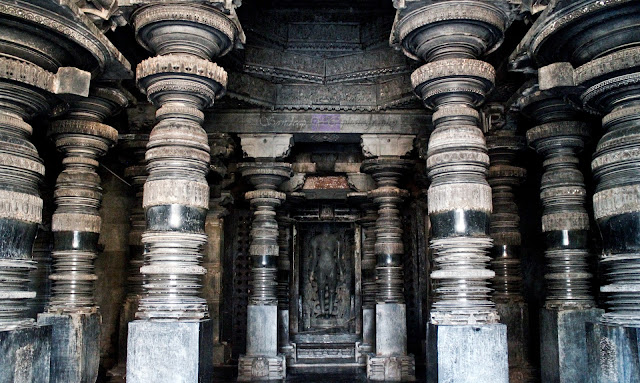
Kedareshwara temple and Parshwanatha Jain Basadi of Halebid


Kedareshwara temple and Parshwanatha Jain Basadi of Halebidu:

Kedareshwara temple:
It was about 5 pm before we headed out of the temple towards the Kedareshwara temple which is just 500 m away from the Hoysaleshwara temple.
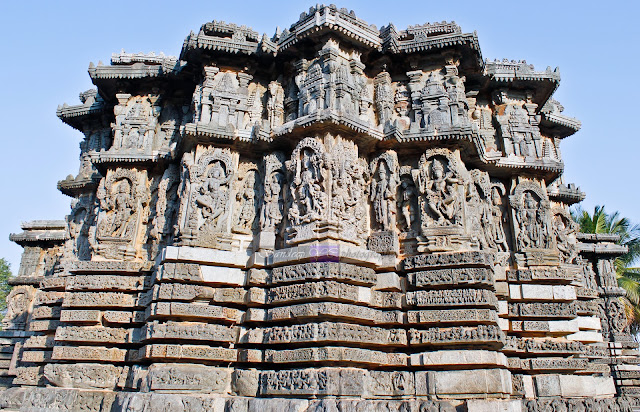
Star shaped structure of the Kedareshwara Temple
According to the inscriptions, it was built by Hoysala king Ballala II and his queen Abhinava Ketaladevi in 1219 A.D. Some parts of this temple had been destroyed and some reconstruction work has been taken place in this temple. In-spite of this, the temple has retained most of its originality and presents a good view of a typical Hoysala Temple.
Image of shiva-parvati on the walls of the temple
Friezes and the sculptures on the walls of the Kedareshwara temple
Built with soapstone, stands on a platform of sixteen points and the super structure are parallel to the contour of the platform. Originally this was a trikuta or three celled temple but all the garbhagrihas are now empty. As a feature of Hoysala architecture the base of the temple wall has horizontal friezes with the scenes depicting stories from Ramayana, Mahabharata and Puranas.  Above these friezes are the sculptures of Gods and Goddesses, shown under ornamented and intricately carved canopies.
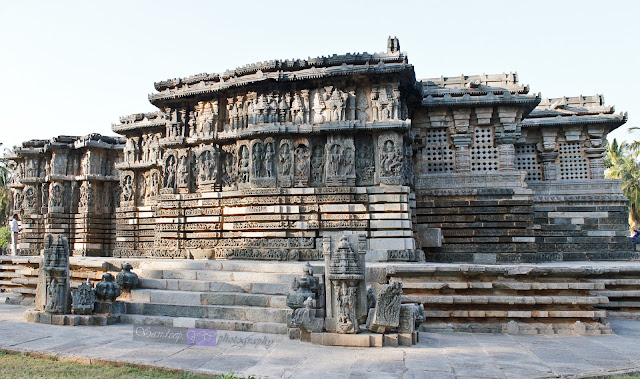
View of the temple, with raised platform and perforated pierced windows
Interiors have lathe turned pillars and minutely carved bhuvaneshvaris (Ceilings). The sikhara which once adorned the southern garbhagriha is now missing.

The temple is destroyed to extent and further to protect this temple the door was closed, so just can have a glance from the temple door.
Inside the temple, as seen from the locked door
Not waiting further we headed towards our last destination the Jain Basadi, since it could get closed as it was already 5.15 pm.

Jain Temples of Halebid:
Further way back just behind the Hoysaleshwara temple are the group of Jain Temples, three at present. This reflects the religious tolerance of the Hoysala's who patronized all the major contemporary sects like Saivism, Vaishnavism and Jainism. The three Jain temples in a row are dedicated to Parsvanatha (west), Adinatha (central), and Shantinatha (east) tirthankaras.

Parshvanatha Basadi: The first temple at the west to the present entrance of the complex is the Parsvanatha Basadi. This temple was built by Boppana, the son of the famous Gangaraja who was a minister under Hoysala King Vishnuvardhana. This temple was built in the year 1133 A.D., in the memory of Gangaraja by his son.

This Basadi is built of soapstone and consists of a garbhagriha, a sukhanasi, a navaranga and a detached mukhamandapa. The pillars of the mukhamandapa are not polished but are beautifully ornate.
The pillars of the mukhamandapa outside the Parshvanatha Basadi
The square garbhagriha and the walls of the navaranga are plain but decorated with pilasters at intervals. The lathe turned and elegant twelve pillars in the navaranga are highly polished with mirror-like glossy surface. The ceilings had small sculptures on it but it was totally dark, so not visible properly.
The lathe turned pillar in the main hall
Ornate Pillars inside the Navaranga (main hall)
Beautifully turned pillars with mirror like finish and amazing designs
The most important attraction of this temple is the 18 ft. tall Parsvanatha Tirtankara statue in the garbhagriha (sanctum). This sculpture with a seven hooded serpent over his head represents a perfect yogi or a realized soul with a benign and sympathetic smile on his lips. Such Jain sculptures are rare.
Parshwanatha tirtankara statue, with 7-head serpent behind
The whole temple was so dark that I was blindly keeping my bare foot ahead, it was getting further darker towards the garbhagriha, there are no windows for this temple, the only light source being the tall entrance door of the temple, it was of the same height as the statue inside, there were no lights inside the temple, the light from the door directly falls on the Parsvanatha statue.
The light source from the door to the garbhagriha
Play of Light and Shade inside the temple
10 of the 12 elegantly carved pillars of the navaranga, Parshvanatha statue at the center, and the ceiling sculptures partially visible through the door.
10 of the 12 elegantly carved pillars of the navaranga, Parshvanatha statue at the center, and the ceiling sculptures partially visible through the door.
Kannada inscriptions outside the temple
The doorjamb of the Parshvanatha temple

 Shantinatha Basadi: Almost similar to the above but of lesser dimensions is the Shantinatha Basadi. It was built around 1192 A.D., during the reign of Ballala II. Its temple plan is similar to that of the Parsvanatha temple, it consists of a garbhagriha, sukhanasi, a navaranga and a mandapa. The mandapa must have been added later during the Vijayanagara period. The garbhagriha has a fine image of Shantinatha tirtankara which is also about 18 ft. in height. In between these two basadis, is another smaller one, the Adinatha Basadi, built in 1138 A.D., by minister Mallayya during the reign of king Vishnuvardhana.


We finally left the Halebeedu and the clock was ticking 5.45 pm and before the darkness falls thought to reach the NH48.

We halted for our dinner at hotel Swathi Delicacy which was newly built and the service of the restaurant must be appreciated. We concluded the trip reaching Bangalore by 11.30 pm, well not just another trip but one of the most beautiful pleasure for our eyes and definitely a must visit for everyone, and I bet you can’t just visit only once ;-)


Comments

  1. My old India guide book from Footprint 2002 states "the Hoysalesvara temple originally had 84 female figures, of which only 14 now remain, over the yrs 70 were stolen". My visit in Oct. 2015 revealed what seemed a very successful restoration of the monument.

    ReplyDelete
  2. a pride for me to be able to discuss on a quality website because I just learned to make an article on
    cara menggugurkan kandungan

    ReplyDelete

Post a Comment

Popular posts from this blog

Micromax Canvas 2 A110 Hands on Review

Micromax Superfone Canvas 2 A110(Jet Black/Calm White): After using it for a week, I felt pretty good about my decision for going with a new brand like Micromax over the mighty Samsung Galaxy S Duos and Sony Tipo Dual. Particularly not sure about its reliability but the build quality looks pretty decent. Below are my ratings for the phone aka Phablet. Build Quality (8/10): The build quality was above my expectations keeping in mind of the price tag, from front it looks just like a Galaxy high end smartphone like SIII or Note II. It has a matte finished back cover which is good for protection towards scratches and there is a metal casing all around the phone, which adds up the beauty of the phone. One more advantage of this phone is it has a touch home button instead of a hard button as seen in iPhone and Galaxy phones. Camera (5/10): [8MP autofocus (Tap to Focus), dual flash, supports up to 3264x2448 pixels, Panorama] Don't fall for the specs as it is said...

Trip to the Misty Hills of Kudremukh

Trip to the Misty Hills of Kudremukh: About Kudremukh: Kudremukh National Park is the second largest protected wildlife area in the Western Ghats (around 600 sq.kms). Three important rivers of Karnataka, the Tunga, Bhadra and Netravathi are said to have their origin in this area. Mist covered roads in Kudremukh All these can be reached within 80km. We first started with sringeri, which is famous for its Vidyashankara temple built in1342 AD. Reached Sringeri at 11am. There is a bridge Sri Vidya Teertha Setu across the Tunga river which connects from Vidyashankara temple to Sringeri Mutt. We had prasadam (lunch) at the mutt. There is one more temple called as Sharadamba temple which has lovely architecture built inside and photography is banned inside. The whole temple area is kept very clean and it was a pleasant experience to spend time in the temple complex. We then left at 12.30pm towards Kudremukh. Vidyashankara temple  Vidyashankara temple  Vidyas...

5 Places in Maharashtra you must visit atleast once

5 places in Maharashtra you Must Visit At Least once Maharashtra is a state best described as a land of cave temples, hilltop forts, and Mountains. Best time to explore them are the monsoons and post monsoons, definitely not in summers. These 5 places in Maharashtra are a must visit, 5. Lavasa The first planned hill station in India and probably the most controversial for the deforestation reasons. Even the road from Tehghar dam till Lavasa is spectacular with forest cover and green valleys. Best time to visit is during monsoons and post monsoons. Best time of the day is after the sun goes down with the entire city lighted up, and the musical fountains adding more flavour to the evening. Lavasa City during night For more information on Lavasa CLICK HERE 4. Lonavla-Khandala Unlike Mahabaleshwar, Lonavla is a monsoon hill-station. Best time to visit is during monsoon and post monsoons (July-Dec) when the entire hill range turns into lush green grasslands and num...

Lalbagh Flower Show Jan-2012

Lalbagh Flower Show 2012 - 100th Exhibition Event :            January 20 till 29, all roads lead to the Glass House in Lalbagh Botanical Gardens. Around 10 lakh visitors are expected to visit the gardens and see a visual treat, thanks to the Mysore Horticultural Society. This flower show is the 100th exhibition of the Mysore Horticultural Society that was started by the then Superintendent of Lalbagh GH Krumbiegal in 1912. Major Attractions this time include Buddha Stupa, Floral dance forms, Floral Flow, Florance Flora Show and Diagonal floral Lines. Buddha Stupa Early Hours crowd at the Glass House GH Krumbiegal Visited the show on Sunday noon (22nd), on that day it recorded a whopping 100,000 visitors, making it difficult to capture the rich colors at the show. I could somehow manage to get a few colorful pics. It was more beautiful and creative than the previous flower shows held here. Entered the Glasshou...

Masinagudi Jungle Trails : A Road Trip to Nilgiris

Masinagudi Jungle Trails : A Road Trip to Nilgiris - II All set and packed for a long road trip to Ooty, left Bangalore late at 8am. What to pack for a long road trips?? Click here The motive of the road trip was to voyage around less explored and adventurous places, rather than popular and easily accessible tourist destinations. To avoid Mysore traffic, we tried to explore another route from Mandya through Somnathapura to Nanjangud, but it turned out to be more tiring and longer route. We reached Bandipur forest check post only by 2pm. Driving through Bandipur forest is a pleasure, with good road conditions, greenery around and spotting wildlife was more exciting. In an intention to spot wildlife, and to maintain silence in the forest, we were driving steadily at 15kmph speed without using horn. We could spot a lot of deer herds, elephants, black bear, boar, Grey Langur monkeys and peacocks.  Peacock spotted on the Bandipur Mudumalai stretch Elephant...