Vitthala Temple:
Hampi - III
This is the most important among the ruins of Hampi for
its art and architecture. Though the
temple complex was attacked by the Muslim invaders, it still stands as the most
beautiful monument of Hampi, leaving behind us to only imagine the grandeur of
the temple complex during the reign of Vijayanagara Kingdom.
It is strategically located on the right bank of the
river Tungabhadra facing Anegundi town on the other side of the river.
Connecting these two was an ancient bridge, which has only the pillars
remaining out of the ruins. This probably was planned to be at the middle of
the old capital Anegundi and new capital Hampi.
This temple is dedicated to Vitthala, a form of lord Vishnu.
 |
| A Ruined city at the Vitthala temple complex |
Design of the temple complex: The Vittala temple complex
is having a high enclosure with three gateway towers or Gopuras, the main tower
facing the east, the smaller ones on to the north and south. To its west is the
Tungabhadra river. In front of the main entrance to the east is a long Bazaar
street with a stepped well at a distance. There are three open mantapas namely
the Maha-Mantapa at the center, Kalyana Mantapa to the south east, and the
100-pillared hall at the south west.
In the temple complex the two main mantapas were built by
Krishnadevaraya in 1513.
 |
| The main-entrance gopura to the east of the complex, made of clay bricks |
 |
| Sculptures on the Main Gopura |
 |
| Portion of the Maha-Mantapa (left) and the northern Gopura (right) |
In front of the main temple is the
Stone Chariot, which is termed as the most popular icon of Hampi.
The stone chariot is a Garuda shrine built in the form of temple, with a ruined
gopura. The stone chariot faces the Main Vittala shrine, as Garuda being the
mount of Vishnu.
It is said that the wheels were once able to turn on
their axles, although they are currently cemented in place.
 |
| The Iconic Stone Chariot |
One more highlight of the temple is its remarkable
monolithic musical pillars. The main hall of the Vittala temple is the
star-shaped great pillared hall called as the Maha-Mantapa is an impressive piece of art with its majestic size
and awe inspiring pillars. Though at present the Maha-Mantapa is in a ruined
state but it still strikes the eye of the beholder. The monolithic pillars of
the Maha-Mantapa are richly carved with the outer ones designed to give out
different musical notes. Each of these pillars is further carved into seven
circular pillars each of these producing different musical tones when tapped
with fingers tied with leathers. The curiosity among men and unscientific
procedure of tapping the pillars have led to partial destruction of these rare
scientific pillars, leading to ban on touching them in the present day only to
preserve it to our future generations. The central hall of the Maha-Mantapa is
collapsed which was already in ruined state after the invasion that followed
the fall of the Vijayanagara Empire. The western side of the temple is mostly a
closed structure with doorways on to its north and south side. The main
entrance to the east is evident of the damage of the temple.
 |
| The mammoth Maha-Mantapa, this probably illustrates why Vitthala Temple is
considered the finest of the Vijayanagara series |
 |
| The central portion of the Maha-Mantapa in a ruined state |
 |
| The magnitude of the Maha-Mantapa can be seen here. |
The
Kalyana Mantapa
or the Marriage Hall is located to the south east of the complex. This was used
to perform marriage ceremonies during the Vijayanagara period. This is an open
pavilion with its interiors surrounded by impressive and massive columns and a
circular raised platform, for the performance of dances. The pillars of the
Mantapa are sculptured with soldiers riding Valis, and carry the roof beams and
large sculptured brackets. The architecture of this Mantapa is similar to that
of the Maha-Mantapa.
 |
| Kalyana-Mantapa, the most sustained among the Vitthala complex |
 |
| The Mantapa to the North-East |
 |
| The Colonnades on the south-east side of the complex along the enclosure wall. |
 |
| The Maha-Mantapa as seen from the north-west corner, at a distance is the main gopura |
Take a note on the closing time of the temple complex,
its gate is closed at sharp 6pm, and all the tourists are forced to take the
exit by the guards.
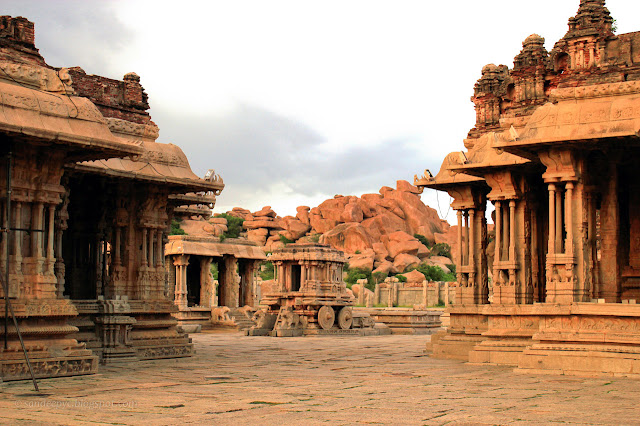 |
| Maha-Mantapa (left), Stone Chariot (center) and the Kalyana-Mantapa (right) |
The route left to the temple complex takes you to the
River Tungabhadra passing through the Kings Balance. The ancient ruined bridge
can be seen over the river.
 |
| The Kings Balance |
 |
| Tungabhadra River with the ruined bridge |
Don’t miss out to spend the evening at the banks of the
river with cold breeze blowing you away with mesmerizing views of the sunset
behind the hills of Anegundi, a perfect place to end the journey.
 |
| Beautiful sunset behind the Vitthala temple |


Comments
Post a Comment