Lakkundi - Brahma Jinalaya


Lakkundi - Brahma Jinalaya Temple:

Next in the itinerary were the Brahma Jinalaya and the museum, which was just about 500m from the Kashivishwanatha temple. After spending enough time at Kashivishwanatha temple, we then moved towards the Museum, where the Brahma Jinalaya temple is also located.
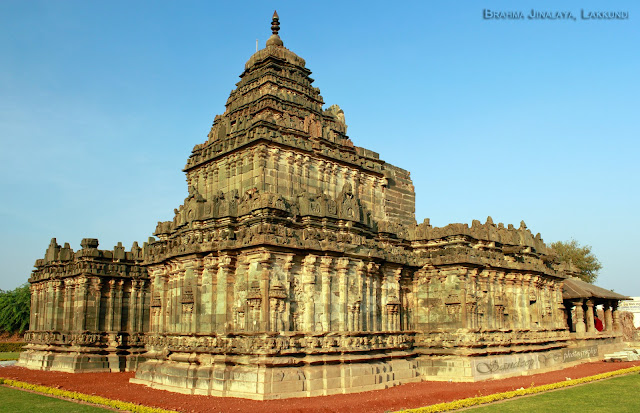
first look of Brahma Jinalaya Temple
Archeological Museum: The Museum is worth a visit. Unlike Kashivishwanatha temple there is a ticketing counter here where one has to take tickets at the museum, it was 10Rs per adult and 25Rs for camera. The museum is undertaken from the Archeological survey of India and is pretty well maintained too. It has a lot of exquisite monuments and here again photography was banned.


Brahma Jinalaya/ Jainalaya (Basadi): behind the museum is the Jain basadi which is perhaps the largest and oldest temple at Lakkundi today. An inscription found here reveals that the temple was built in 1007 AD by queen Attimabbe or Attiyabbe, wife of chief Nagadeva, during the reign of the Kalyani Chalukya ruler Irivabedanga Satyashraya. This temple is a good example of the Karnataka Dravida style of temple construction, a style that evolved during the Kalyani Chalukya period.

The temple is arranged along an east-west axis, and has a sanctum, a vestibule, a walled hall, a large open pillared hall, and an entrance gateway. But an unusual feature here is the second functional smaller sanctum over the ground floor sanctum. The temple’s three-storied superstructure is crowned by a square cupola and a pot finial. The front open pillared hall with its varieties of beautiful pillars and sloping roof may be a later addition. Exterior decoration is restricted to architectural motifs and small figures of Tirthankaras, Yakshas and Yakshis.

Side view of the sloping roof
The square navaranga has in the center four Chalukyan pillars of great beauty. The base of the pillars has low relief sculptures of dancers, musicians, mother and a child etc.
sculptures on the base of the pillars
The doorway is finely carved with creeper and has Gajalakshmi on the lintel.
Lintel
Lintel
five sections of the door-frame of the grabhagriha
five sections of the door-frame of the grabhagriha
Close up of the door frame carvings
The open mukhamandapa has 28 fine pillars.
Inside the open mukhamandapa with each of the pillar design being unique
The temple is dedicated to Mahavira, the most revered saint of Jainism. The square garbagudi holds the idol of Vardhamana Mahavira tirthankara in a fine black stone. He is flanked on both sides by Chamara bearers and there is a triple umbrella above.
Statue of Mahavira, with golden statue in the front
Statue of Mahavira
Statue of Mahavira
There was hardly any light inside the garbhagriha, i took the above pic with long exposure and the one above it with flash.
Sculptures on the roof top
Sculptures on the walls of the temple
More than all, the cylindrical sculptor of Chaturmukha Brahma located on the right side of the temple hall, attracts the pilgrims and the art lovers to the heart's content. This was one of the most beautiful sculptures I've ever seen. There were already a lot of damages on the statue so i feel this should rather be preserved inside the museum.
Statue of Brahma -  termed as the creator of the universe with 4 heads
Statue of Brahma -  termed as the creator of the universe with 4 heads
Here i leave it with few more snaps of the temple,
Front view of the Brahma Jinalaya temple
Sideview of the Brahma Jinalaya temple
Side view of the Brahma Jinalaya temple
Sideview of the Brahma Jinalaya temple
Side view of the Brahma Jinalaya temple
View from one corner of the temple
The two storey garbhagriha shikara showing of its height
The two storey garbhagriha shikara showing of its height 
Monkeys at Lakkundi Brahma Jinalaya Temple
Rear view of the temple
Rear view on the other side
had to mention in this blog, this was another temple just beside the Museum which is encroached by the locals, hope government take back these ancient temples under the control of ASI
Recall, one of the most popular song in Kannada film, "Anisuthide yaako endu" from movie "Mungaaru Male" was shot here.
It was by late afternoon when we finished seeing this temple and felt have to leave to reach Gadag before dark, so our plan to visit Manikeshwara temple was dropped thought shall see it in my next visit. Our auto was waiting and we went back to the bus stand and caught our bus to Gadag from there. As said by most of the visitors of Lakkundi, it never disappoints you, so it was definitely worth the visit and my time. We reached Gadag in the early evening hours and again felt the Trikuteshwara temple over here would be closed by that time and hence decided that will also go in my next visit.

Hope I visit Manikeshwara temple of Lakkundi, Trikuteshwara temple of Gadag and temples of Dambal and Lakshmeshwar in my next visit.

I leave here some of the information about Lakkundi,
Information About Lakkundi:
Distances from Lakkundi bus stand to various temples:
Manikeshwara Temple: 230m
Kashivishwanatha, Suryanarayana and Nanneshwara Temple: 900m
Brahma Jinalaya and Museum: 900m
Distance from Museum to Kashivishwanatha temple: 500m

How to reach: Lakkundi is well connected by government buses from Gadag and Koppal & can be reached by road easily.

Nearest airport: Hubli, Belgaum. Nearest International airport is Bangalore.

Nearest railway station: Gadag

Camera Used: Canon 550D with 18-55mm lens

Hotels & Restaurants: there are no proper hotels at Lakkundi, so one have to stay at Gadag.


Comments

  1. Very good article, well drafted and executed with well executed photographs. Will surely go through your other articles.
    -Saurabh
    puratattva.in

    ReplyDelete

Post a Comment

Popular posts from this blog

Sky Islands to the Pacific shores - Part 1: The Sky Islands of Southeastern Arizona

In August 2026, I crossed the Atlantic to chase a long-cherished dream, stepping into the vast, untamed birding horizons of the American Wild West. Across a sweeping route through Arizona, Texas, Utah, and California, I logged 108 total species -  the vast majority of them absolute lifers for me! While the landscapes were vast and the wildlife was extraordinary, what truly made the Arizona portion of the trip unforgettable was the incredible warmth of the local birding community. At almost every trail, feeding station, and wetland, I met welcoming, friendly locals who were quick to share site tips, point out hidden roosts, and make a first-time visitor feel right at home. While North America’s diverse habitats delivered endless surprises, it was Arizona's high-desert canyons, towering rims, and lush riparian corridors that anchored the trip. Here is a location-by-location breakdown of the top birding hotspots, standout avian highlights, and unexpected wildlife encounters from the A...

Sky Islands to the Pacific Shores – Part 2: Desert Valleys, Urban Wetlands & The Grand Canyon

If you missed Part 1: The Sky Islands of Southeastern Arizona , we explored the cool, high-elevation pine-oak Canyons of Madera, Montosa, Ramsey, Ash, and Carr, tracking hummingbird diversity and vibrant montane species across the legendary Sky Island ranges. Leaving the high, pine-scented peaks of the Sky Islands behind, the journey transitions into the sprawling lowlands and desert basins of Arizona. This second leg follows a dramatic ecological gradient—from open desert waters and lush suburban wetland oases into the iconic giant Saguaro forests of the Sonoran Desert, before ascending the Colorado Plateau to the high-elevation pine rims of the Grand Canyon. 3. Canoa Ranch Conservation Park Nestled in the Santa Cruz River Valley, Historic Canoa Ranch combines rich Southwestern heritage with wide-open water and vast desert horizons. Spending the late afternoon here delivered a bustling wildlife spectacle right up until dusk. Active hunters like the Belted Kingfisher, Black Phoebe, Ver...

Seabird photography adventure on the Isle of May

Seabird Photography Adventure on the Isle of May – July 2025 Tucked off the east coast of Scotland, the Isle of May National Nature Reserve is a dream for wildlife and photography enthusiasts alike - especially during seabird breeding season. My trip in early July 2025 turned out to be more thrilling and rewarding than I had imagined, thanks to an unexpected boat change, incredible wildlife encounters, and a few lucky early moments of solitude with the stars of the island— the Puffins . A puffin staring right at the lens, proud of its catch. Getting There: A Wild Ride on the North Sea Originally, I had booked a standard boat tour with BlueWild from Dunbar harbour, but due to a last-minute issue with the vessel the night before, our journey was downgraded - well, depending on how you look at it - to a RIB (Rigid Inflatable Boat) . What followed was a wild, wind-whipped ride across the North Sea , bouncing over waves with little warning. Thankfully, our guide kindly offered me a spar...

Birding in the Netherlands

The Netherlands has a coastline of over 451 km, wide open to the north sea. Much of its land has been reclaimed from the sea and is below sea level, not surprisingly its coastal wetlands make up some of the best birding hotspots, apart from the inland nature reserves. Close to 500 bird species are recorded in the country, much of them are waders and water birds due to its geography. As a non-resident birdwatcher it was not an easy task to locate the right bird watching spots, whilst ebird helped considerably, the rest was on me to explore the Dutch lands. Nevertheless, the country is much safer to explore and the good facilities such as birding hides at the right places, easy access to most reserves makes it a birder friendly country. I have explored two of the birding hotspots, the Texel Island and Oostvaardersplassen nature reserve. Apart from these, I found bird watching and bird photography can be interesting in the neighborhood city parks and also tourist places such as Zaans...

Chennakeshava temple of Belur- Exteriors

Chennakeshava temple of Belur: Some facts about the Chennakeshava Temple: Hoysala king Vishnuvardhana defeated the Cholas at Talakad & to commemorate this great event built many temples in 1117 A.D., of which Chennakeshava temple at Belur is the most important & beautiful , dedicated to Keshava one of the 24 forms of Vishnu. Although the temple was completed by Narasimha, it took over 103 years to finish the structure. Though the legends assign this temple to have been built by Jakanachari, as per the inscriptions the master builders of this temple are Dasoja and his son Chavana, other sculptors include Chikka-Hampa, Malliyana, Padari Malloja, Masada and Nagoja who bestowed their best in creating this masterpiece. Chennakeshava Temple, Belur Back to the travelogue: Most important aspect of these Belur Halebeedu temples is that Chennakeshava temple is famous for beautiful and intricate interiors and Hoysaleshwara temple is famous for the magnificent sculpture...