Chennakeshava temple of Belur:
Some facts about the Chennakeshava Temple: Hoysala king Vishnuvardhana defeated the Cholas at Talakad & to commemorate this great event built many temples in 1117 A.D., of which Chennakeshava temple at Belur is the most important & beautiful, dedicated to Keshava one of the 24 forms of Vishnu.
Although the temple was completed by Narasimha, it took over 103 years to finish the structure.
Though the legends assign this temple to have been built by Jakanachari, as per the inscriptions the master builders of this temple are Dasoja and his son Chavana, other sculptors include Chikka-Hampa, Malliyana, Padari Malloja, Masada and Nagoja who bestowed their best in creating this masterpiece.
 |
| Chennakeshava Temple, Belur |
Back to the travelogue: Most important aspect of these Belur Halebeedu temples is that Chennakeshava temple is famous for beautiful and intricate interiors and Hoysaleshwara temple is famous for the magnificent sculptures on the exteriors. Employing a tourist guide in these places is recommended, as there is immense history to be said from there sculptures.
We hired a guide here who took for a tour around the temple first, he explained about the temple for almost an hour, and charged 200 Rs.
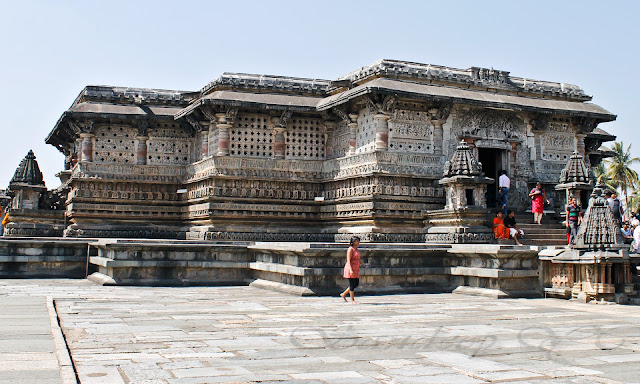
About the temple Plan: The building material used in the Chennakeshava temple is soapstone (chloritic schist) and is of a star shape of 32 angles, which stands on a wide elevated platform of similar outline, which raises about 3 feet in height. It is 178 feet long (east-west side) and 156 feet broad (north-south). The Shikhara surmounting its sanctum is now gone. It consists of a Garbhagriha (sanctum), a Sukhanasa (Vestibule), and a Navaranga (the central hall). The navaranga pavilion is a large hall with beautifully designed lathe turned and polished pillars and ceiling and has entrances on the east, north and south.
 |
| Chennakeshava Temple Main Entrance(East), Belur |
 |
| Chennakeshava Temple |
 |
| Chennakeshava Temple |
 |
| Chennakeshava Temple |
 |
| Chennakeshava Temple |
The platform with pradakshinapatha has flight of steps on east, north and south flanked by a small tower on either side.
 |
| south side entrance with model shrines on either side |
Friezes on the wall:
The outer wall of the temple from bottom on-wards has tiers of minute sculptures consisting of rows of elephants, lion faces, creepers, ornamental frieze, dancers in small niches, female sculptures in between the pillars, and episodes of Ramayana and Mahabharata.
 |
| There are a total of 650 such elephant sculptures all around the temple base on the wall, each one said to be carved uniquely. |
 |
| Friezes on outer wall |
 |
| Friezes on outer wall |
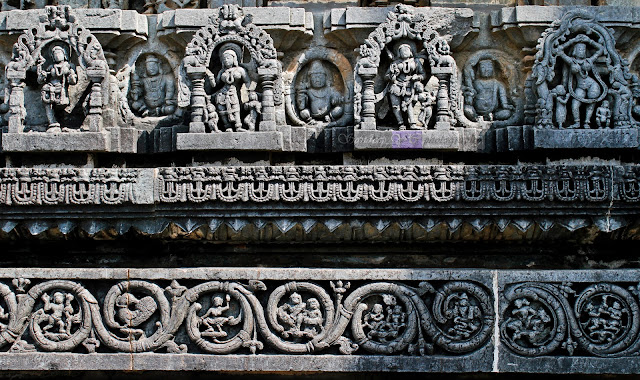 |
| Should be Shilabalikas on the friezes |
 |
| Intricate Sculptures on the walls of the Chennakeshava temple, Belur |
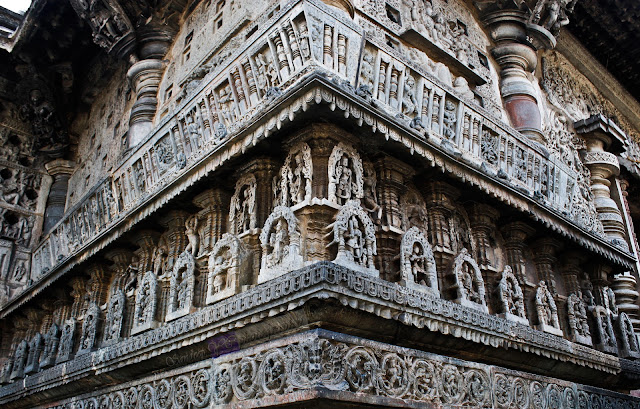 |
| Intricate Sculptures on the walls of the Chennakeshava temple, Belur |
3 desired characteristics represented on the base of the walls:
From the Bottom:
- Bhala (Strength) represented by Elephant
- Shourya (Vigor/Courage) represented by Lion
- Veega (Speed) represented by Horse
 |
| Base of the wall representing 3 desired characteristics |
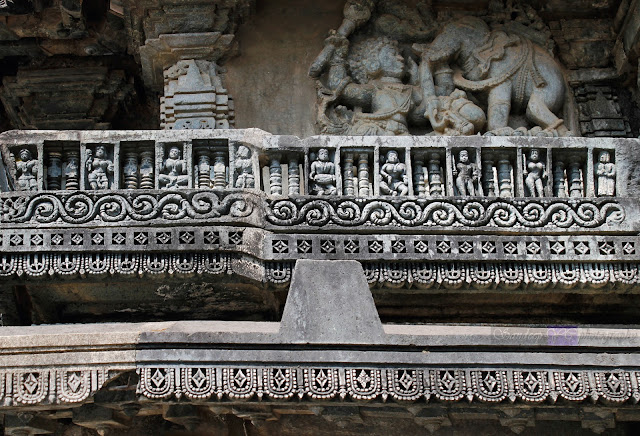 |
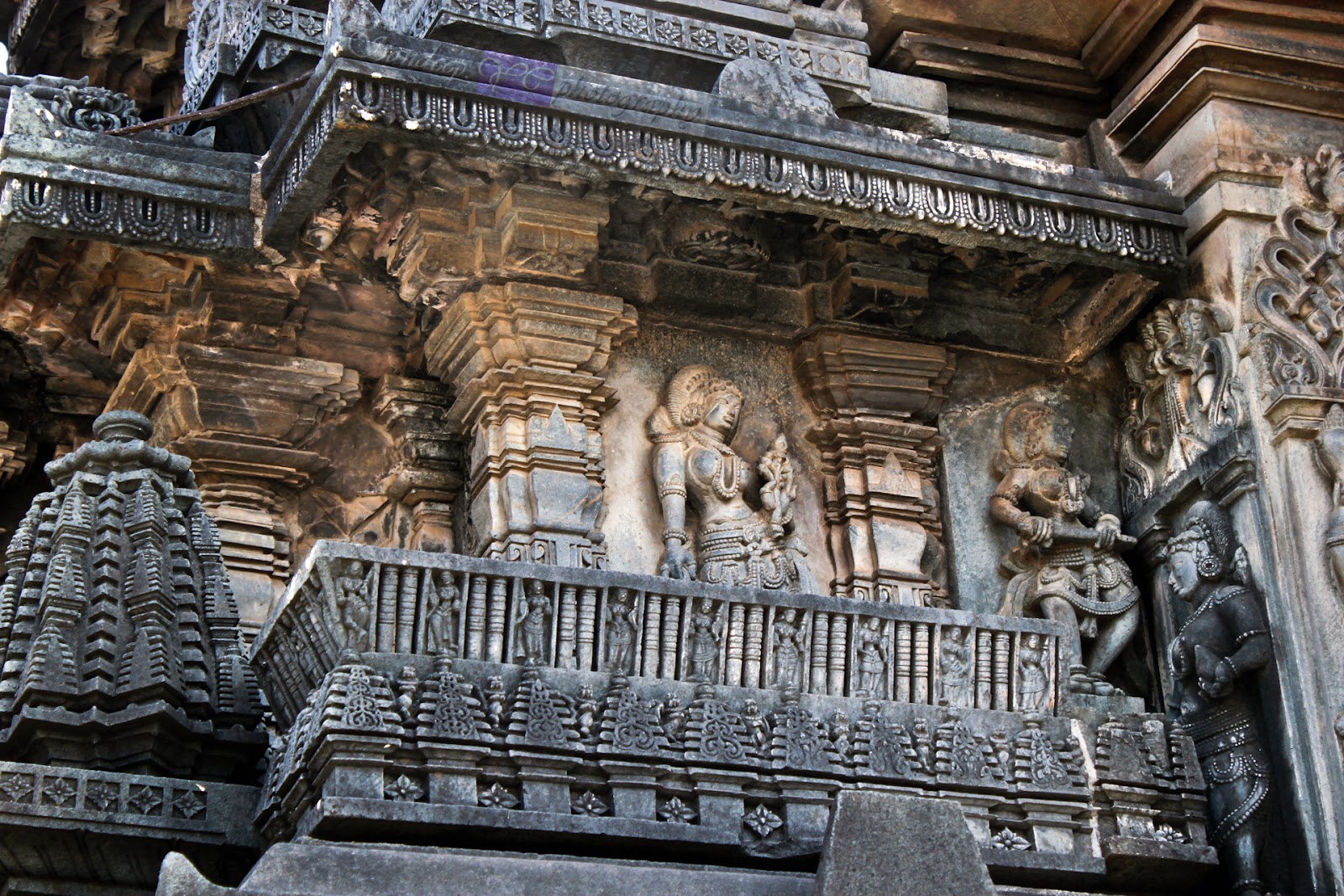
| Miniature Balcony kind of structures on the carved on walls of the temple |
 |
| It looks as if the lady is looking out of the house through the pillars standing beside the balcony |
 |
| This also gives the same perspective of the previous picture. |
 |
| Some kind of beautiful pattern sculptures on the shrines of the temple |
 |
| Huge columns on the walls of the temple |
Sculptures of Gods & Goddesses on the outer wall:
Above the friezes are sculptures of gods and goddesses in various poses under finely carved canopies. These sculptures are so varied and finely ornamented; it looks like an open air museum. The important sculptural depictions of Vishnu as Lakshminarayana, Vamana, Narasimha (half man & half lion form of Vishnu), Varaha, Balarama, Siva & Parvati, Siva as Andhakasura & Gajasura (Lord Shiva slaying demon in form of elephant), Harihara, Surya, Durga & Mahishasuramardini, Bhairava, Brahma could be considered as the best representations of the Hoysala sculptural art.
 |
| Sculptures on the walls of Chennakeshava temple |
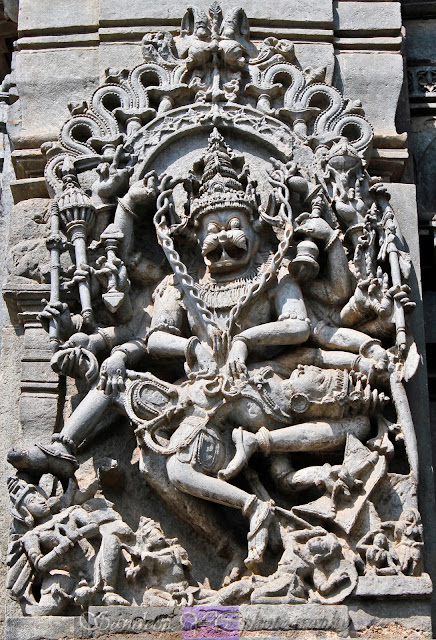
1. Narasimha: This vigorous sculpture portrays the rage of the man-lion, with adoring Garuda at photo left. Chennakeshava means "beautiful god," a form of Vishnu; the shrine images are of this god, while the panel sculptures include both Vaishnava and Shaiva images.
 |
| Narasimha |
2.Shiva Gajasamharara: Shiva dances in triumph on the decapitated head of the elephant demon Nila, while stretching the elephant's skin over his head like a canopy.
 |
| Shiva Gajasamharara |
3. Varaha: Varaha's expression in this well-known piece seems kindly or perhaps even humorous rather than heroic, fierce, or tender.
 |
| series of sculptures including Varaha in the right of the pic and Arjuna shooting in the left side |
4. Arjuna’s shooting : To the left in the pic you can see Arjuna shooting the fish by looking at the shadow reflected in a bowl of oil, placed just below the target pillar.
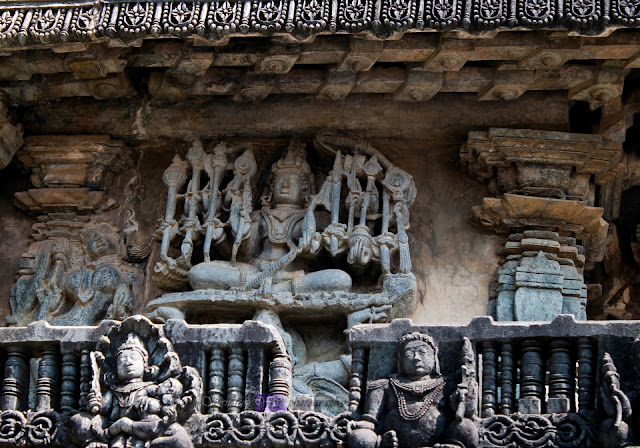
5. Sixteen-armed Narayana: From the outside of the south shrine. Sixteen-armed Narayana seated on a lotus upheld by a four-armed Garuda, carries attributes (photo left to right) of club, spoon, skull staff, conch, sword, drum, chakra, and other attributes, some of which are hidden behind the visible arms and attributes, is supported by another image, of which only the hands and the tip of the head are visible.
 |
| Sixteen-armed Narayana |
6. Ravana shaking mount Kailash: Ten-headed demon king Ravana is holding up Kailas mountain. You can see Lord Shiva is sitting with his beloved Parvathi on the top of the mountain.
 |
| Ravana lifting the Kailash mountain |
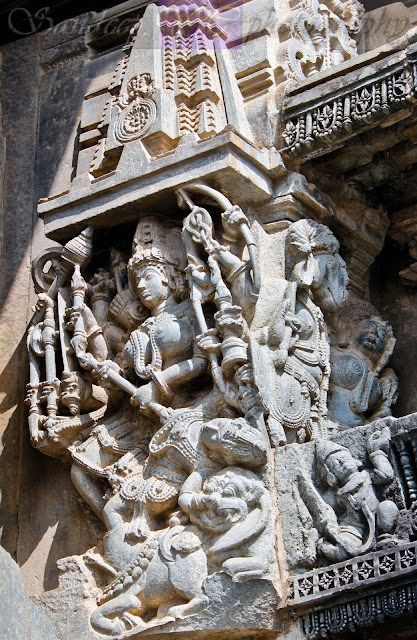
7. Chamundi: The goddess Chamundi is killing the demon Mahishasura.
 |
| Chamundi |
8. The Sun god: The sun God is coming upon his seven-horsed chariot.
 |
| Surya Deva |
9.Vishnu (???)
10.Brahma and forms of Vishnu:
Ornate Pierced Screen:
The ornamented windows called jalandhras which were inserted, between the previously open columns of the mandapa, in the 13th century allow sufficient light and air to enter the interior of the temple.
There are twenty pierced stone windows (perforated screens) surmounted by the eaves, ten on the right and ten on the left of the cast doorway, covering the whole temple. Ten of them are decorated with Puranic scenes and the rest with geometrical designs. Among them five on the right and five on the left of the east doorway are especially noteworthy.
 |
| Ornate perforated Screen |
 |
| Ornate perforated Screen |
 |
| Ornate perforated Screen |
Entrance:
Ornate Lintel: An ornate lintel above one of the temple entrances shows Vishnu as Narasimha (hard to see) above Garuda (easy to see), beneath an elaborately curved arch that issues from the open mouths of elephantine makaras bearing riders.
 |
| Lintel sculptures on the east entrance(Main) |
 |
| Lintel sculptures on the east entrance(Main) in close up, you can see the Makaras on both sides of the Lintel, on top of the pillars |
 |
| Lintel sculptures on the east entrance(Main) further close up to show up the Narasimha and Garuda below that |
 |
| The south entrance, you can observe that it is not as beautifully carved compared to the east door |
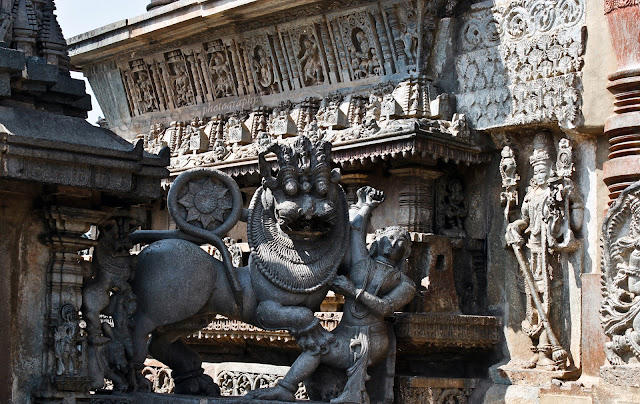
Hoysala Emblem: The warrior, killing a horned lion with his sword, is the emblem of the Hoysala dynasty, symbolizing their courage and strength.
 |
| Hoysala Emblem at the doors |
Ruvari Mallitamma, a prolific artist, had more than 40 sculptures attributed to him in Chennakesava. Dasoja and his son Chavana, from Balligavi in Shimoga district, also made many contributions. Chavana has been credited with the work on five madanika and Dasoja with four. Malliyanna and Nagoja created birds and animals in their sculptures. Artists Chikkahampa and Malloja have been credited with some the sculptures in the mantapa.
Over the sculptures and on the level of the roof are bracket figures known as Madanikas or Silabalika sculptures. Which I’ll be detailing in the next blog.
Madanikas of Belur Chennakeshava temple … To be continued…




.... you have done a painstaking work! Keeping hope liked this,we will get much more informative topic in future too ! Wish you the best!
ReplyDeleteThanks for liking the post.
DeleteGlad you liked the post.
ReplyDelete