Kedareshwara temple and Parshwanatha Jain Basadi of Halebid


Kedareshwara temple and Parshwanatha Jain Basadi of Halebidu:

Kedareshwara temple:
It was about 5 pm before we headed out of the temple towards the Kedareshwara temple which is just 500 m away from the Hoysaleshwara temple.
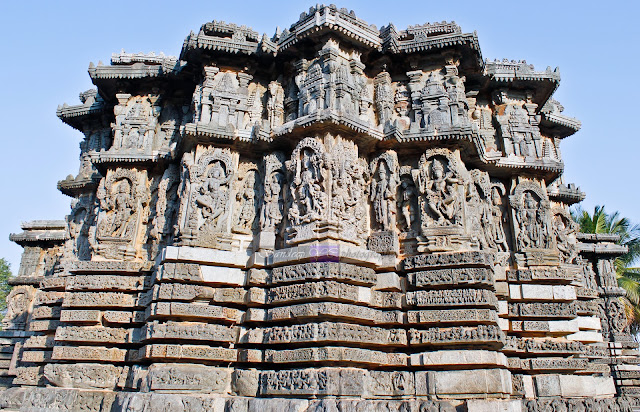
Star shaped structure of the Kedareshwara Temple
According to the inscriptions, it was built by Hoysala king Ballala II and his queen Abhinava Ketaladevi in 1219 A.D. Some parts of this temple had been destroyed and some reconstruction work has been taken place in this temple. In-spite of this, the temple has retained most of its originality and presents a good view of a typical Hoysala Temple.
Image of shiva-parvati on the walls of the temple
Friezes and the sculptures on the walls of the Kedareshwara temple
Built with soapstone, stands on a platform of sixteen points and the super structure are parallel to the contour of the platform. Originally this was a trikuta or three celled temple but all the garbhagrihas are now empty. As a feature of Hoysala architecture the base of the temple wall has horizontal friezes with the scenes depicting stories from Ramayana, Mahabharata and Puranas.  Above these friezes are the sculptures of Gods and Goddesses, shown under ornamented and intricately carved canopies.
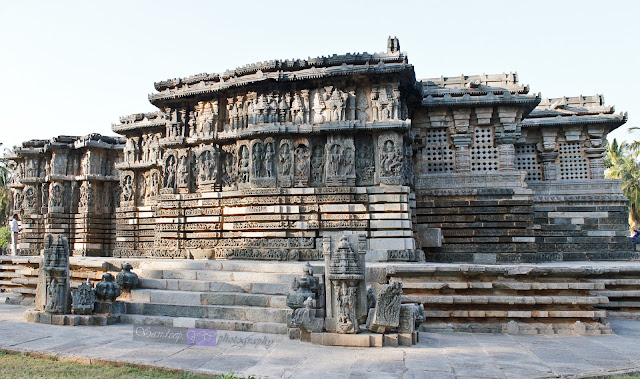
View of the temple, with raised platform and perforated pierced windows
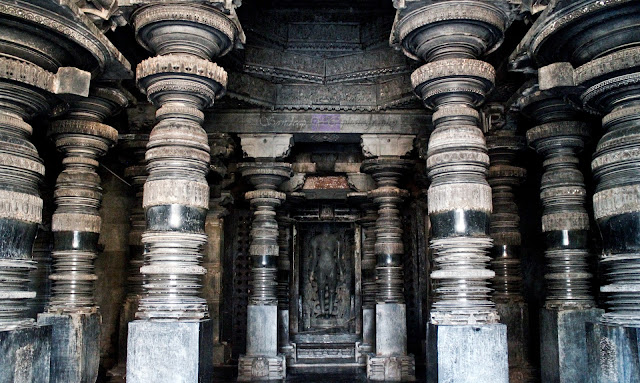
Interiors have lathe turned pillars and minutely carved bhuvaneshvaris (Ceilings). The sikhara which once adorned the southern garbhagriha is now missing.

The temple is destroyed to extent and further to protect this temple the door was closed, so just can have a glance from the temple door.
Inside the temple, as seen from the locked door
Not waiting further we headed towards our last destination the Jain Basadi, since it could get closed as it was already 5.15 pm.

Jain Temples of Halebid:
Further way back just behind the Hoysaleshwara temple are the group of Jain Temples, three at present. This reflects the religious tolerance of the Hoysala's who patronized all the major contemporary sects like Saivism, Vaishnavism and Jainism. The three Jain temples in a row are dedicated to Parsvanatha (west), Adinatha (central), and Shantinatha (east) tirthankaras.

Parshvanatha Basadi: The first temple at the west to the present entrance of the complex is the Parsvanatha Basadi. This temple was built by Boppana, the son of the famous Gangaraja who was a minister under Hoysala King Vishnuvardhana. This temple was built in the year 1133 A.D., in the memory of Gangaraja by his son.

This Basadi is built of soapstone and consists of a garbhagriha, a sukhanasi, a navaranga and a detached mukhamandapa. The pillars of the mukhamandapa are not polished but are beautifully ornate.
The pillars of the mukhamandapa outside the Parshvanatha Basadi
The square garbhagriha and the walls of the navaranga are plain but decorated with pilasters at intervals. The lathe turned and elegant twelve pillars in the navaranga are highly polished with mirror-like glossy surface. The ceilings had small sculptures on it but it was totally dark, so not visible properly.
The lathe turned pillar in the main hall
Ornate Pillars inside the Navaranga (main hall)
Beautifully turned pillars with mirror like finish and amazing designs
The most important attraction of this temple is the 18 ft. tall Parsvanatha Tirtankara statue in the garbhagriha (sanctum). This sculpture with a seven hooded serpent over his head represents a perfect yogi or a realized soul with a benign and sympathetic smile on his lips. Such Jain sculptures are rare.
Parshwanatha tirtankara statue, with 7-head serpent behind
The whole temple was so dark that I was blindly keeping my bare foot ahead, it was getting further darker towards the garbhagriha, there are no windows for this temple, the only light source being the tall entrance door of the temple, it was of the same height as the statue inside, there were no lights inside the temple, the light from the door directly falls on the Parsvanatha statue.
The light source from the door to the garbhagriha
Play of Light and Shade inside the temple
10 of the 12 elegantly carved pillars of the navaranga, Parshvanatha statue at the center, and the ceiling sculptures partially visible through the door.
10 of the 12 elegantly carved pillars of the navaranga, Parshvanatha statue at the center, and the ceiling sculptures partially visible through the door.
Kannada inscriptions outside the temple
The doorjamb of the Parshvanatha temple

 Shantinatha Basadi: Almost similar to the above but of lesser dimensions is the Shantinatha Basadi. It was built around 1192 A.D., during the reign of Ballala II. Its temple plan is similar to that of the Parsvanatha temple, it consists of a garbhagriha, sukhanasi, a navaranga and a mandapa. The mandapa must have been added later during the Vijayanagara period. The garbhagriha has a fine image of Shantinatha tirtankara which is also about 18 ft. in height. In between these two basadis, is another smaller one, the Adinatha Basadi, built in 1138 A.D., by minister Mallayya during the reign of king Vishnuvardhana.


We finally left the Halebeedu and the clock was ticking 5.45 pm and before the darkness falls thought to reach the NH48.

We halted for our dinner at hotel Swathi Delicacy which was newly built and the service of the restaurant must be appreciated. We concluded the trip reaching Bangalore by 11.30 pm, well not just another trip but one of the most beautiful pleasure for our eyes and definitely a must visit for everyone, and I bet you can’t just visit only once ;-)


Comments

  1. My old India guide book from Footprint 2002 states "the Hoysalesvara temple originally had 84 female figures, of which only 14 now remain, over the yrs 70 were stolen". My visit in Oct. 2015 revealed what seemed a very successful restoration of the monument.

    ReplyDelete
  2. a pride for me to be able to discuss on a quality website because I just learned to make an article on
    cara menggugurkan kandungan

    ReplyDelete

Post a Comment

Popular posts from this blog

Micromax Canvas 2 A110 Hands on Review

Micromax Superfone Canvas 2 A110(Jet Black/Calm White): After using it for a week, I felt pretty good about my decision for going with a new brand like Micromax over the mighty Samsung Galaxy S Duos and Sony Tipo Dual. Particularly not sure about its reliability but the build quality looks pretty decent. Below are my ratings for the phone aka Phablet. Build Quality (8/10): The build quality was above my expectations keeping in mind of the price tag, from front it looks just like a Galaxy high end smartphone like SIII or Note II. It has a matte finished back cover which is good for protection towards scratches and there is a metal casing all around the phone, which adds up the beauty of the phone. One more advantage of this phone is it has a touch home button instead of a hard button as seen in iPhone and Galaxy phones. Camera (5/10): [8MP autofocus (Tap to Focus), dual flash, supports up to 3264x2448 pixels, Panorama] Don't fall for the specs as it is said...

How to update Micromax canvas 2 A110 with official Jelly Bean V3 - detailed steps

How to update Micromax A110 Canvas 2 to V3 ROM: I've just updated my canvas 2 to Jelly Bean official update from Micromax. Before you proceed I would like to make sure that this site is nowhere guaranteed for your successful upgrade and we are nowhere responsible for any claims. This is just a tried and tested genuine way to upgrade to Jellybean only for Micromax Canvas 2 A110 users. Software release notes (from Micromax ftp site): 1. Operating system is upgraded from ICS to Jelly bean. 2. M! Store is removed. 3. New wallpapers are integrated. 4. Software is backward compatible with old TP available (BYD Make). Here is what you can do by yourself and it is simple too. First of all take a complete backup of your data, you can use the following tools from the play.google.com 1. App Backup & Restore: to backup all your apps as apk files which will store them on mnt\sdcard2\ app_backup_restore 2. G Cloud Backup from GENIE9: It c...

20 Must have free Andriod apps for ICS

20 Must have free Andriod apps for ICS 20.Camera MX Developer: MAGIX Category: Photography   Get creative with your camera - combine effects and photo frames live in the camera. Optimize and edit your best photos. More than 20 customizable realtime photo effects: HDR, Vintage Lomo, Tilt-shift, Pop Art, Sepia etc. 19.Desi Calendar Developer: Fingertips Software Category: Tools Desi Calendar provides a view of all Indian festival in a Calendar format. Now you would not miss any Indian festival and would not have to go through multiple web sites to find the dates for each of the festival. Desi Calendar does it for you. 18.Adobe Reader Developer: Adobe Systems Category: Productivity The global standard for reliably viewing and sharing PDF documents Adobe® Reader® is the free, trusted leader for reliably viewing and interacting with PDF documents across platforms and devices. Install the free Adobe Reader mobile app to work with PDF documents on yo...

10 Ancient Temples in Karnataka you must visit

Top 10 Ancient Temples in Karnataka: The ageless monuments of Karnataka, with their unique architectural styles are a delight to the history and archaeology buffs. The iconic stone chariot to the intricate sculptures of Halebid or the cave temples of Badami, here is the ten most renowned Ancient temples in Karnataka State of India. All of these temples are built with stone, which is one of the main feature of ancient Indian temples. Temples of Karnataka 10. Brahma Jinalaya Temple, Lakkundi (1007 A.D) This Jain basadi is perhaps the largest and oldest temple at Lakkundi today. Temples at Lakkundi are best examples of Kalyani Chalukya Architecture. Location:Lakkundi, Gadag Accessibility: Nearest International Airport is Bangalore (422km), Nearest Railway station is Gadag (13km) Highlights: Chaturmukha Brahma, one of the most beautiful sculptures of Brahma Jinalaya Lakkundi  Brahma Jinalaya Temple, Lakkundi (1007AD- Kalyani Chalukya ) 9. Durga Temple, Aihole (7...

Bird watching tour to Davanagere - Part I

Birding in Davanagere - Part I Water Birds: With not much expectations headed for bird watching in Davangere, but what turned out later was an extravaganza of our beloved winged friends. A colony of Black-winged Stilt There is a reason why I had less expectations, we usually hear from bird watchers in and around Bengaluru and have rarely heard of a city such as Davanagere for bird spotting. Winter is the best time for bird watching in Davanagere as the winged guests from far across the Himalayas visit here in search of food and tropical climate. Was expecting to spot the migratory bar headed goose and waders along with the resident Kingfishers, Munias, Weaver bird, and Coucal. Though couldn't witness some of them but ended up spotting over 50 species of birds. A little knowledge about these birds and a lots of patience can help spot many of these with a binocular or a camera with 250 mm lens. Compared to birds in Bengaluru, here the birds were very shy and not used to ...