Bagalkot Heritage Drive - Day 2 – Badami Cave Temples (1 & 2)
Some Facts about Badami: Badami or Vatapi (Sanskrit form) was the capital of the early Chalukyas. Pulakeshi I, one of the early kings of this dynasty built a strong fort at Badami & made it his capital in the year 547 A.D., and from that time onwards the later kings of this dynasty built rock-cut & structural temples here for about three hundred years & hence Badami became a great center of Karnataka architecture and Sculpture.
The Early Chalukyas chose the sandstone cliffs of Badami, for rock excavation. Badami was the headquarters of the Early Chalukyas, who ruled much of Karnataka in the 6th - 8th centuries. The Badami cave temples are an early example of the Chalukyan style of architecture.
Back to the travelogue: After a ten min drive from the restaurant we reached the Badami cave temples at about 4.40pm & started to climb up the steps, there are a total of 4 caves here, 3rd one being the most important, first 3 have been dedicated to Hindu Gods and the last one to Jain. First one dedicated to Shiva, 2nd and 3rd to Lord Vishnu and the 4th to Lord Mahavira.
These cave-temples essentially consist of a rectangular pillared verandah (mukha-mandapa), a more or less square pillared hall (maha-mandapa) and a small almost square shrine-cell (garbha-griha) at its rear, all in an axial plane and entirely rock-cut, constituting the flat-roofed mandapa type of temples.
The whole Badami is so beautiful with both the beautiful red sandstone cliffs and the beautifully carved cave temples and the Badami fort on the cliffs and the temples surrounding the more beautiful Agasthya tank. No wonder why so many movies were shot at this place listed below,
- Hindi movies (Bollywood): Rowdy Rathore (2012), Guru (2007).
- Kannada movies (Sandalwood): Veera Madakari, Sanju Weds Geetha
- Telugu movies (Tollywood): Daruvu (2012), Brindavanam (2010), Dhamarukam (2012), Vikramarkudu (2006), Shirdi Sai (2012), Shakti (2011), Nagavalli (2011), Magadheera (2009)
- Tamil movies (Kollywood): Siruthai (2011)
There is a ticketing counter here & enough parking spaces, we started towards the 1st cave which is about 40 steps from the bottom.
Badami Cave 1:
 |
| Shiva cave temple |
The first in the series and is dedicated to Shiva and is built in 585 A.D, it is larger than the cave 2 and smaller than cave 3. Its facade, just below the square-cut columns, displays a long frieze of dancing ganas.
Shiva Panel: Shiva in his dancing form – as Nataraja depicted with eighteen arms. The celebrated Shiva panel is located on the right wall of the facade, perpendicular to the entrance. The gana frieze, also turns the corner to continue on this wall. In the panel, a fine carving of Shiva, multi-armed & dancing, is flanked by Nandi on the viewer's left, with Ganesha & a drummer on the viewer's right.
 |
| Shiva panel |
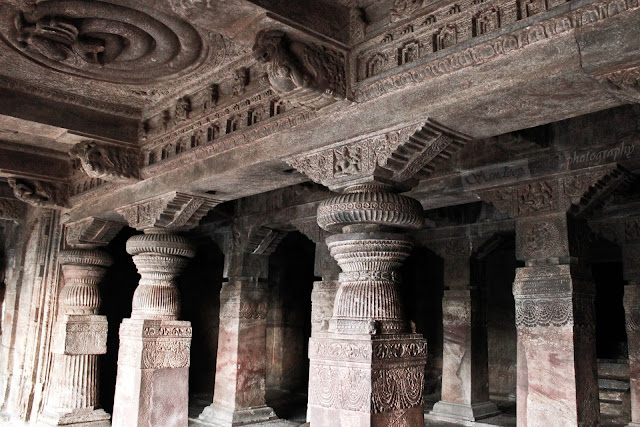
Ceiling Bracket: A fanciful animal issues from the mouth of a makara on the ceiling bracket.
 |
| Column & ceiling bracket |
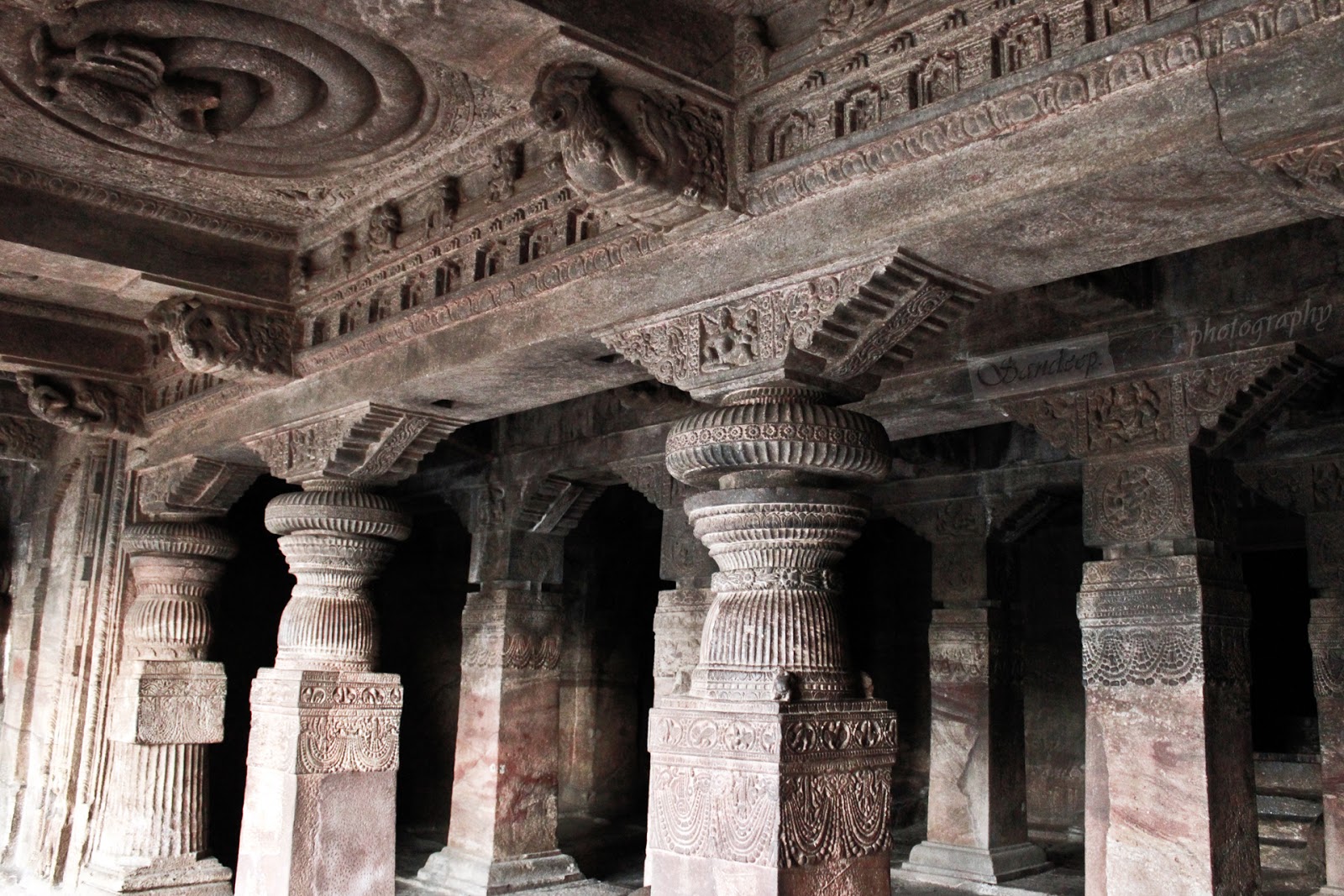
Columns: A rounded engaged column is shown in the left; a detached, square-cut, column is visible in the photo left. The engaged column sports a pincushion capital, & is interrupted midway by a square section.
 |
| Columns |
Ardhanareeshwara: the eight feet tall Ardhanareeshwara with sage Bhringi (the skeleton like figurine) and Nandi on left & Parvati in the right, is another elegant sculpture. The left portion in the photo is symbolic of male while the right is female.
 |
| Ardhanareeshwara |
Harihara: a fusion of Shiva and Vishnu – the coming together of two sects – the Shaivites & the Vaishnavites. On the left in the photo is Shiva, accompanied by Nandi & Parvati, while on the right is Vishnu, with Garuda & Lakshmi by his side. Shiva has his matted hair piled up atop his head, a snake holding it together, a moon decorating it, while Vishnu has a jeweled crown. Shiva has snakes as ornaments while Vishnu has jewels galore. They hold their signature weapons, such as the noose & the conch. Every aspect of the two gods has been depicted so beautifully that one can just stand on & on staring at it!
After about 15mins here we started towards the 2nd cave which is again about 64 stairs from the 1st cave.
 |
| Harihara |
 |
| Beautiful carvings on the pillars |
 |
| Some sculptures on the ceilings |
Badami Cave 2:
 |
| Vishnu cave temple |
Constructed after cave 3 in the late 6th century, it is dedicated to Vishnu, & is the smallest of the 4 caves.
Vishnu Trivikrama: Vamana is described in the Puranas as the fifth Avatar of Vishnu. Vishnu saves the world from Bali. Several episodes of the story, as it unfolds in time, are shown at once (continuous narrative):
First, at the bottom right of the main panel, Vishnu disguised as Vamana visits Bali underneath a royal umbrella; the demon king & his court are shown standing to the right of the dwarf.
Second, in the main action of the panel, Vishnu takes his giant step and in the process defeats Bali, who is shown upside down just below Vishnu's outstretched foot. The strange-looking face in the upper right corner is not identified; it may represent the sun, looking on in surprise.
Finally, photo left, Bali admits defeat & clings to Vishnu's standing leg in submission. The whole composition is supported on a prominent frieze of dwarf musicians.
 |
| Vishnu Trivikrama |
Varaha: Varaha is the third avatar of Vishnu, taking the form of a boar. Vishnu's boar incarnation rescues the earth goddess, Bhu Devi. Her body bends toward the boar in a graceful arc, as she drapes her right arm over the end of Varaha's muzzle. His discus (chakra) in the other hand. His left foot rests in the netherworld, as he rescues Bhudevi from the depths of the ocean. The denizens of the netherworld, the snakes, led by their king, Vasuki, are shown praying to the Lord’s foot which rests in their land.
Below the main scene is the usual frieze of dancing dwarves.
 |
| Varaha |
Beautiful work on the ceiling: There is a wheel which has 16 spokes; each of these spokes is a fish, made on the ceiling of a cave. There is swastika pattern seems to be a popular one. The most interesting thing about this pattern is that these four swastikas can be drawn without lifting our pen from the paper.
 |
| four swastikas can be drawn without lifting our pen(top) and wheel of fish(bottom) |
 |
| Beautiful work on the ceilings |
After the 2 cave temples we have to flight through another 60 steps to reach the 3
rd cave, and got one of these sight of the Badami town between the sandstone cliffs, an hour before the sunset.
 |
| Leading from cave 2 upto cave 3 |
 |
| view of the Badami town in between the rock formations |
There is also a natural cave between 2nd and 3rd cave. As you rise through the steps you cross by the door to end up directly to 3rd cave.
Bagalkot Heritage Drive - Day 2 – Badami Cave Temples (3 & 4)… to be continued….




Comments
Post a Comment