Hoysaleshwara temple Sculptures and Doorways

Sculptures & Doorways of Hoysaleshwara temple
Sculptures on the walls of the Hoysaleshwara temple
Entrance:
There are totally 4 doorways for the temple out of which the south door is of most importance. The entrance looks similar to that of the Belur, and is a true Hoysala style of architecture, with two model shrines on either sides of the door and the Lintel being exquisitely carved with small sculptures on them.
The south entrance of the Hoysaleshwara temple
The Dwarapalakas and the lintel work at the south entrance
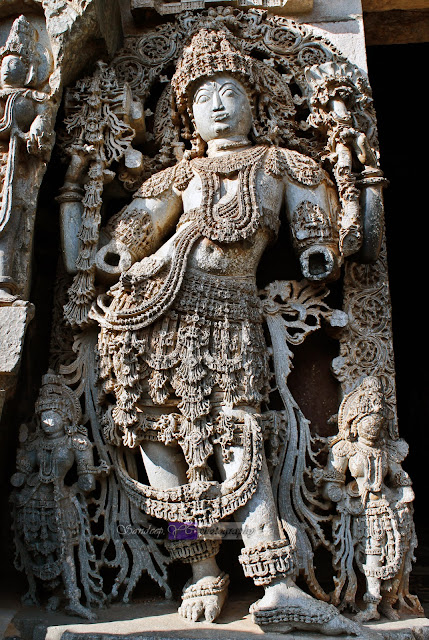
The most beautiful sculpture in Hoysaleshwara temple were the two sculptures of Dwarapalakas at the south door of the temple, it has the most elaborately carved ornaments  on both these sculptures.
Dwarapalaka at the North entrace
Dwarapalaka on the right of the south entrance
Dwarapalaka on the left of the south entrance
Here you can imagine those days how rich and elegant were there ornaments decorated so beautifully
Even today you wont find such a beautiful jewels of gold which were those days carved out of stone
Sculptures:
There are 240 large sculptures on the walls of the temple, out of them the most significant ones being the Shiva and Vishnu images.
The avatars of Vishnu include Varaha, Narasimha, Vamana, and Krishna. And there are many Shiva sculptures found on the walls.


1. Varaha
This relief of Varaha seems to emphasize his fierceness against the conquered demon, rather than his tenderness towards the rescued goddess.
The fineness of the carving, which is deeply undercut and encrusted with ornamentation in the best Hoysala style, is characteristic of most sculptures on the temple.
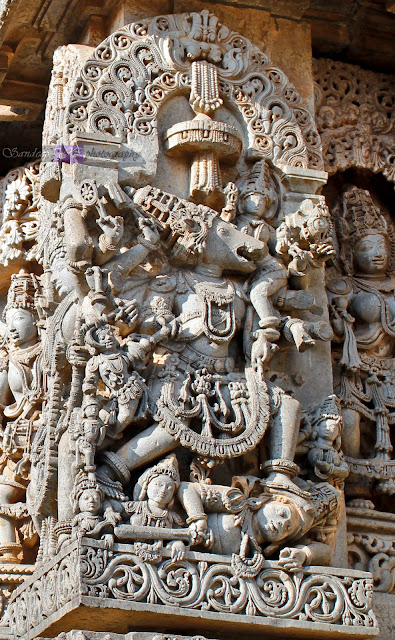
Varaha
Varaha
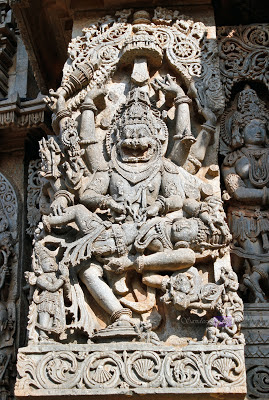
2. Narasimha
There were many images of Narasimha out of which im showing you two of them below
Narasimha 1Narasimha 2

3. Vishnu Trivikrama
Vishnu takes a giant step to reclaim the universe, as Garuda worships to his right. Brahma (with three heads) appears beside Vishnu's right foot, indicating that in this step Vishnu has covered the heavens.

Vishnu Trivikrama
Vishnu Trivikrama
4. Garuda
There were two images of Garuda which i found here. The first one is the Garuda, who as a bird is the traditional enemy of snakes, fights a pair of nagas.
The second one was on another here also you can notice the wings on the left side of the pic.
Garuda fighting with snake
Garuda, you can notice the wings on his right
5. Shiva
Shiva dances powerfully on the body of a demon, which he tramples under foot.

Shiva
Shiva
6. Shiva
A fierce manifestation of Shiva dancing on a demon. Shiva holds multiple weapons, a snake-entwined skull staff (photo left), and a drum (photo left, above Nandi). A corpse appears to the right edge of the photo. At the upper right of the photo, Shiva spears a small enemy with his trident.

Shiva with Trishul in his hand
7.Shiva & Parvati
The right image is of Shiva Parvati on Nandi
Shiva Parvati Shiva Parvati on Nandi

8. Gajasurasamhara
The Slayer of the elephant demon.The fierce aspect of the Hindu god Shiva as the Destroyer of the elephant demon, Gajasura.
Gajasura 1
Gajasura
Gajasura 2
Gajasura
9. Bhikshatana / Bhairava
This image is a stunning amalgamation of gentle Bhikshatana and fierce Bhairava, both forms of Shiva. The sandals belong to Bhikshatana, the other attributes to Bhairava. In the lower right, two figures seem to represent a Brahmin trying to keep his wife away from Bhikshatana. The figures may be interpreted as emaciated aescetics (Bhikshatana), as corpses (Bhairava), or - as so often in additive cultures like India's - as both. Overall, the fierce expression and imagery of Bhairava clearly dominate this sculpture, which I would characterize as Bhikshatana assimilated into Bhairava.
Bhikshatana
Bhikshatana
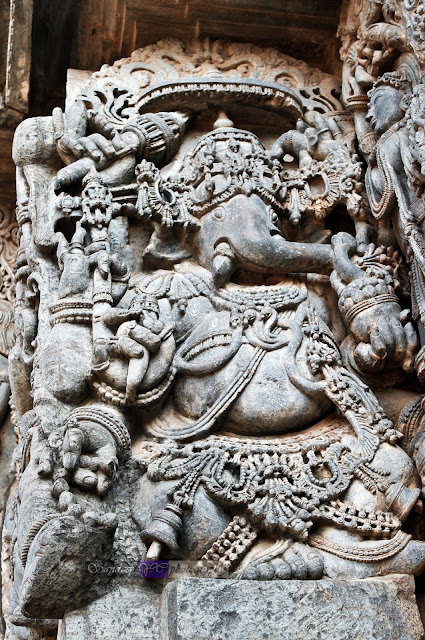
10. Ganesha
Dancing Ganesha
Dancing Ganesha
Ganesha
Ganesha
11. Lakshmi Narayana
Lakshmi Narayana, also seen here is the most popular madanika style of Belur on the right of the pic
12. Ravana lifting Kailasa

Ravana Lifting Kailasa mountain, Similar to that of the Belur.
So much of details can be seen here, with Shiva - Parvati sitting on Nandi on top of the mountain. 
Ravana Lifting Mount Kailasa
13. Arjuna
Arjuna
Arjuna
14. Durga Mahishasuramardini
Durga, armed with the weapons of all the gods, slays the buffalo demon Mahisha.
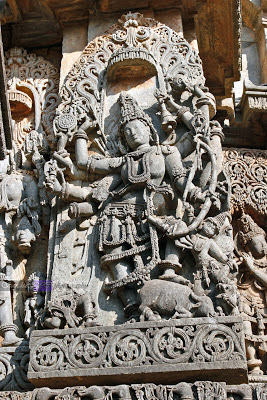
Durga Mahishasuramardini
15. Kaali
Kali dances around the graveyard with trident, sword, and severed head. She is adored by attendant corpses. Kali represents Time, which brings all things to ruin.
Kaali
Kaali
16. Trimurti - Brahma, Vishnu and Maheshwara
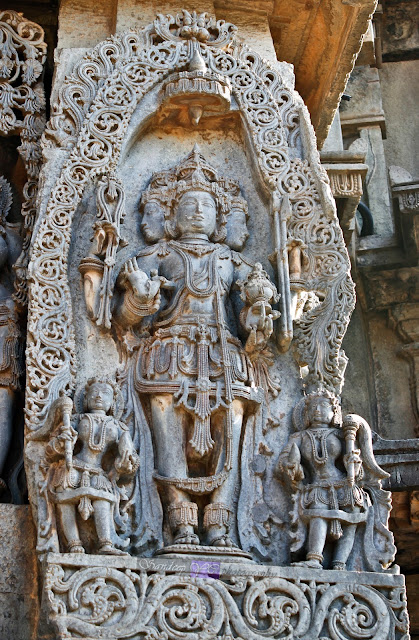
Trimurthi
Trimurthi
17. Lord Krishna
Lord Krishna
Lord Krishna
18. Govardhana Giridhari
Lord Krishna again......Govardhana Giridhari!! Notice the details of Govardhana Mountain!!
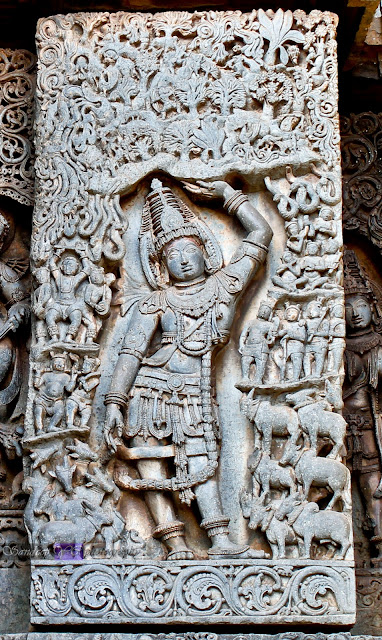
Govardhana Giridhari
19. Saraswati
Sawaswati at the center
20. Madanika under foliage
Shilabalikas under foliage. Notice beautifully sculpted robes of theirs!! 
Shilabalike under foliage
21. Dancing girl under Foliage
Madanika or Dancing girl under Foliage.......can anything be more beautiful and complete than this!!!!!

Madanika or Dancing girl under FoliageMadanika or Dancing girl under Foliage

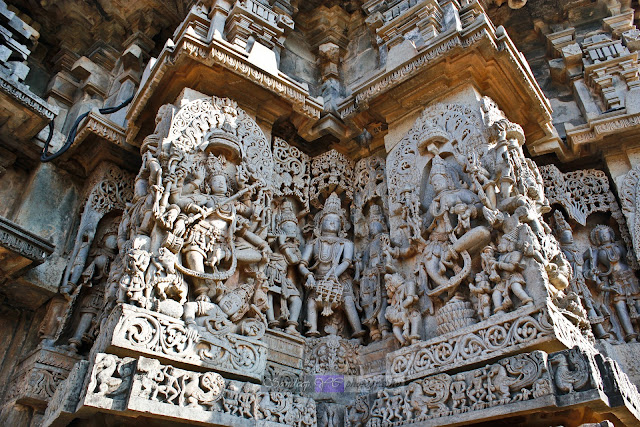
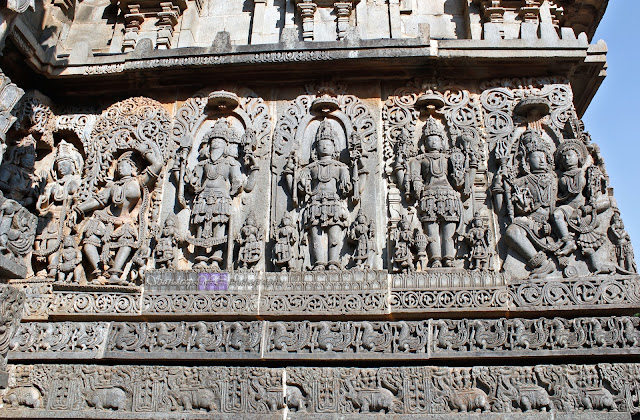
There was a large panel of sculptures of Gods and Goddesses, seven in total, and i suppose the most unique of them all. All of these images were on top of the wall, unreachable from ground.
Panel of sculptures of Gods and Goddesses, with seven images
The first four of them were, from left, Brahma, Maheshwara, Vishnu, Lakshmi(??)
The last three were Vishnu with Adishesha, Shiva and the last one coudnt recall the name
There was another panel with series of images which includes a madanika also along with the Gods
From right Shiva-Parvati, Vishnu, Maheshwara, Brahma, and followed by Madanika in dancing pose
I'm pasting here the rest of the images which i felt were also important...


Some more images of the walls of the temple

Wall Sculptures on the walls of the Hoysaleshwara temple
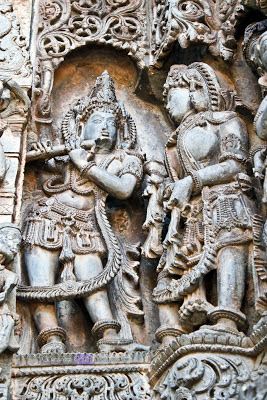
Wall sculptures with drum dancer at the center, here the ropes of the dhol or dholi is carved out of the stone leaving behind hollow sections inside, giving a view of a real Dhol or Hand Drum
The designs on top of the sculptures
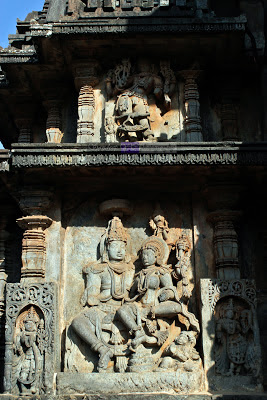
On the left is the Dancer with tabla, at the center must be the image of Vishnu, and on the right is a Shilabalike or the dancing madanika
Light and Shade on the Sculptures

Apart from these sculptures there were two Nandi mantapas attached to the temple and an Archeological museum in the campus which i'll be detailing in the following post.

Nandi Mandapa’s and the Temple complex...To be continued...


Comments

Popular posts from this blog

Micromax Canvas 2 A110 Hands on Review

Micromax Superfone Canvas 2 A110(Jet Black/Calm White): After using it for a week, I felt pretty good about my decision for going with a new brand like Micromax over the mighty Samsung Galaxy S Duos and Sony Tipo Dual. Particularly not sure about its reliability but the build quality looks pretty decent. Below are my ratings for the phone aka Phablet. Build Quality (8/10): The build quality was above my expectations keeping in mind of the price tag, from front it looks just like a Galaxy high end smartphone like SIII or Note II. It has a matte finished back cover which is good for protection towards scratches and there is a metal casing all around the phone, which adds up the beauty of the phone. One more advantage of this phone is it has a touch home button instead of a hard button as seen in iPhone and Galaxy phones. Camera (5/10): [8MP autofocus (Tap to Focus), dual flash, supports up to 3264x2448 pixels, Panorama] Don't fall for the specs as it is said...

Trip to the Misty Hills of Kudremukh

Trip to the Misty Hills of Kudremukh: About Kudremukh: Kudremukh National Park is the second largest protected wildlife area in the Western Ghats (around 600 sq.kms). Three important rivers of Karnataka, the Tunga, Bhadra and Netravathi are said to have their origin in this area. Mist covered roads in Kudremukh All these can be reached within 80km. We first started with sringeri, which is famous for its Vidyashankara temple built in1342 AD. Reached Sringeri at 11am. There is a bridge Sri Vidya Teertha Setu across the Tunga river which connects from Vidyashankara temple to Sringeri Mutt. We had prasadam (lunch) at the mutt. There is one more temple called as Sharadamba temple which has lovely architecture built inside and photography is banned inside. The whole temple area is kept very clean and it was a pleasant experience to spend time in the temple complex. We then left at 12.30pm towards Kudremukh. Vidyashankara temple  Vidyashankara temple  Vidyas...
5 Places in Maharashtra you must visit atleast once

5 places in Maharashtra you Must Visit At Least once Maharashtra is a state best described as a land of cave temples, hilltop forts, and Mountains. Best time to explore them are the monsoons and post monsoons, definitely not in summers. These 5 places in Maharashtra are a must visit, 5. Lavasa The first planned hill station in India and probably the most controversial for the deforestation reasons. Even the road from Tehghar dam till Lavasa is spectacular with forest cover and green valleys. Best time to visit is during monsoons and post monsoons. Best time of the day is after the sun goes down with the entire city lighted up, and the musical fountains adding more flavour to the evening. Lavasa City during night For more information on Lavasa CLICK HERE 4. Lonavla-Khandala Unlike Mahabaleshwar, Lonavla is a monsoon hill-station. Best time to visit is during monsoon and post monsoons (July-Dec) when the entire hill range turns into lush green grasslands and num...

Lalbagh Flower Show Jan-2012

Lalbagh Flower Show 2012 - 100th Exhibition Event :            January 20 till 29, all roads lead to the Glass House in Lalbagh Botanical Gardens. Around 10 lakh visitors are expected to visit the gardens and see a visual treat, thanks to the Mysore Horticultural Society. This flower show is the 100th exhibition of the Mysore Horticultural Society that was started by the then Superintendent of Lalbagh GH Krumbiegal in 1912. Major Attractions this time include Buddha Stupa, Floral dance forms, Floral Flow, Florance Flora Show and Diagonal floral Lines. Buddha Stupa Early Hours crowd at the Glass House GH Krumbiegal Visited the show on Sunday noon (22nd), on that day it recorded a whopping 100,000 visitors, making it difficult to capture the rich colors at the show. I could somehow manage to get a few colorful pics. It was more beautiful and creative than the previous flower shows held here. Entered the Glasshou...

Masinagudi Jungle Trails : A Road Trip to Nilgiris

Masinagudi Jungle Trails : A Road Trip to Nilgiris - II All set and packed for a long road trip to Ooty, left Bangalore late at 8am. What to pack for a long road trips?? Click here The motive of the road trip was to voyage around less explored and adventurous places, rather than popular and easily accessible tourist destinations. To avoid Mysore traffic, we tried to explore another route from Mandya through Somnathapura to Nanjangud, but it turned out to be more tiring and longer route. We reached Bandipur forest check post only by 2pm. Driving through Bandipur forest is a pleasure, with good road conditions, greenery around and spotting wildlife was more exciting. In an intention to spot wildlife, and to maintain silence in the forest, we were driving steadily at 15kmph speed without using horn. We could spot a lot of deer herds, elephants, black bear, boar, Grey Langur monkeys and peacocks.  Peacock spotted on the Bandipur Mudumalai stretch Elephant...