Shoreline Birdwatching in Arnala Vasai, Mumbai:
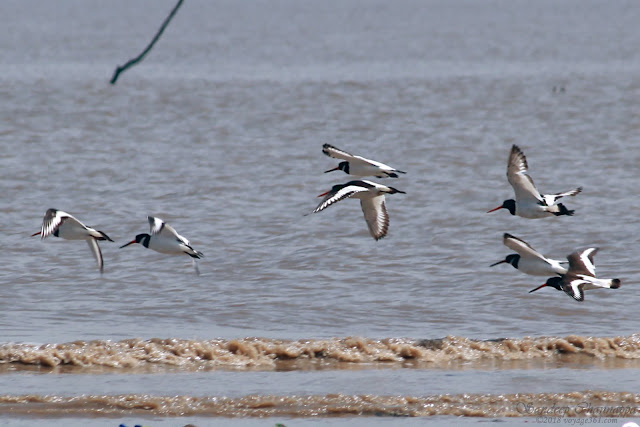 |
| Eurasian Oystercatcher in flight at the beach in Arnala, Mumbai |
After having done bird watching in lakes, parks, hills and grasslands, one thing which was long awaited was a dedicated bird walk in seashores. There are many popular birding destinations in and around Mumbai for shorebirds including the Arnala beach and Buigaon beach in Virar, Uran wetlands in Panje, and Akshi beach in Alibaug. After following recent bird counts reported in Arnala, decided to visit the shoreline of Arnala in Virar.
About Arnala Shoreline:
Not to be confused with the Arnala beach where tourists and locals flock in, but the shoreline extending towards Mamachi Wadi and Tuss Khadi are popular among the shorebirds. Its very much undisturbed and unfrequented by humans.
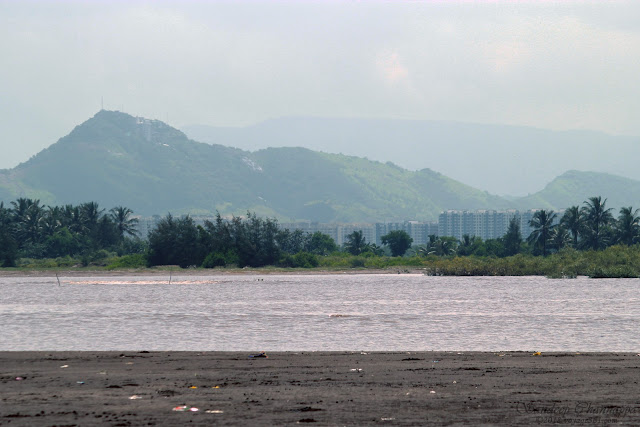 |
| Arnala Shoreline, Mamachi Wadi |
How to reach:
The nearest bus stop is the Jyoti Mata Church stop in Virar. Buses from Virar railway station run every ten mins to Arnala. The beach is a fair 2.5km walk from the bus stop.
Birds of Arnala:
The beach is a hotspot for coastal birds, while many of the birds are seasonal including the Lesser Whistling-Duck, Watercock, Bar-tailed Godwit, Gull's, Eurasian Hoopoe, Lesser Whitethroat, Siberian Stonechat, Rosy Starling, Red-breasted Flycatcher, Common Tern, and Pied Cuckoo.
Most of the birds can be found round the year including the Western Reef Heron, Broad-billed / Curlew Sandpiper, Sanderling, Eurasian Oystercatcher, Black-bellied / Pacific Golden / Lesser Sand / Greater Sand / Kentish / Litle Ringed Plover, Ruddy Turnstone, Terek Sandpiper, Eurasian Curlew, Dunlin, Little Stint, Gull-billed / Caspian Tern, Long-tailed Shrike, Indian Golden Oriole, Yellow /Cinnamon Bittern, Striated Heron, Osprey, Oriental Honey-buzzard, Scaly-breasted / Tricolored Munia, Coppersmith Barbet, White-eared Bulbul, and White-browed Bulbul.
The Eurasian Oystercatcher, Watercock, Plovers, Ruddy Turnstone, Curlew sandpiper and Eurasian Curlew topped my bucket-list. Most of the shorebirds were new to me and had only seen them in internet. So most of these shorebirds were also in my wish-list.
Birding Experience:
While the perching birds are active during the early hours, the shorebirds are dependent on the tide times. Based on the tide timings, reached the place at 9.30 am when the tide had started to rise. The walk from the main road was rewarding with sightings of many bird species around the grasslands and mangroves.
Spotted a few long tailed Shrikes, Spotted Doves, Cormorants, Egrets, White-throated Kingfisher, Green Bee-eater, Rose-ringed Parakeet, Black Drongo, Red-vented Bulbul, Prinias and Sunbirds.
Although the highlight was crossing hundreds of butterflies in various colors and patterns.
After a thirty minutes walk I reached the seashore, it was was totally secluded with no humans seen around, a perfect place to be close with nature.
My first experience after reaching the beach was pitiful, with lots of plastic waste washed to the shore. The beach was in a miserable condition.
There were hundreds of large crabs moving around the beach and not even a single bird which caught my sight in the beach. It was a disappointing start, but my instincts were positive and started exploring the shoreline. While I watched my feet carefully for crabs and snakes(one small snake spotted on my way to beach, probably a water snake), I was curiously looking for shorebirds as well.
 |
| One of the hundreds of Ghost Crabs found on the beach |
As I moved close to the crabs they started to move away from the shore, hundreds of them and only after some time I realized there were small birds moving away on the ground along with those crabs. Only after having focused through my camera at 250 mm focal length, I realized they were
Lesser-Sand Plovers. There was absolutely no contrast with the sand color and the Sand Plovers, making it very difficult to spot them. My next move was more careful, as I didn't wish to distract the birds.
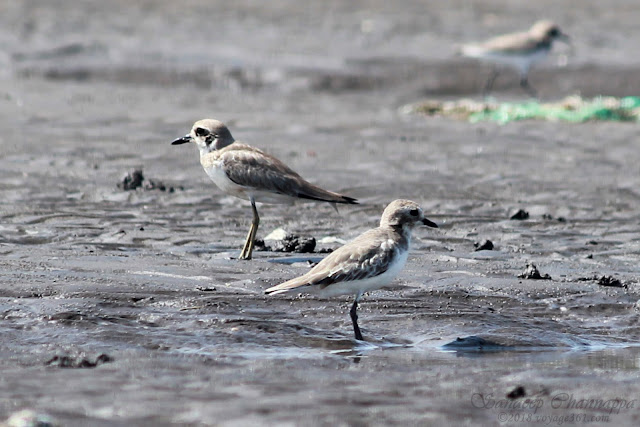 |
| Greater (left) and Lesser Sand Plovers - notice the longer bill, and longer and yellow-greenish legs of the Greater Sand Plovers over the Lesser Sand Plovers |
Slowly as I approached further I got to see many different species of plovers including the
Greater Sand-Plover and
Kentish Plover. Many flocks of
Little Stint's were flying around me, they were all in a hurry and not sticking to the ground for longer times.
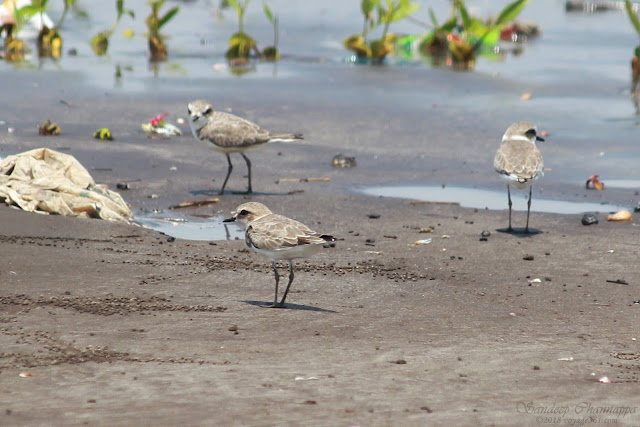 |
| Kentish Plovers with the distinctive white collar and smaller size compared to Sand-Plovers |
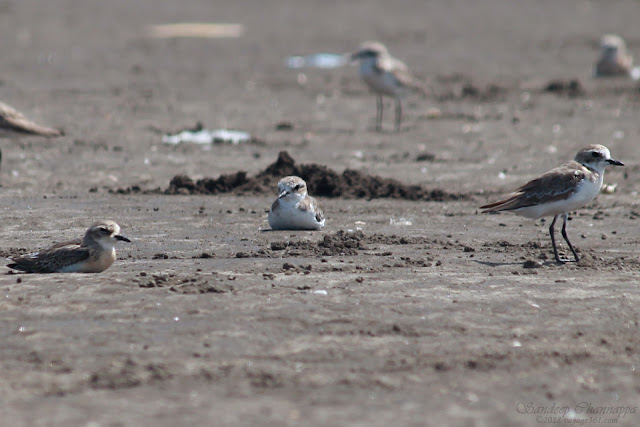 |
| Lesser Sand Plover resting on the grounds |
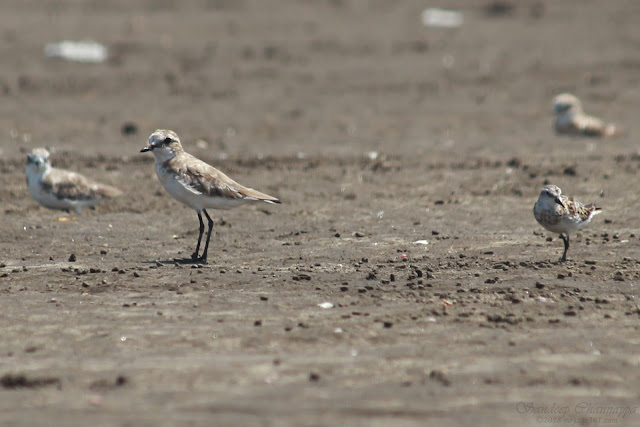 |
| Lesser Sand Plover along with Little Stint |
There was a large group of
Gull-billed Tern resting on the ground, I didn't wanted to distract them so walked away from the shoreline, which made me spot many other shorebirds including a few
Common Redshanks busy foraging in the shallow waters along with Little Stint's and Sand Plovers. At some distance there were slightly larger birds with an uneven pattern of black and white. They were
Ruddy Turnstone, resting on the ground along with Sand-Plovers.
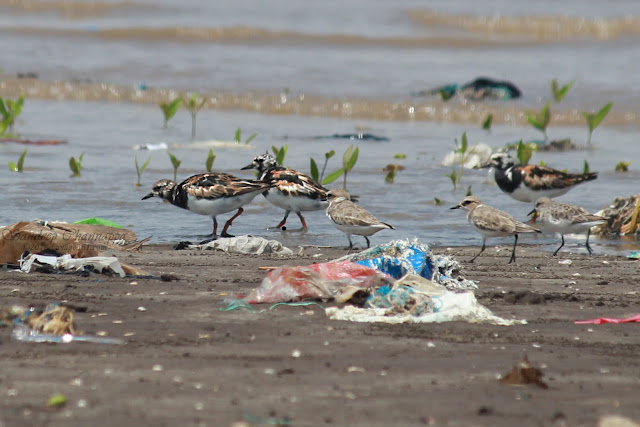 |
| Ruddy Turnstones along with the Kentish Plovers and Little Stint |
At the edge of the shore were a group of
Eurasian Oystercatchers. I didn't proceed further, as it would interfere the birds resting on the ground. So decided to head back and also the tides were started to rise quickly. The flock of Gull-billed Terns were still seen resting on the ground. I started to walk towards them to get a closer sight and spotted few
Terek Sandpipers foraging in the water, along with them
River Tern and
Common Tern were also seen.
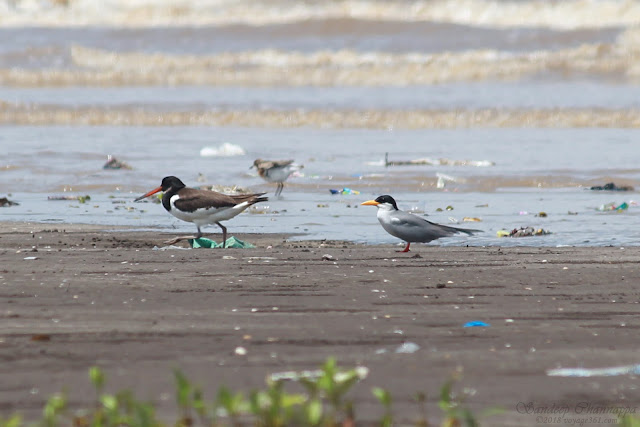 |
| River Tern and Eurasian Oystercatcher |
I was lucky to spot an Eurasian Oystercatcher at a close distance. So decided to lie-down on the ground to make myself less visible to the bird. It started to approach towards me along with Terek Sandpiper and River Tern. Slowly the sand plovers and little stints joined the party.
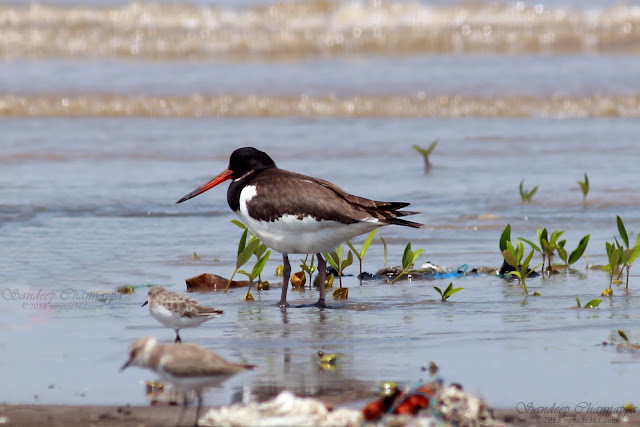 |
| Eurasian Oystercatcher, also are the Little Stint and Kentish Plover |
By this time one flock of Gull-billed Tern started to fly away and another flock also flew away after few minutes.
 |
| One flock of Gull-Billed Terns flowing away over another flock resting on the grounds |
After having shot to my heart’s delight and the sun starts to beat down heavily, I decided to call off for the day. This birdwalk was one of the most rewarding for me, it yielded me with seven lifers.


Comments
Post a Comment