Aurangabad - II: Ajanta - Paintings of cave 1 & 2
Cave temples of Maharashtra:
Maharashtra is famous for its cave temples, there are over a thousand caves found in the state, out of which three are declared as UNESCO world heritage sites. Maharashtra is home for the cave temple architecture and is housed with maximum cave temples in India. These caves dating back from 200B.C to about a thousand years A.D, are scattered right from the west at Elephanta till the Ajanta towards the east. Aurangabad and Mumbai Districts hold the majority and prominent ones.
The most important of them are listed below in there order of significance,
1. Ellora caves, Aurangabad
2. Ajanta Caves, Aurangabad
3. Elephanta caves, Mumbai
4. Pandavleni Caves/Trirashmi Caves/ Nashik Caves, Nashik
5. Bhaja caves, Pune
6. Kanheri Caves, Mumbai
7. Aurangabad caves, Aurangabad
8. Lenyadri Caves, Pune
9. Pitalkhora Caves, Aurangabad
10. Karla Caves, Lonavala
11. Bedse Caves, Pune
12. Mahakali Caves, Mumbai
13. Pataleshwar cave temple, Pune
1. Ellora caves, Aurangabad
2. Ajanta Caves, Aurangabad
3. Elephanta caves, Mumbai
4. Pandavleni Caves/Trirashmi Caves/ Nashik Caves, Nashik
5. Bhaja caves, Pune
6. Kanheri Caves, Mumbai
7. Aurangabad caves, Aurangabad
8. Lenyadri Caves, Pune
9. Pitalkhora Caves, Aurangabad
10. Karla Caves, Lonavala
11. Bedse Caves, Pune
12. Mahakali Caves, Mumbai
13. Pataleshwar cave temple, Pune
History:
Ajanta caves are more popular for its paintings and facades, and are the finest surviving example of Indian art. Ajanta caves are all Buddhist caves dating back to 200 B.C. After the decline of Buddhism, the caves of Ajanta were completely abandoned and gradually forgotten by the world, but the rediscovery in 1819 was accidental, a British hunter who had gone for an expedition in the valley sighted the upper part of the façade of cave 10, only then the hidden treasure of the magnificent fine arts was unveiled to the world. This isolation has greatly contributed in the preservation of the paintings.
These Ajanta caves are unique for their fine art paintings on walls, murals, ceiling, and columns & also their façade architecture. They were declared as World Heritage monument by UNESCO in 1983.
Layout of the caves:
The Ajanta caves were excavated in horse-shoe shaped bend of rock, between 200 B.C and 650 A.D, by two dynasties Satavahanas and Vakatakas. Out of the 30 caves, five (cave 9, 10, 19, 26, 29) are Chaityarihas (temples) and the rest are vihars. Among these 30 caves, Six (Cave 8, 9, 10, 12, 13, 30) caves belong to Hinayana phase (earliest phase of Buddhism), and the remaining are Mahayana phase.
The location of the caves is peaceful and serene surrounded by dense forests and Waghora River overlooking the caves. One more interesting aspect of the river is it descends down the hill giving rise to seven waterfalls before joining the stream at the foot of the cave hill, hence this waterfalls is known as Sapta Kund. This waterfalls flows in glory during the. Over these watchtowers, one can get a panoramic view of the entire range of caves along with the forest and river spread across the valley.
Paintings:
The prominent colors used in the paintings are green, blue, yellow, black, white and red. Ajanta paintings are best example of tempera technique, executed after elaborate preparation of rock surface. After chiseling rock surface, different layers of clay mixed with ferruginous earth, sand, fibrous material of organic origin were applied very carefully. Then the surface was finally finished with a thin coat of lime wash. Over this surface, outlines are drawn boldly, then the spaces are filled with requisite colors in different shades and tones to achieve three dimensional effect of rounded and plastic volumes. The pigments used for the paintings are kaolin, shell white, lead white, red ochre, yellow ochre, lapis lazuli (for blue) etc.
Travelogue:
If you are planning to visit both Ajanta and Ellora, then I would suggest to start from Ajanta as it gives a view of prehistoric and then passes by various dynasties.
Ajanta caves are about 110km from Aurangabad. The road from Aurangabad to Ajanta is good at times but most of its stretch has potholes. We left our hotel from Aurangabad a little late reason being a prolonged wait for hot breakfast, second time unlucky the cab got punctured and we were almost lost hopes of seeing the human marvels. Only after 10am we reached the parking lot of Ajanta. The place is maintained very well by ASI (Archeological Survey of India), the private vechicles are not allowed beyond this place, and one has to walk about five mins through the shopping area to reach the shuttle bus stand. From here the A/C buses take you till the foot of the hill. Once you enter the ticketing counter, no street sellers are allowed, keeping the whole place clean and peaceful. There is a MTDC restaurant here, after that one can either take the route passing the river or ascend up the hill starting from cave 1, the later route is more advisable. There are porters available for elderly people who cannot climb the steep rock cut steps. Also there is toilet facility available over here.
The caves over here are numbered according to their accessibility and is in series and nothing significant about its digits. All the 30 caves are distributed along the horseshoe bend in about 350m in length. The total distance from the Shuttle bus stand till the farthest cave is about 750m.
If you don’t have enough time to go about all the 30 caves then it is convenient to round off only the below highlights based on one’s interest.
In each of these caves you can find many guides who can take you on tour with their knowledge. Also many of these caves are still being worshipped and are not allowed to wear footwear while entering the cave. One more significant thing to notice here is clicking photos with flash an offence, since the camera flash can damage the paintings over a period of time. Also tripods are also not allowed inside the caves. There are dustbins kept in front of every cave, so you can’t show your laziness in littering around. All the caves are under supervision and the significant ones are being monitored thoroughly.
Highlights:
Cave 4 being the largest
Cave 1, 17 and 2 has the best preserved paintings
Cave 9 and 10 being the oldest
Cave 19 has the most beautiful façade
Cave 26 has the finest monuments
Cave 6 double storeyed monastery
The best examples of paintings of Mahayana phase are 1,2,17 and of Hinayana phase are 9 and 10
Note: On priority of their importance, the must see are in this order; cave 1, 10, 2, 17.
The paintings of Ajanta can be categorized as below,
Ceiling paintings: The ceiling decoration invariably consists of decorative patterns, geometrical as well as floral and also contains plants, fruits, birds, animals, and also mythical animals, depicting the eternal beauty of nature.
Wall paintings: The main theme of the paintings is depiction of various Jataka stories, different incidents associated with the life of Lord Buddha, and the contemporary events and social life.
So here I take you to the pre Christ period to about 600 A.D in the following cave experience.
Cave 1:
Built in the Mahayana Phase datable to 4th – 5th centuries A.D is a Buddhist monastery (Vihara). This cave is considered to be the finest among the rock cut temples of India for its fine Art. The entire wall space and ceiling along with the pillars in this cave was once painted. Much of them have skinned-off, but the outline of the story telling has survived, although this has best preserved paintings compared to other Ajanta caves.
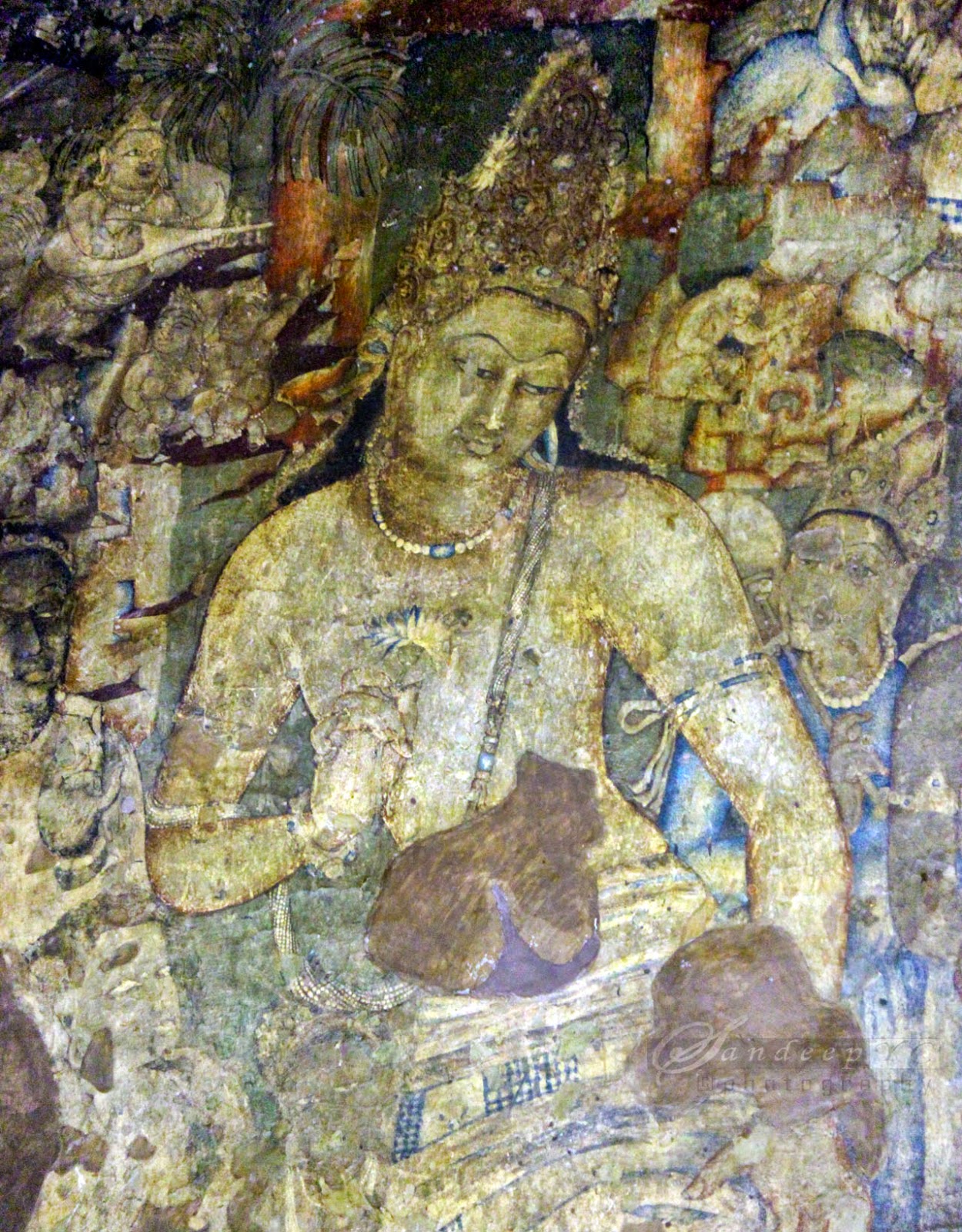
Some of the prominent paintings of this cave are Boddhisatva Padmapani, Boddhisatva Vajrapani, Mahajanaka Jataka, Sibi Jataka, Samakhapala Jataka, and Champeya Jataka. The entire ceiling has well preserved floral and mythical paintings, giving an elegant and artistic perspective of the cave.
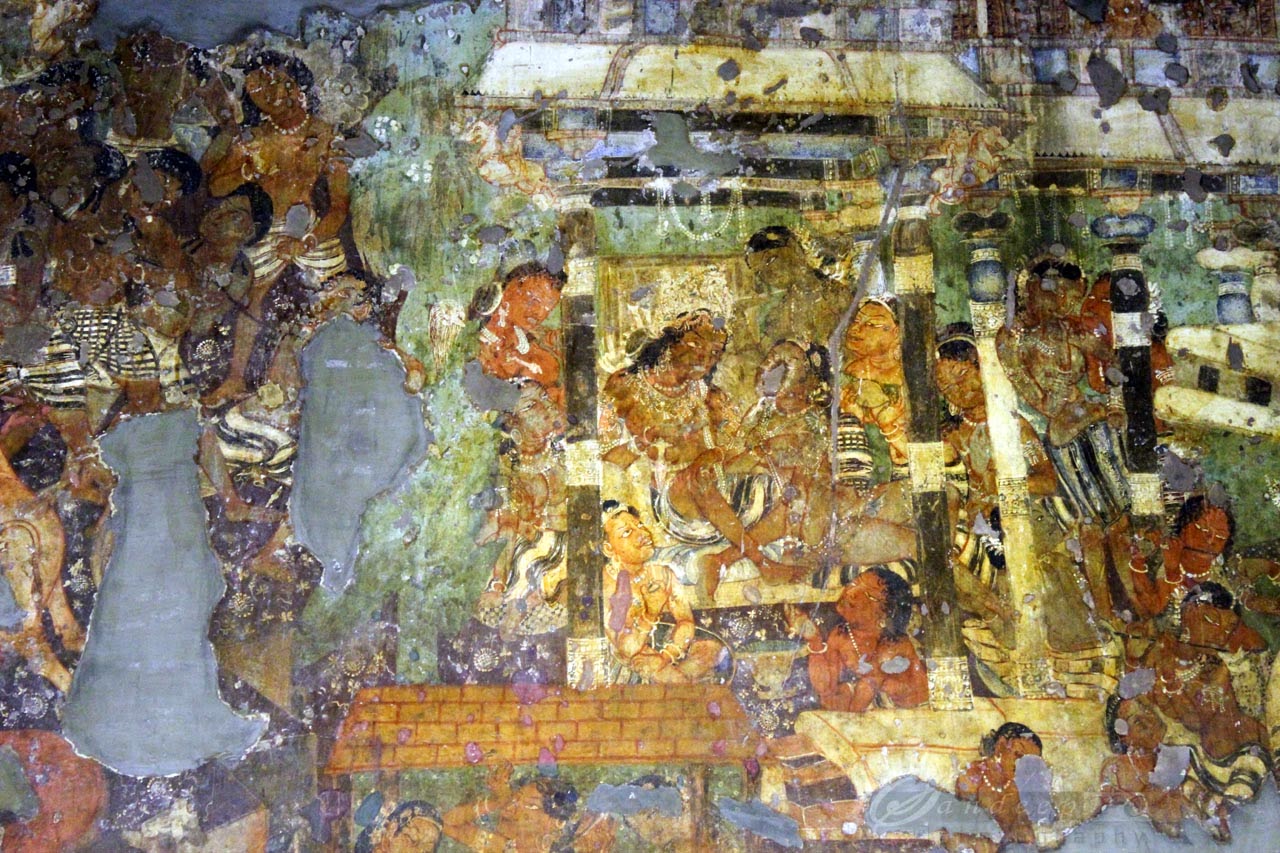
Mahajanaka Jataka: This story is well preserved. Once the Buddha was born as a king Mahajanaka. The story commences from the palace-scene. The king and the queen Sivali are seated in a magnificient palace. The king is extremely sad on realizing the futility of the worldly life. In the next scene the queen arranged a dance-show for him, but he is unmoved and unconvinced.
 |
| Mahajanaka Painting at cave 1 |
 |
| Mahajanaka Painting at cave 1 |
Below is the painting of Mahajanaka Jataka, showing the prince reluctant to lead a life of idle pleasure and his wife’s attempts to lure him away from the monastic path with music and dance.
 |
| Mahajanaka with Sivali, Mahajanaka jataka, Mahayana phase |
Boddhisatva Padmapani: This portrait is undoubtedly considered the pride of Indian Fine Arts. The colossal size of the figure of the Bodhisattva graceful pose, refined expression and appropriate colour combination at once capture the attention of the viewer. The body of the Boddhisatva is an ideal specimen of the perfect physical features of a man. The facial features are more elegant. The body of the Bodhisatva is adorned with a pearl and sapphire necklace, studded with the finest gems. The triflex (tribhanga) posture in his body seems to be adopted from the dancing attitude. In his right hand he holds a blue Lotus, which indicates the purity of his heart and character.
 |
| Bodhisatva Padmapani, Mahayana phase |
 |
| Ceiling Paintings |
 |
| Interesting Paintings on the Ceiling |
 |
| Wall Paintings at Cave 1 |
 |
| Cave 1 - entrance |
Cave 2:
This is a Mahayana monastery excavated between 500-600 A.D. Watch out for the paintings on ceilings and the walls. Even the pillars and verandah were also once painted in glory. The paintings in this cave is less preserved compared to cave 1 and 17. The most significant painting in this cave is the Miracle of Sarasvati, and Vidhurapandita & Ruru.
The paintings contain some of the finest circle designs drawn in contrasting colors, which still retain their brightness and lustre.
 |
| Amazing art on the ceilings |
The paintings on the ceilings are similar to that of Cave 1
 |
| Ceiling paintings |
 |
| Buddha as a Boddhisatva in Vidhurpandit Jataka |
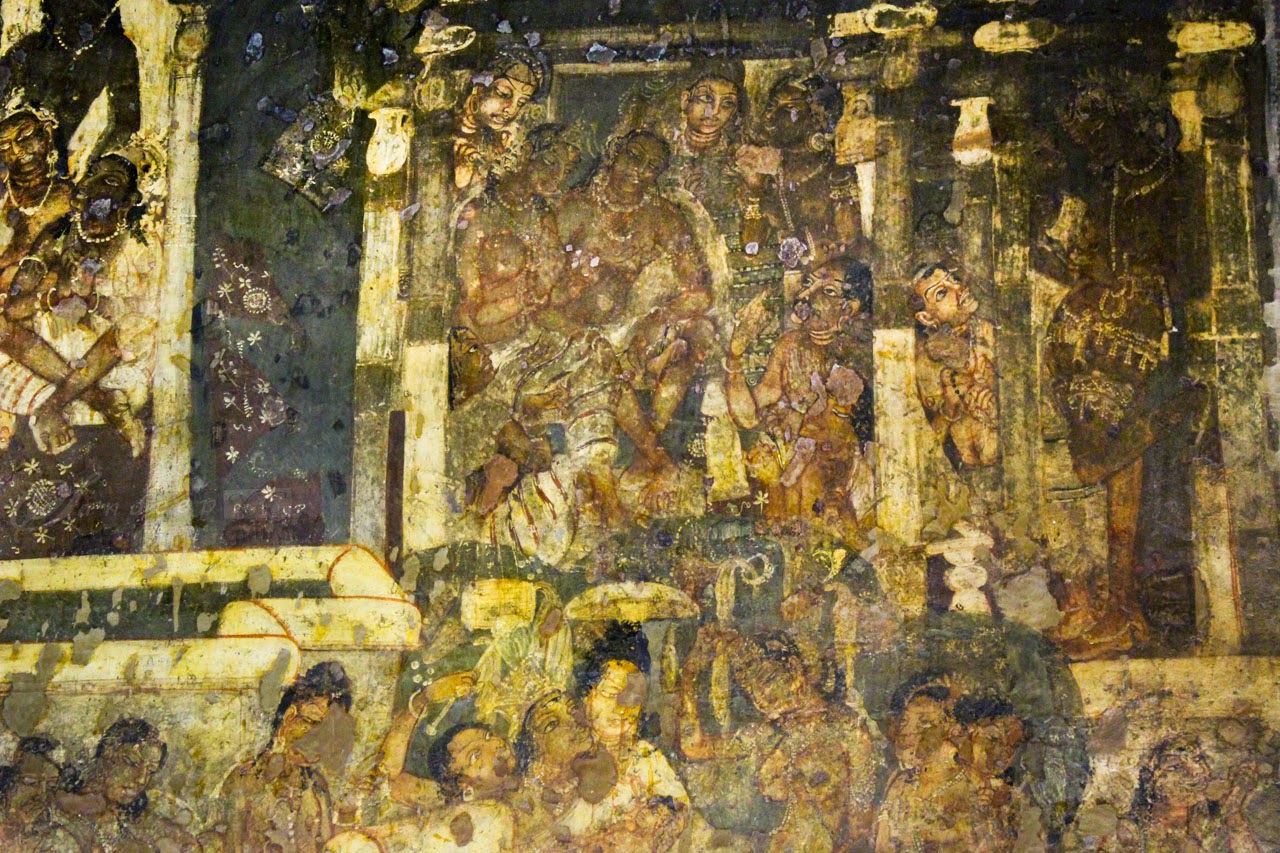 |
| Queen Mother Maya stands musingly between 2 Pillars |
 |
| Bodhisattva of Tushita Heaven before his descent to earth |
Miracle of Sarasvati: This was the miracle exhibited by Buddha, by appearing before the assembly in a seated meditation attitude on lotus, in a multitude appearance of a thousand figures. This has been depicted on the walls of the Ajanta cave 2, though not a thousand images but very high in numbers.
 |
| Miracle of Sarasvati |
 |
| Paintings on the pillars |
 |
| screens were covered to protect paitings on the verandah |
Yes, Ajanta-Ellora deserves to be nominated for Wonders of the world
ReplyDeleteSee all our wide range of Wall Mural Designs which will Enhance The Beauty Of Your Home or Office, also have large choice of Painting prints from world promising fine art painters. http://dreamwall.in/
ReplyDeleteSee all our wide range of Wall Mural Designs which will Enhance The Beauty Of Your Home or Office, also have large choice of Painting prints from world promising fine art painters. http://dreamwall.in/
ReplyDelete