Aurangabad - II: Ajanta - Cave 19, 21, 23, 24, 26
Cave 19:
This cave has the most beautiful façade of the all of Ajanta caves. This chaityagriha (16.05 X 7.09 m) was excavated in 5th century A.D of the Mahayana phase. The stupa is carved with a standing image of Buddha.
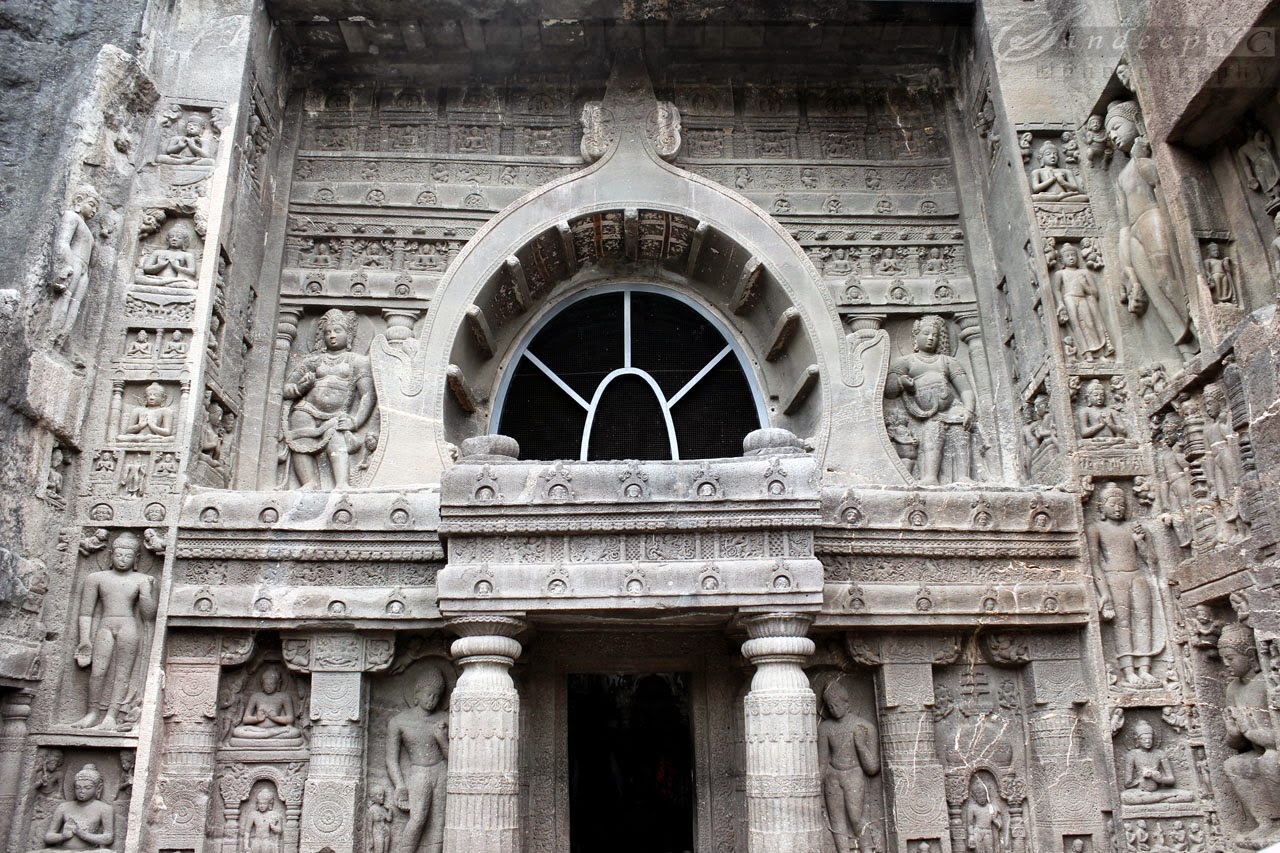 |
| Exquisite facade of the Cave 19 |
The façade has a portico standing on two pillars, above this is a horse-shoe shaped chaitya arch-window. On either side of the chaitya window are the imposing sculptures of Yakshas which are notable for their ornate jewelry and interesting hair styles. There is Buddha images on either sides of the entrance and the whole façade is ornate with sculptures. This cave is one of the best specimens of Buddhist rock cut architecture.
 |
| Ornate sculptures on the facade |
The entire cave was once painted including the pillars, walls and the vaulted ceiling. Traces of paintings can be see even today. The space between the vaulted ceiling and the pillars, is filled with beautiful sculptures.
 |
| The ornate pillars and the vaulted ceiling of Cave 19 |
 |
| The painted sculptures above the columns |
 |
| Buddha Image |
 |
| Traces of paintings at Cave 19 |
The caves 20-25 are not of much importance and are sometimes unfinished.
Cave 20:
A pillar less monastery consists of hall (16.2 X 17.91 m) cells, sanctum sanctorum and a pillared verandah datable between A. D. 450 and 525. A Brahmi inscription in the verandah records the gift of the mandapa by one Upendra. Buddha in preaching attitude is housed in the sanctum. The sculpture of seven Buddhas accompanied by attendants is another important sculptural panel in this cave.
 |
| Cave 20 verandah |
Cave 21:
This monastery (28.56 X 28.03 m) was excavated during 6th century A.D. It consists of pillared verandah (pillar’s restored now), a hall with twelve pillars and twelve cells on three sides, sanctum with an ante-chamber. Out of 12 cells four are with pillared porches. The sanctum houses a seated Buddha in preaching pose. Traces of paintings are noticed depicting Buddha preaching a congregation.
 |
| Cave 21 entrance |
 |
| Inside cave 21 |
Cave 22:
This monastery (12.72 X 11.58 m) is small and unfinished, you can find traces of paintings inside the cave.
Cave 23:
This is an unfinished monastery (28.32 X 22.52 m) and consists of an astylar hall, sanctum sanctorum, antechamber & side cells and a pillared verandah. The cave is known for the rich decoration of pillars and pilasters and the naga doorkeepers.
 |
| Cave 23 Verandah |
 |
| Sculptures in Cave 23 |
Cave 24:
This is an incomplete monastery (29.3 X 29.3 m) and second largest excavation at Ajanta after Cave 4. The plan consists of a hall with pillared verandah and sanctum sanctorum. A chapel with pillared porch is excavated outside the verandah. In this cave we can see the technique of excavation. The ceiling is finished, but the unfinished floor along with the columns indicate the method of excavation.
 |
| Cave 24 |
 |
| Uncompleted cave 24 |
Cave 25:
This is a small monastery (11.37 X 12.24 m) excavated at a higher level and is not of much importance.
Cave 26:
This Chaityagriha is quite similar to cave 19, but in a larger dimension (25.34 x 11.52m). While cave 19 has a more exquisite façade, cave 26 is famous for its sculpted figures. This cave has the best sculptures in all of Ajanta caves. . An inscription (A.D. 450 – 525) found on the wall of the front verandah records the gift of this chaityagriha by a monk Buddhabhadra, a friend of Bhavviraja, a minister of the king of Asmaka (Vidarbha). The chaityagriha consists of a hall, side aisles (pradikshana) and a rock-cut stupa front by an image of Buddha in seated pose. The façade, the inner pillars, the triforium (between pillars and roof arch), aisles side walls are extensively carved with images and decorative designs.
 |
| Sculptures on the facade of Cave 26 |
The ceiling and pillars of the verandah have been collapsed. This cave was once painted, only traces can be found.
 |
| The Amazing facade of the cave 26 |
The colossal reclining Buddha: the most striking and prominent image of cave 26 is that of Mahaparinirvana of Buddha on the right aisle wall which is about 7m in length. Reclining Buddha preparing to enter Nirvana. In the scene above are the celestial creatures rejoicing for the arrival of the Holy Spirit in the heaven, whereas the creatures on the earth shown in below part are moaning at the death of the holy being.
 |
| The colossal reclining Buddha |
The assault of Mara: the assault of Mara during Buddha’s penance adorns the same wall, depicting the temptation of Mara (devil). In this exquisite sculpture at the center is the Buddha seated under the Pupil tree at Bodh Gaya. Mara (lord of passions) came to Buddha tempting him to abandon his meditation, but it went in vain. On Buddha’s right is the army of the daemons of Mara trying to attack Buddha and scare him by their frightful presences, but Buddha was unaffected. In the scene below depicts the angry devil bringing his beautiful daughters to seduce Lord Buddha, with sensual delights, which made Lord Buddha unmoved. So finally the retreat of Mara’s army is delineated to the left of Buddha. Ultimately Lord Buddha overcame all the obstacles and attained enlightenment (Bodhi).
 |
| The assault of Mara and Buddha attaining enlightenment |
 |
| Series of sculptures appearing as open Museum at cave 26 |
 |
| The ornate columns and the vaulted ceiling |
 |
| Traces of paintings at cave 26 |
 |
| Detailed and delicate Sculptures above the columns |
This is the last cave which is of significance, the rest can be skipped.
Cave 27:
It consists of two storeys, the upper one partially collapsed. This cave was closed for renovation.
Cave 28:
This is an unfinished monastery of which only the pillared verandah was excavated, and the path to this cave was also closed.
Cave 29:
This is an unfinished Chaityagriha (22.8 X 12.84 m) and located at the highest level, located between Caves 20 and 21.
Cave 30:
Located between Caves 15 and 16 and is the Smallest of all the excavations at Ajanta this cave.
 |
| Map of Ajanta caves and the shuttle bus details |
By the time we completed cave 26 it was already lunch time and we started walking down to the MTDC restaurant near the ticket counter. The lunch was served quickly and was delicious. Quickly we started to walk back and the shuttle bus was waiting, we got the bus and in ten mins we were at the parking area and did our shopping for some antiques and reached our cab, but our cab driver didn’t turned up even after calling him, we had a guess that he is deliberately doing this to avoid us taking to Ellora on the same day, maybe he wanted us to extend our tour for one more day to cover Ellora. But I fixed with my plans. It was about 2pm when the driver turned up, after waiting for about 20mins for him. We then asked the driver to take us to Ellora, and he initially disagreed saying it is very far and we won’t be able to make it up, but I was a little angry this time and said him to please take us to Ellora even if we reached there at 5pm, as it is just 30km away from Aurangabad and it won’t be extra burden. He finally agreed to drive to Ellora but on a condition that he won’t switch on the A/C. We didn’t bother about the A/C, though I needed at least an hour to just glance around Kailasha temple.
Our next journey was Ellora
Comments
Post a Comment