The Legacy of Pallavas, Mahabalipuram-Part II: Caves and Sculptures

The Legacy of Pallavas, Mahabalipuram-Part II: Caves and Sculptures

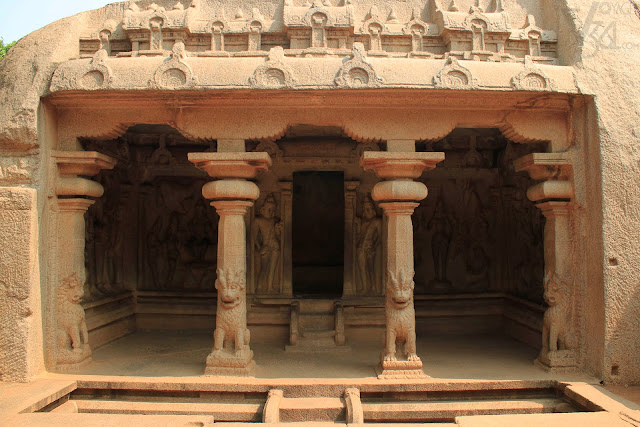
The second and the largest complex at the Mahabalipuram hosts many cave temples and bas-reliefs.  The monuments in this complex are scattered across on the hillock and one have to walk for more than a kilometer to cover all the monuments. On a shorter visit, do visit the Mahishasuramardini and Varaha cave temples, Descent of the Ganges and the Krishna Mantapa.
"Descent of the Ganges" - largest open-air bas-relief in the world
We started with Olakkannesvara Temple which is built on top of the Mahishasura mardhini cave, it also served as a light house overlooking the Coromandel Coast of the Bay of Bengal. During the 7th century Mahabalipuram served as a major port for the Pallavas.
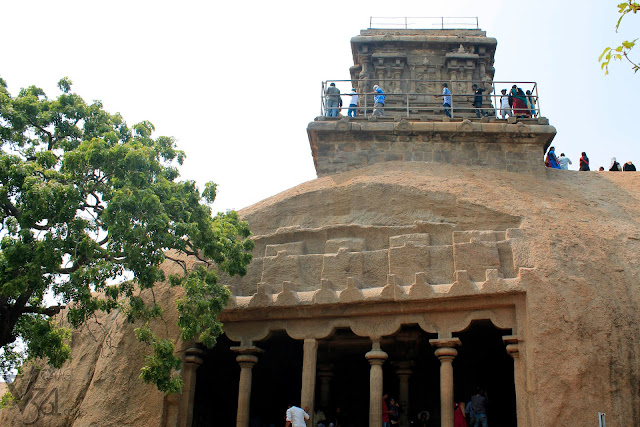
Olakkannesvara Temple on top of the Mahishasura mardhini cave
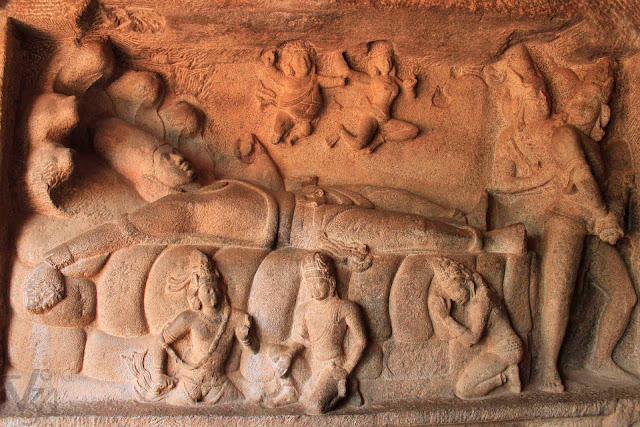
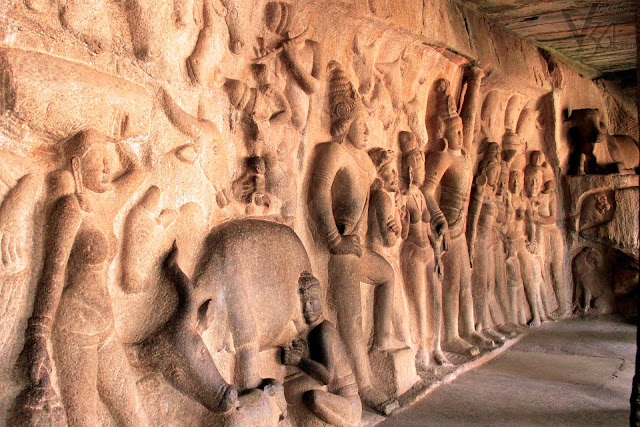
Mahishasuramardini Mandapa is a rock-cut cave temple with large exquisitely carved reliefs on its interiors, the prominent ones are the goddess Durga slaying the buffalo headed Mahishasura and on the other side is the panel of Adisesha - Vishnu reclining on the seven hooded serpent.
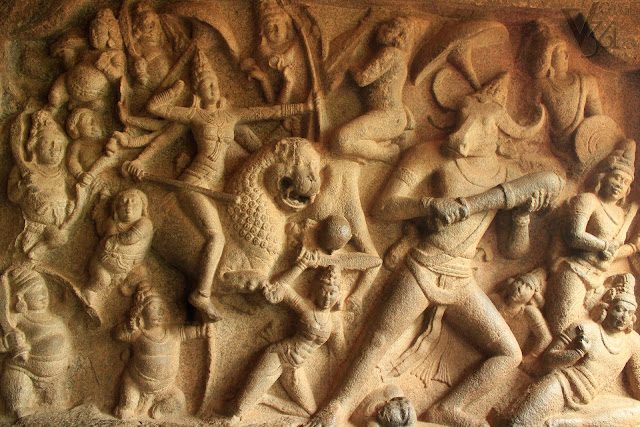
Large panel of goddess Durga slaying the buffalo headed Mahishasura
Another large carved panel inside the Mahishasura mardhini cave depicting Adisesha - Vishnu reclining on the seven hooded serpent.
Another large carved panel inside the Mahishasura mardhini cave depicting Adisesha - Vishnu reclining on the seven hooded serpent.
Further on the way are the Ramanuja Mantapa and Raya gopura, leading our way to the Varaha Cave Temple
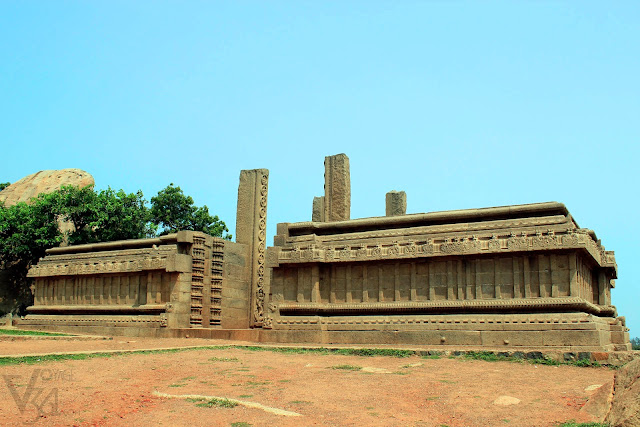
Ramanuja Mantapa, originally a shiva cave temple
Raya Gopuram on the way towards Varaha Cave
The most prominent sculpture in the Varaha cave temple is that of Lord Vishnu in the incarnated form of a Varaha or boar lifting Bhudevi, the mother earth goddess from the sea. On the other side of the wall is a sculpture panel of Vishnu as Trivikrama. On the eastern wall are the panels of Goddess Lakshmi and another of Goddess Durga standing on a lotus.
Varaha Cave temple with the panel of Lord Vishnu in the incarnated form of a Varaha or boar lifting Bhudevi
Sculpture panel of Vishnu as Trivikrama
Varaha cave temple with panels of Goddess Lakshmi (left) and another of Goddess Durga standing on a lotus (right)
There is also an interesting natural rock boulder over the hillock called as the Krishna's butter ball. This is a massive rock about 5 meter in diameter in the shape of a ball, balanced on the slope of the hill which is inclined at an angle of 45 degrees. Legend has it that it has sustained elephants pull and tsunamis but still standing still.
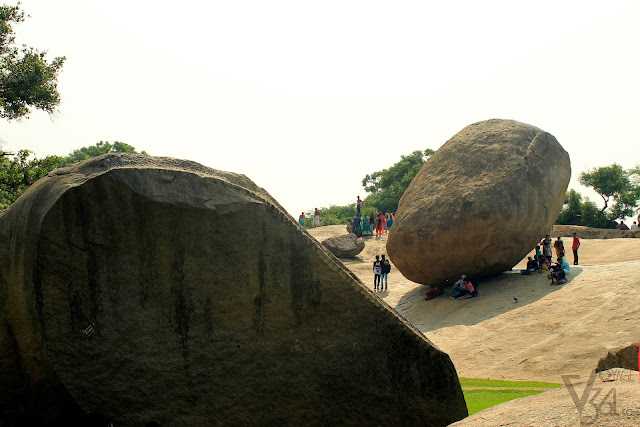
Krishna's butter ball - The Balancing rock of Mahabalipuram
Krishna's butter ball - The Balancing rock of Mahabalipuram
The last one in the path was the Trimurti Cave Temple, which is less visited by tourists due to its isolation from other monuments. The cave temple has three shrines dedicated for Brahma, Vishnu and Maheshwara (Shiva).
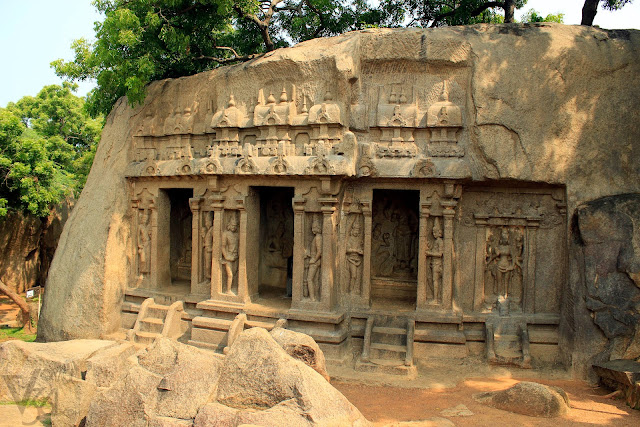
Trimurti cave temple
Further down the hillock on the West Raja street is the largest open-air bas-reliefs in the world, Descent of the Ganges and Arjuna's Penance. It represents the legend of the descent of the sacred river Ganges to earth emerging from Shiva's head and flowing in between the two huge boulders and about 146 characters are carved out to represent animals, half-humans, people and gods. Most notable piece of art is the life size panel of elephant herd including adult and baby elephants moving towards the river to drink water.
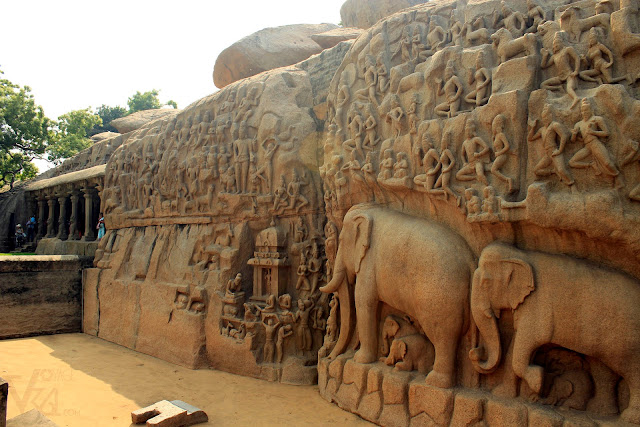
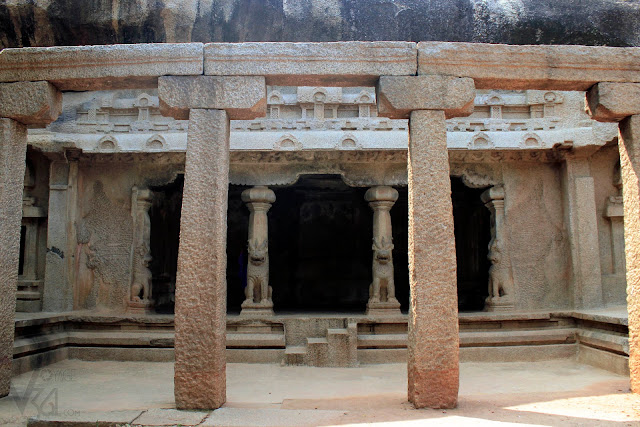
Descent of the Ganges bas-relief and the adjoining Panchapandava cave
Life size panel of elephant herd moving towards the river ganges


The cave temple adjoining the open-air bas relief is the unfinished Panchapandava Mandapa, which is also the largest cave temple length-wise in Mahabalipuram. The columns of the verandah have lion bases which is typical to Pallava style of architecture. There are six pillars and two pilasters on the front facade of the cave temple.


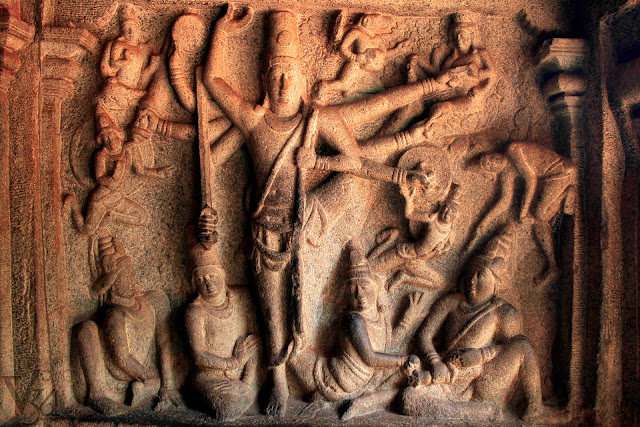
Krishna Mantapa is another masterpiece beside the Panchapandava Mandapa, originally an open air bas-relief dedicated to lord Krishna but later enclosed within a mantapa during the Vijayanagara rule in 16th century. The bas-relief in the mantapa has sculptured panels of Krishna lifting the Govardhana hill to protect the gopis (milkmaids) and cowherds from floods.
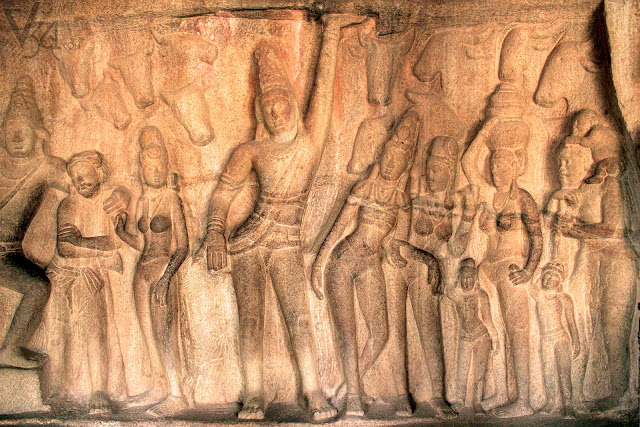
Bas-relief of Govardhandhari
Panel of Krishna lifting the Govardhana hill to protect the gopis (milkmaids) and cowherds from floods

Entry ticket and Parking fee: Entry is free. Car parking is on the road and is free.
Timings: Sunrise to Sunset, typically 6:00 am to 6:00 pm.


Tiger cave:
Tiger cave is another interesting Pallava monument about 5 km north of Mahabalipuram on the Mahabalipuram-Chennai Highway. It is definitely worth the visit, as the cave is unique compared to typical Indian cave temples. It has carvings of tiger heads on the mouth of a cave, eleven in total; five on either sides and one in the middle. There is a pavilion at the center, which was probably used as a platform for hosting events. The beach near the tiger cave is also popular among tourists.
Tiger cave
Tiger cave
Tiger cave beach
Tiger cave beach
Standing rock formation near the tiger cave

Entry ticket and Parking fee: Entry is free. Car parking is ₹30, ample parking is available.
Timings: Sunrise to Sunset, typically 6:00 am to 6:00 pm. The gates at the beach closes before 6 pm.

More on Mahabalipuram Click below:
The Legacy of Pallavas, Mahabalipuram-Part I: Rathas

The Legacy of Pallavas, Mahabalipuram-Part III: Shore Temple

Comments

Popular posts from this blog

Micromax Canvas 2 A110 Hands on Review

Micromax Superfone Canvas 2 A110(Jet Black/Calm White): After using it for a week, I felt pretty good about my decision for going with a new brand like Micromax over the mighty Samsung Galaxy S Duos and Sony Tipo Dual. Particularly not sure about its reliability but the build quality looks pretty decent. Below are my ratings for the phone aka Phablet. Build Quality (8/10): The build quality was above my expectations keeping in mind of the price tag, from front it looks just like a Galaxy high end smartphone like SIII or Note II. It has a matte finished back cover which is good for protection towards scratches and there is a metal casing all around the phone, which adds up the beauty of the phone. One more advantage of this phone is it has a touch home button instead of a hard button as seen in iPhone and Galaxy phones. Camera (5/10): [8MP autofocus (Tap to Focus), dual flash, supports up to 3264x2448 pixels, Panorama] Don't fall for the specs as it is said...

Trip to the Misty Hills of Kudremukh

Trip to the Misty Hills of Kudremukh: About Kudremukh: Kudremukh National Park is the second largest protected wildlife area in the Western Ghats (around 600 sq.kms). Three important rivers of Karnataka, the Tunga, Bhadra and Netravathi are said to have their origin in this area. Mist covered roads in Kudremukh All these can be reached within 80km. We first started with sringeri, which is famous for its Vidyashankara temple built in1342 AD. Reached Sringeri at 11am. There is a bridge Sri Vidya Teertha Setu across the Tunga river which connects from Vidyashankara temple to Sringeri Mutt. We had prasadam (lunch) at the mutt. There is one more temple called as Sharadamba temple which has lovely architecture built inside and photography is banned inside. The whole temple area is kept very clean and it was a pleasant experience to spend time in the temple complex. We then left at 12.30pm towards Kudremukh. Vidyashankara temple  Vidyashankara temple  Vidyas...

5 Places in Maharashtra you must visit atleast once

5 places in Maharashtra you Must Visit At Least once Maharashtra is a state best described as a land of cave temples, hilltop forts, and Mountains. Best time to explore them are the monsoons and post monsoons, definitely not in summers. These 5 places in Maharashtra are a must visit, 5. Lavasa The first planned hill station in India and probably the most controversial for the deforestation reasons. Even the road from Tehghar dam till Lavasa is spectacular with forest cover and green valleys. Best time to visit is during monsoons and post monsoons. Best time of the day is after the sun goes down with the entire city lighted up, and the musical fountains adding more flavour to the evening. Lavasa City during night For more information on Lavasa CLICK HERE 4. Lonavla-Khandala Unlike Mahabaleshwar, Lonavla is a monsoon hill-station. Best time to visit is during monsoon and post monsoons (July-Dec) when the entire hill range turns into lush green grasslands and num...

Lalbagh Flower Show Jan-2012

Lalbagh Flower Show 2012 - 100th Exhibition Event :            January 20 till 29, all roads lead to the Glass House in Lalbagh Botanical Gardens. Around 10 lakh visitors are expected to visit the gardens and see a visual treat, thanks to the Mysore Horticultural Society. This flower show is the 100th exhibition of the Mysore Horticultural Society that was started by the then Superintendent of Lalbagh GH Krumbiegal in 1912. Major Attractions this time include Buddha Stupa, Floral dance forms, Floral Flow, Florance Flora Show and Diagonal floral Lines. Buddha Stupa Early Hours crowd at the Glass House GH Krumbiegal Visited the show on Sunday noon (22nd), on that day it recorded a whopping 100,000 visitors, making it difficult to capture the rich colors at the show. I could somehow manage to get a few colorful pics. It was more beautiful and creative than the previous flower shows held here. Entered the Glasshou...

Masinagudi Jungle Trails : A Road Trip to Nilgiris

Masinagudi Jungle Trails : A Road Trip to Nilgiris - II All set and packed for a long road trip to Ooty, left Bangalore late at 8am. What to pack for a long road trips?? Click here The motive of the road trip was to voyage around less explored and adventurous places, rather than popular and easily accessible tourist destinations. To avoid Mysore traffic, we tried to explore another route from Mandya through Somnathapura to Nanjangud, but it turned out to be more tiring and longer route. We reached Bandipur forest check post only by 2pm. Driving through Bandipur forest is a pleasure, with good road conditions, greenery around and spotting wildlife was more exciting. In an intention to spot wildlife, and to maintain silence in the forest, we were driving steadily at 15kmph speed without using horn. We could spot a lot of deer herds, elephants, black bear, boar, Grey Langur monkeys and peacocks.  Peacock spotted on the Bandipur Mudumalai stretch Elephant...