
Aurangabad - III: Ellora - Cave 29 & 32

Aurangabad - III: Ellora - Cave 29 & 32

The road to Ellora from Ajanta, is in a bad state. We reached Ellora by 4pm and took an auto for about 400Rs for taking around the important caves. As it was already late and we had only about 2hours, so we shortlisted to about 3-4 caves only. Since our cab driver was too lazy to take us over the route, we had decided to go with auto paying extra. Unlike Ajanta, Ellora caves are scattered around a track of over 2km. We started Ellora with cave 29, as our main plan was Kailasa Temple, we kept it for last.
For two reasons it is recommended to visit Ajanta before Ellora, the first being is the chronological order of period of their excavation and second is that the hugeness of Ellora should be felt after the detailing of Ajanta to make the entire journey exciting.
History:  The excavation of Ellora caves started when the builders gradually started shifting to Ellora during 450 – 700 A.D, following the Buddhist trend they continued to construct Buddhist caves at Ellora. The first twelve caves are dedicated to Buddhism, Later on when Buddhism started to decline in India, Ellora seen a transformation with the tradition of Buddhist caves to Hindu caves. The caves 13 to 29 represent Hinduism which were excavated during 650 to 900 A.D. The caves 30 to 34 were excavated during later stages, during 800 to 1000 A.D, which are dedicated to Jainism. Ellora caves are one of the largest rock-hewn monastic-temple complexes in the entire world. Best time to visit these caves are the monsoons, when the waterfalls will be in full glory and also in winter.
The prominent ones of the Buddhist group of caves are cave 2; cave 5, Maharvada; cave 10, Visvakarma; and cave 12, Teen Thal.
Out of the 17 Hindu caves the prominent ones are, Cave 14, Ravana-ka-khai, the demon king of Lanka; Cave 15, Das Avatar or the Ten incarnations of Vishnu; Cave 16, the great Kailasa; Cave 21, Ramesvara; Cave 29, Dumar Lena are of importance.
Lastly the prominent ones of the five Jain caves are cave 32 and 33
Since we didn’t had much time we decided to visit only caves 16, 29, 21 and 32.
The first of them which we visited was cave 29.

The Dumar Lena (Cave 29):

This marks as an important excavation at Ellora by the side of “Sita-ka-nahani” a pool created by a waterfall in the Elaganga. The shrine houses a huge linga entered through four entrances flanked by huge dvarapalakas (door-keepers). 
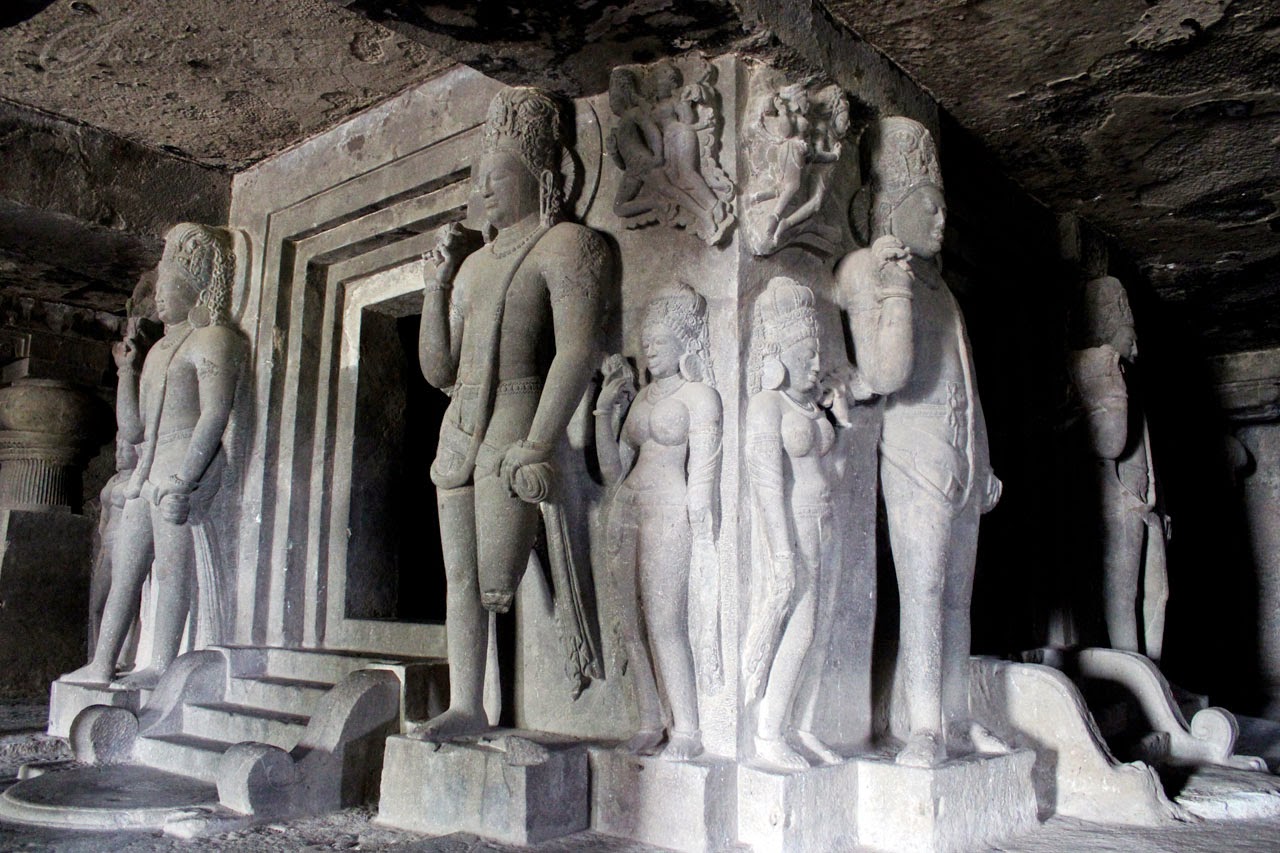
Gigantic dwarapalakas, 8 in number, each about 15ft tall surrounding the shrine
Sita-ka-nahani, at a distance are other cave temples of Ellora
The cave is huge with about 50m wide, and 5m high, with 26 giant and exquisitely caved pillars. The excavation was completed during the 7th century A.D.
The main entrance of the Cave
Massive Pillar structures inside the cave
The halls are adorned with six huge sculptural panels depicting various episodes connected with Lord Siva.
The cave temple has three entrances with lion sculptures on either sides of each entrance.
At the main entrance are the panels Ravananugrahamurti or Ravana Shaking Mount Kailasa (Siva blessing Ravana, the demon King), and Antakasuravadamurti (killing of the demon Antaka).
At the North West entrance are the panels of Nataraja (the celestial dance of Lord Siva), Lakulisa (form of Lord Siva).
At the South East entrance are the panels of Kalyanamurti (the celestial marriage between Lord Siva & Parvati), and Siva & Parvati playing chausar.
Huge panel at the south east entrance
This cave also has two enigmatic sculpted depressions, one on south and other on the north. The exact function of these depressions is not clearly understood.
one of the sculpted depression

INDRA SABHA (Cave 32):

The next one we visited was cave 32, which is located about 1km from cave 29. This cave is double storeyed dedicated to Digambar sect of Jainism, dating back to 10th – 11th century A.D. Through the entrance of Dravidian gopura, is an exquisitely carved monolithic shrine at the center of the courtyard.
Cave 32 entrance with Dravidian gopura
exquisitely carved monolithic shrine at the center of the courtyard
The court leads to multiple shrines, two on the west, one on the north and one on the east, dedicated to Mahavira. Through the Main Shrine on the north are a flight of steps which leads to the first floor. The cave was once painted. The pillars on the upper floor are notably beautiful. 
Monolithic Pillar
Monolithic Pillar
Sculptured Pillars inside the cave on the first floor


The shrine on the east is unique with its design, the doorframe acting as pillars in lifting the upper weight.
The east Shrine with door-frame pillars

The caves 33, 34 and 31 are lined up along with 32, whereas cave 30 is an unfinished excavation located a distance apart from the rest of the Jain caves, which is also known as mini Kailasa due to its resemblance with the Kailasa Cave 16.
Cave 34
Cave 34
Cave 33
Cave 33


Didn’t spend much time in exploring these, we immediately headed towards cave 21, which is about 1.2km away from cave 32. 

Comments

  1. Nice post. Ajanta caves are the famous caves in Maharashtra. maharashtraplanet.com is provide you list of caves in Maharashtra along with other places to visit in Maharashtra.

    ReplyDelete

Post a Comment

Popular posts from this blog

Micromax Canvas 2 A110 Hands on Review

Micromax Superfone Canvas 2 A110(Jet Black/Calm White): After using it for a week, I felt pretty good about my decision for going with a new brand like Micromax over the mighty Samsung Galaxy S Duos and Sony Tipo Dual. Particularly not sure about its reliability but the build quality looks pretty decent. Below are my ratings for the phone aka Phablet. Build Quality (8/10): The build quality was above my expectations keeping in mind of the price tag, from front it looks just like a Galaxy high end smartphone like SIII or Note II. It has a matte finished back cover which is good for protection towards scratches and there is a metal casing all around the phone, which adds up the beauty of the phone. One more advantage of this phone is it has a touch home button instead of a hard button as seen in iPhone and Galaxy phones. Camera (5/10): [8MP autofocus (Tap to Focus), dual flash, supports up to 3264x2448 pixels, Panorama] Don't fall for the specs as it is said...

Trip to the Misty Hills of Kudremukh

Trip to the Misty Hills of Kudremukh: About Kudremukh: Kudremukh National Park is the second largest protected wildlife area in the Western Ghats (around 600 sq.kms). Three important rivers of Karnataka, the Tunga, Bhadra and Netravathi are said to have their origin in this area. Mist covered roads in Kudremukh All these can be reached within 80km. We first started with sringeri, which is famous for its Vidyashankara temple built in1342 AD. Reached Sringeri at 11am. There is a bridge Sri Vidya Teertha Setu across the Tunga river which connects from Vidyashankara temple to Sringeri Mutt. We had prasadam (lunch) at the mutt. There is one more temple called as Sharadamba temple which has lovely architecture built inside and photography is banned inside. The whole temple area is kept very clean and it was a pleasant experience to spend time in the temple complex. We then left at 12.30pm towards Kudremukh. Vidyashankara temple  Vidyashankara temple  Vidyas...

5 Places in Maharashtra you must visit atleast once

5 places in Maharashtra you Must Visit At Least once Maharashtra is a state best described as a land of cave temples, hilltop forts, and Mountains. Best time to explore them are the monsoons and post monsoons, definitely not in summers. These 5 places in Maharashtra are a must visit, 5. Lavasa The first planned hill station in India and probably the most controversial for the deforestation reasons. Even the road from Tehghar dam till Lavasa is spectacular with forest cover and green valleys. Best time to visit is during monsoons and post monsoons. Best time of the day is after the sun goes down with the entire city lighted up, and the musical fountains adding more flavour to the evening. Lavasa City during night For more information on Lavasa CLICK HERE 4. Lonavla-Khandala Unlike Mahabaleshwar, Lonavla is a monsoon hill-station. Best time to visit is during monsoon and post monsoons (July-Dec) when the entire hill range turns into lush green grasslands and num...

Lalbagh Flower Show Jan-2012

Lalbagh Flower Show 2012 - 100th Exhibition Event :            January 20 till 29, all roads lead to the Glass House in Lalbagh Botanical Gardens. Around 10 lakh visitors are expected to visit the gardens and see a visual treat, thanks to the Mysore Horticultural Society. This flower show is the 100th exhibition of the Mysore Horticultural Society that was started by the then Superintendent of Lalbagh GH Krumbiegal in 1912. Major Attractions this time include Buddha Stupa, Floral dance forms, Floral Flow, Florance Flora Show and Diagonal floral Lines. Buddha Stupa Early Hours crowd at the Glass House GH Krumbiegal Visited the show on Sunday noon (22nd), on that day it recorded a whopping 100,000 visitors, making it difficult to capture the rich colors at the show. I could somehow manage to get a few colorful pics. It was more beautiful and creative than the previous flower shows held here. Entered the Glasshou...

Masinagudi Jungle Trails : A Road Trip to Nilgiris

Masinagudi Jungle Trails : A Road Trip to Nilgiris - II All set and packed for a long road trip to Ooty, left Bangalore late at 8am. What to pack for a long road trips?? Click here The motive of the road trip was to voyage around less explored and adventurous places, rather than popular and easily accessible tourist destinations. To avoid Mysore traffic, we tried to explore another route from Mandya through Somnathapura to Nanjangud, but it turned out to be more tiring and longer route. We reached Bandipur forest check post only by 2pm. Driving through Bandipur forest is a pleasure, with good road conditions, greenery around and spotting wildlife was more exciting. In an intention to spot wildlife, and to maintain silence in the forest, we were driving steadily at 15kmph speed without using horn. We could spot a lot of deer herds, elephants, black bear, boar, Grey Langur monkeys and peacocks.  Peacock spotted on the Bandipur Mudumalai stretch Elephant...