
Aurangabad - III: Ellora - Cave 29 & 32

Aurangabad - III: Ellora - Cave 29 & 32

The road to Ellora from Ajanta, is in a bad state. We reached Ellora by 4pm and took an auto for about 400Rs for taking around the important caves. As it was already late and we had only about 2hours, so we shortlisted to about 3-4 caves only. Since our cab driver was too lazy to take us over the route, we had decided to go with auto paying extra. Unlike Ajanta, Ellora caves are scattered around a track of over 2km. We started Ellora with cave 29, as our main plan was Kailasa Temple, we kept it for last.
For two reasons it is recommended to visit Ajanta before Ellora, the first being is the chronological order of period of their excavation and second is that the hugeness of Ellora should be felt after the detailing of Ajanta to make the entire journey exciting.
History:  The excavation of Ellora caves started when the builders gradually started shifting to Ellora during 450 – 700 A.D, following the Buddhist trend they continued to construct Buddhist caves at Ellora. The first twelve caves are dedicated to Buddhism, Later on when Buddhism started to decline in India, Ellora seen a transformation with the tradition of Buddhist caves to Hindu caves. The caves 13 to 29 represent Hinduism which were excavated during 650 to 900 A.D. The caves 30 to 34 were excavated during later stages, during 800 to 1000 A.D, which are dedicated to Jainism. Ellora caves are one of the largest rock-hewn monastic-temple complexes in the entire world. Best time to visit these caves are the monsoons, when the waterfalls will be in full glory and also in winter.
The prominent ones of the Buddhist group of caves are cave 2; cave 5, Maharvada; cave 10, Visvakarma; and cave 12, Teen Thal.
Out of the 17 Hindu caves the prominent ones are, Cave 14, Ravana-ka-khai, the demon king of Lanka; Cave 15, Das Avatar or the Ten incarnations of Vishnu; Cave 16, the great Kailasa; Cave 21, Ramesvara; Cave 29, Dumar Lena are of importance.
Lastly the prominent ones of the five Jain caves are cave 32 and 33
Since we didn’t had much time we decided to visit only caves 16, 29, 21 and 32.
The first of them which we visited was cave 29.

The Dumar Lena (Cave 29):

This marks as an important excavation at Ellora by the side of “Sita-ka-nahani” a pool created by a waterfall in the Elaganga. The shrine houses a huge linga entered through four entrances flanked by huge dvarapalakas (door-keepers). 
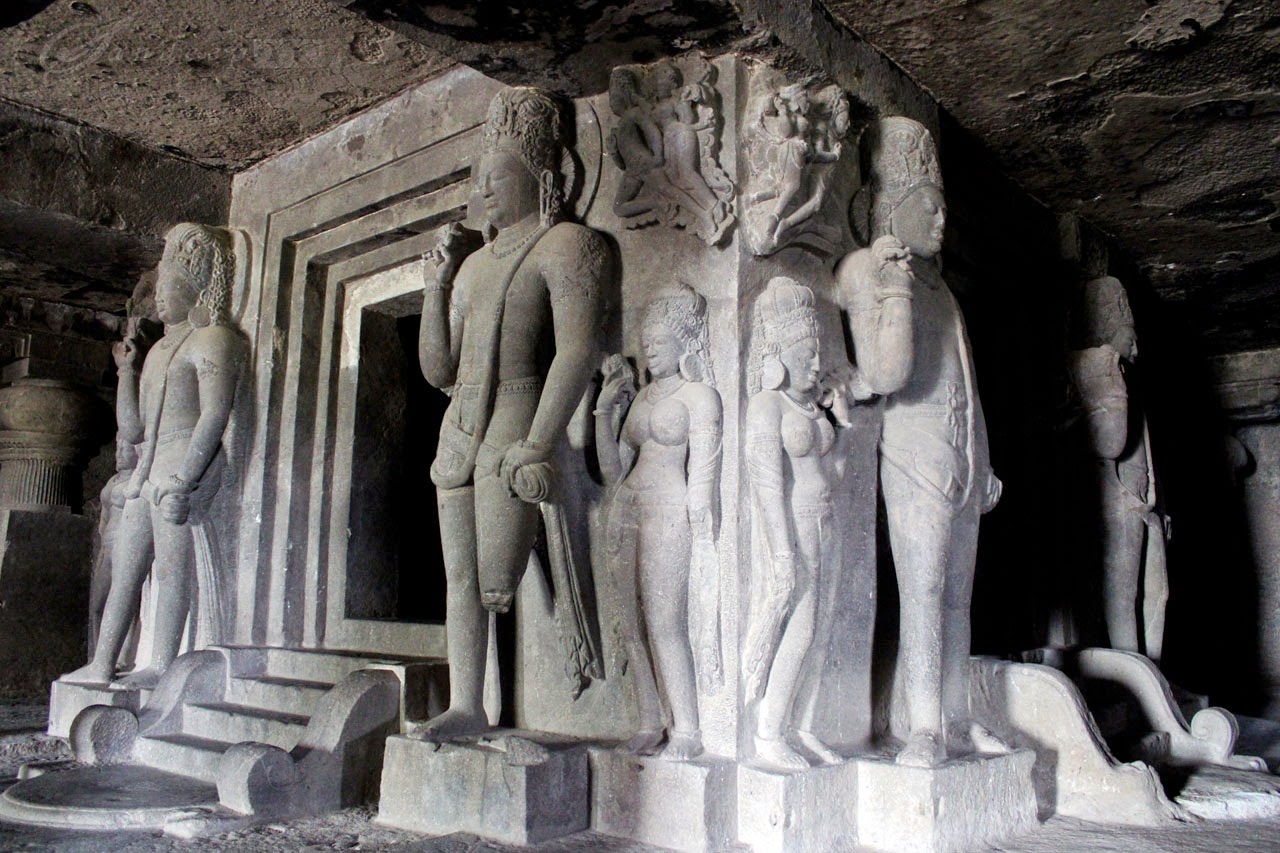
Gigantic dwarapalakas, 8 in number, each about 15ft tall surrounding the shrine
Sita-ka-nahani, at a distance are other cave temples of Ellora
The cave is huge with about 50m wide, and 5m high, with 26 giant and exquisitely caved pillars. The excavation was completed during the 7th century A.D.
The main entrance of the Cave
Massive Pillar structures inside the cave
The halls are adorned with six huge sculptural panels depicting various episodes connected with Lord Siva.
The cave temple has three entrances with lion sculptures on either sides of each entrance.
At the main entrance are the panels Ravananugrahamurti or Ravana Shaking Mount Kailasa (Siva blessing Ravana, the demon King), and Antakasuravadamurti (killing of the demon Antaka).
At the North West entrance are the panels of Nataraja (the celestial dance of Lord Siva), Lakulisa (form of Lord Siva).
At the South East entrance are the panels of Kalyanamurti (the celestial marriage between Lord Siva & Parvati), and Siva & Parvati playing chausar.
Huge panel at the south east entrance
This cave also has two enigmatic sculpted depressions, one on south and other on the north. The exact function of these depressions is not clearly understood.
one of the sculpted depression

INDRA SABHA (Cave 32):

The next one we visited was cave 32, which is located about 1km from cave 29. This cave is double storeyed dedicated to Digambar sect of Jainism, dating back to 10th – 11th century A.D. Through the entrance of Dravidian gopura, is an exquisitely carved monolithic shrine at the center of the courtyard.
Cave 32 entrance with Dravidian gopura
exquisitely carved monolithic shrine at the center of the courtyard
The court leads to multiple shrines, two on the west, one on the north and one on the east, dedicated to Mahavira. Through the Main Shrine on the north are a flight of steps which leads to the first floor. The cave was once painted. The pillars on the upper floor are notably beautiful. 
Monolithic Pillar
Monolithic Pillar
Sculptured Pillars inside the cave on the first floor


The shrine on the east is unique with its design, the doorframe acting as pillars in lifting the upper weight.
The east Shrine with door-frame pillars

The caves 33, 34 and 31 are lined up along with 32, whereas cave 30 is an unfinished excavation located a distance apart from the rest of the Jain caves, which is also known as mini Kailasa due to its resemblance with the Kailasa Cave 16.
Cave 34
Cave 34
Cave 33
Cave 33


Didn’t spend much time in exploring these, we immediately headed towards cave 21, which is about 1.2km away from cave 32. 

Comments

  1. Nice post. Ajanta caves are the famous caves in Maharashtra. maharashtraplanet.com is provide you list of caves in Maharashtra along with other places to visit in Maharashtra.

    ReplyDelete

Post a Comment

Popular posts from this blog

Sky Islands to the Pacific shores - Part 1: The Sky Islands of Southeastern Arizona

In August 2026, I crossed the Atlantic to chase a long-cherished dream, stepping into the vast, untamed birding horizons of the American Wild West. Across a sweeping route through Arizona, Texas, Utah, and California, I logged 108 total species -  the vast majority of them absolute lifers for me! While the landscapes were vast and the wildlife was extraordinary, what truly made the Arizona portion of the trip unforgettable was the incredible warmth of the local birding community. At almost every trail, feeding station, and wetland, I met welcoming, friendly locals who were quick to share site tips, point out hidden roosts, and make a first-time visitor feel right at home. While North America’s diverse habitats delivered endless surprises, it was Arizona's high-desert canyons, towering rims, and lush riparian corridors that anchored the trip. Here is a location-by-location breakdown of the top birding hotspots, standout avian highlights, and unexpected wildlife encounters from the A...

Sky Islands to the Pacific Shores – Part 2: Desert Valleys, Urban Wetlands & The Grand Canyon

If you missed Part 1: The Sky Islands of Southeastern Arizona , we explored the cool, high-elevation pine-oak Canyons of Madera, Montosa, Ramsey, Ash, and Carr, tracking hummingbird diversity and vibrant montane species across the legendary Sky Island ranges. Leaving the high, pine-scented peaks of the Sky Islands behind, the journey transitions into the sprawling lowlands and desert basins of Arizona. This second leg follows a dramatic ecological gradient—from open desert waters and lush suburban wetland oases into the iconic giant Saguaro forests of the Sonoran Desert, before ascending the Colorado Plateau to the high-elevation pine rims of the Grand Canyon. 3. Canoa Ranch Conservation Park Nestled in the Santa Cruz River Valley, Historic Canoa Ranch combines rich Southwestern heritage with wide-open water and vast desert horizons. Spending the late afternoon here delivered a bustling wildlife spectacle right up until dusk. Active hunters like the Belted Kingfisher, Black Phoebe, Ver...

Seabird photography adventure on the Isle of May

Seabird Photography Adventure on the Isle of May – July 2025 Tucked off the east coast of Scotland, the Isle of May National Nature Reserve is a dream for wildlife and photography enthusiasts alike - especially during seabird breeding season. My trip in early July 2025 turned out to be more thrilling and rewarding than I had imagined, thanks to an unexpected boat change, incredible wildlife encounters, and a few lucky early moments of solitude with the stars of the island— the Puffins . A puffin staring right at the lens, proud of its catch. Getting There: A Wild Ride on the North Sea Originally, I had booked a standard boat tour with BlueWild from Dunbar harbour, but due to a last-minute issue with the vessel the night before, our journey was downgraded - well, depending on how you look at it - to a RIB (Rigid Inflatable Boat) . What followed was a wild, wind-whipped ride across the North Sea , bouncing over waves with little warning. Thankfully, our guide kindly offered me a spar...

Birding in the Netherlands

The Netherlands has a coastline of over 451 km, wide open to the north sea. Much of its land has been reclaimed from the sea and is below sea level, not surprisingly its coastal wetlands make up some of the best birding hotspots, apart from the inland nature reserves. Close to 500 bird species are recorded in the country, much of them are waders and water birds due to its geography. As a non-resident birdwatcher it was not an easy task to locate the right bird watching spots, whilst ebird helped considerably, the rest was on me to explore the Dutch lands. Nevertheless, the country is much safer to explore and the good facilities such as birding hides at the right places, easy access to most reserves makes it a birder friendly country. I have explored two of the birding hotspots, the Texel Island and Oostvaardersplassen nature reserve. Apart from these, I found bird watching and bird photography can be interesting in the neighborhood city parks and also tourist places such as Zaans...

Chennakeshava temple of Belur- Exteriors

Chennakeshava temple of Belur: Some facts about the Chennakeshava Temple: Hoysala king Vishnuvardhana defeated the Cholas at Talakad & to commemorate this great event built many temples in 1117 A.D., of which Chennakeshava temple at Belur is the most important & beautiful , dedicated to Keshava one of the 24 forms of Vishnu. Although the temple was completed by Narasimha, it took over 103 years to finish the structure. Though the legends assign this temple to have been built by Jakanachari, as per the inscriptions the master builders of this temple are Dasoja and his son Chavana, other sculptors include Chikka-Hampa, Malliyana, Padari Malloja, Masada and Nagoja who bestowed their best in creating this masterpiece. Chennakeshava Temple, Belur Back to the travelogue: Most important aspect of these Belur Halebeedu temples is that Chennakeshava temple is famous for beautiful and intricate interiors and Hoysaleshwara temple is famous for the magnificent sculpture...