Join Sandeep on global journeys capturing birds, wildlife, nature, monuments, and travel adventures through breathtaking photography.
Search This Blog
Road trip to Kemmangundi and Kudremukh hills
Road trip to the hills of Kemmangundi and Kudremukh:
In our last visit to Chikmangalur we visited the Mullayanagiri and Bababudengiri hills, so this time we decided to visit the other two magnificient hills of Chickmagaluru Kemmangundi and Kudremukh hills. Kemmangundi was something which was planned in our previous trip, but due to its dry conditions in summer we had to skip it. This time we had planned in last weekend of July, Kemmangundi on day one and Kudremukh on the second.
Kemmangundi
On our way from Bengaluru we took the route through Arsikere to visit the 13th century Hoysala masterpiece, the Ishvara Temple. We reached the temple by 9am, and there were hardly any tourists but the temple is functional.
Ishvara Temple, Arsikere - Star shaped shrine (left) and open hall dome (right)
The Ishvara temple dates back to 1220 CE built by the Hoysala Empire using soapstone. The asymmetrical star shaped shrine hosts the sanctum with the shivalinga inside.
Although the main architectural significance of the temple is its open hall dome, with its 16-pointed star plan. The central ceiling is of the open mantapa is carved elegantly and the exterior of the temple is decorated elaborately.
Elegantly carved central ceiling of the open mantapa dome
Unlike the more popular Hoysala temples of Belur and Halebeedu, this one is small but tranquil.
Ishvara temple, Arsikere
Having spent decent time at the temple, we headed towards the Kemmangundi hills and reached the parking area by 11.30 am. It was raining most of the time at Kemmangundi. After parking the vehicle one can take a walk along the various view points and there is a kids play area with swings and slides.
Z-point as seen from Kemmangundi
Apart from this there is nothing much to do over here. Adventure seekers has two routes to take one is the Z-point and other is the Hebbe falls, both need to take a jeep ride followed by short trek. Since it was raining we skipped these and reached for the restaurant to have our lunch.
On our way back we stopped at the Kalhatti Falls, the actual falls are of a total height of about 400ft, the lower part is near the Veerabhadreshwara Temple which is the only easily accessible portion of the falls. Watch-out for the three elephants carved out of the rocks through which the water falls down.
Three elephants carved out of the rocks at the Kalhatti falls
The upper falls dropping down the chandra drona hills are very difficult to reach without any proper path to reach, although the upper part of the mighty Kallathigiri Falls are visible from the Kemmanagundi road near Kallathipura village.
On our final day we started towards the Kudremukha national park. Stopped at the Bhadra stop coffee shop near Balehonnur for a snacks break.
Bhadra river, Balehonnur
The drive from Balehonnur till Horanadu was very scenic. On our route stopped at multiple places to get glimpses of the beautiful Bhadra river which was otherwise playing hide and seek.
Mushrooms at the banks of the river Bhadra
Bhadra river, Balehonnur-Kalasa road
We reached Horanadu Annapoorneshwari Ammanavara Temple for darshana well before the Mahamangalarathi which started at 1.30 we had prasada and then proceeded towards Kudremukha. Horanadu is also famous for shopping spices and dry fruits.
Bhadra river crossing at the Kalasa-Horanadu road
The drive from here towards Kudremukha is amazing with breathtaking views through the route. Kudremukha is actually a national park and there is nothing particularly famous as tourist spots inside the national park. But for nature enthusiasts it is a bliss with many rivers, cascading waterfalls, majestic hills, endless grasslands and think vegetation.
Samse Tea estates, Chikmagaluru
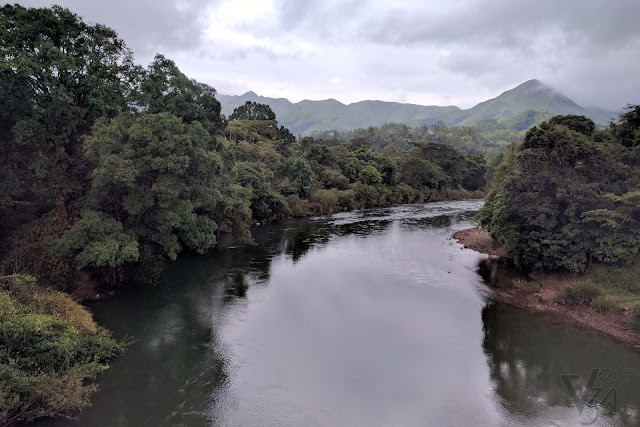
Bhadra river bridge, Kudremukha
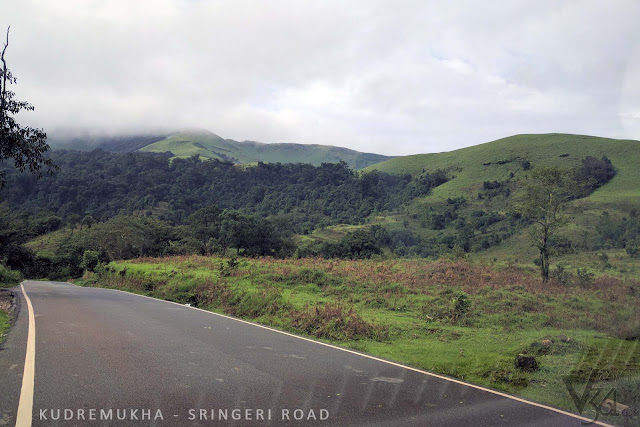
Kudremukh-Sringere road
We reached Kadambi falls in the late afternoon and since it was getting dark we skipped the Hanumanagundi falls. The major tributary of the Bhadra river drops from about 30feet through the rocks to form Kadambi falls which later flows through Kalasa and Balehonnur. The falls are popular because of its easy accessibility from the bridge over the Sringeri-Kudremukh main road.
Kadambi falls, Kudremukha
There is no mobile network inside the National park and on all exit/entry points there are forest check-posts who note your entry and exit timings, you are not allowed to stay inside the national park.
Road condition and route for Kemmangundi-Hornadu-Kudremukh:
Bengaluru -> Nelamangala via NH4 - 30km - 4 Lane Toll road in Excellent condition
Nelamangala -> Channarayapatna NH75 - 120km - 4 Lane Toll road in Excellent condition
Channarayapatna -> Arasikere - Channarayapatna-Arasikere main road - 44km - road condition is good
Arasikere -> Birur - NH206 (Bangalore-Shimoga Highway) - 46km - road condition is very good
Birur -> Lingadahalli - 16km - road condition is good
Lingadahalli -> Kemmangundi - 18km - very scenic, road condition is good except for the last 3km which is extremely bad
Lingadahalli -> Chickmagaluru - 44km - road condition is good and very scenic
Chickmagaluru -> Hornadu via Balehonnur - 90km - road condition is good and very scenic (20km from Chickmagaluru after aldur ghat road starts)
Hornadu -> Kadambi falls via Kudremukh National Park- 39km - excellent Ghat road with many scenic view points
Micromax Superfone Canvas 2 A110(Jet Black/Calm White): After using it for a week, I felt pretty good about my decision for going with a new brand like Micromax over the mighty Samsung Galaxy S Duos and Sony Tipo Dual. Particularly not sure about its reliability but the build quality looks pretty decent. Below are my ratings for the phone aka Phablet. Build Quality (8/10): The build quality was above my expectations keeping in mind of the price tag, from front it looks just like a Galaxy high end smartphone like SIII or Note II. It has a matte finished back cover which is good for protection towards scratches and there is a metal casing all around the phone, which adds up the beauty of the phone. One more advantage of this phone is it has a touch home button instead of a hard button as seen in iPhone and Galaxy phones. Camera (5/10): [8MP autofocus (Tap to Focus), dual flash, supports up to 3264x2448 pixels, Panorama] Don't fall for the specs as it is said...
How to update Micromax A110 Canvas 2 to V3 ROM: I've just updated my canvas 2 to Jelly Bean official update from Micromax. Before you proceed I would like to make sure that this site is nowhere guaranteed for your successful upgrade and we are nowhere responsible for any claims. This is just a tried and tested genuine way to upgrade to Jellybean only for Micromax Canvas 2 A110 users. Software release notes (from Micromax ftp site): 1. Operating system is upgraded from ICS to Jelly bean. 2. M! Store is removed. 3. New wallpapers are integrated. 4. Software is backward compatible with old TP available (BYD Make). Here is what you can do by yourself and it is simple too. First of all take a complete backup of your data, you can use the following tools from the play.google.com 1. App Backup & Restore: to backup all your apps as apk files which will store them on mnt\sdcard2\ app_backup_restore 2. G Cloud Backup from GENIE9: It c...
20 Must have free Andriod apps for ICS 20.Camera MX Developer: MAGIX Category: Photography Get creative with your camera - combine effects and photo frames live in the camera. Optimize and edit your best photos. More than 20 customizable realtime photo effects: HDR, Vintage Lomo, Tilt-shift, Pop Art, Sepia etc. 19.Desi Calendar Developer: Fingertips Software Category: Tools Desi Calendar provides a view of all Indian festival in a Calendar format. Now you would not miss any Indian festival and would not have to go through multiple web sites to find the dates for each of the festival. Desi Calendar does it for you. 18.Adobe Reader Developer: Adobe Systems Category: Productivity The global standard for reliably viewing and sharing PDF documents Adobe® Reader® is the free, trusted leader for reliably viewing and interacting with PDF documents across platforms and devices. Install the free Adobe Reader mobile app to work with PDF documents on yo...
Top 10 Ancient Temples in Karnataka: The ageless monuments of Karnataka, with their unique architectural styles are a delight to the history and archaeology buffs. The iconic stone chariot to the intricate sculptures of Halebid or the cave temples of Badami, here is the ten most renowned Ancient temples in Karnataka State of India. All of these temples are built with stone, which is one of the main feature of ancient Indian temples. Temples of Karnataka 10. Brahma Jinalaya Temple, Lakkundi (1007 A.D) This Jain basadi is perhaps the largest and oldest temple at Lakkundi today. Temples at Lakkundi are best examples of Kalyani Chalukya Architecture. Location:Lakkundi, Gadag Accessibility: Nearest International Airport is Bangalore (422km), Nearest Railway station is Gadag (13km) Highlights: Chaturmukha Brahma, one of the most beautiful sculptures of Brahma Jinalaya Lakkundi Brahma Jinalaya Temple, Lakkundi (1007AD- Kalyani Chalukya ) 9. Durga Temple, Aihole (7...
Birding in Davanagere - Part I Water Birds: With not much expectations headed for bird watching in Davangere, but what turned out later was an extravaganza of our beloved winged friends. A colony of Black-winged Stilt There is a reason why I had less expectations, we usually hear from bird watchers in and around Bengaluru and have rarely heard of a city such as Davanagere for bird spotting. Winter is the best time for bird watching in Davanagere as the winged guests from far across the Himalayas visit here in search of food and tropical climate. Was expecting to spot the migratory bar headed goose and waders along with the resident Kingfishers, Munias, Weaver bird, and Coucal. Though couldn't witness some of them but ended up spotting over 50 species of birds. A little knowledge about these birds and a lots of patience can help spot many of these with a binocular or a camera with 250 mm lens. Compared to birds in Bengaluru, here the birds were very shy and not used to ...





Good information,
ReplyDeleteशानदार जगह, यहाँ तो जाना ही पडेगा।
Thanks Sandeep Panwar :-)
Delete