Ranganathittu - A Birdwatcher's Paradise

Ranganathittu - A Birdwatcher's Paradise:

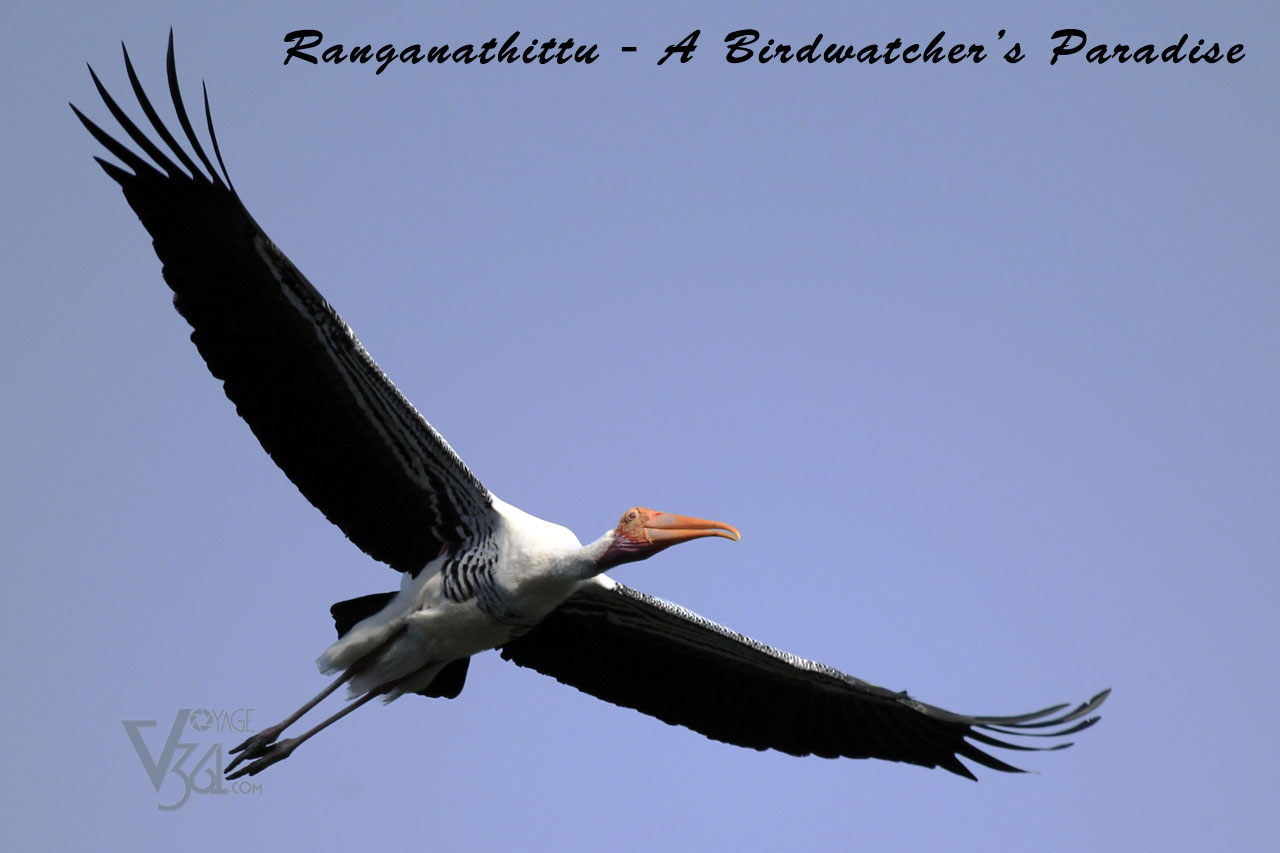
A Painted Stork in flight at Ranganathittu
It was spring season and definitely one of the best seasons for going out bird watching, we chose to drive to Ranganathittu Bird Sanctuary over Kokkare Bellur. Early morning drive on Bengaluru-Mysuru highway was as amazing as always it used to be. After relishing the divine sunrise on the highway, we reached Ranganathittu BS by 8.30am which is about 2.5km from the Highway.
Sunrise at Bengaluru-Mysuru Highway
We were one of the first tourists here, so had a peaceful time in adoring the Mother Nature.
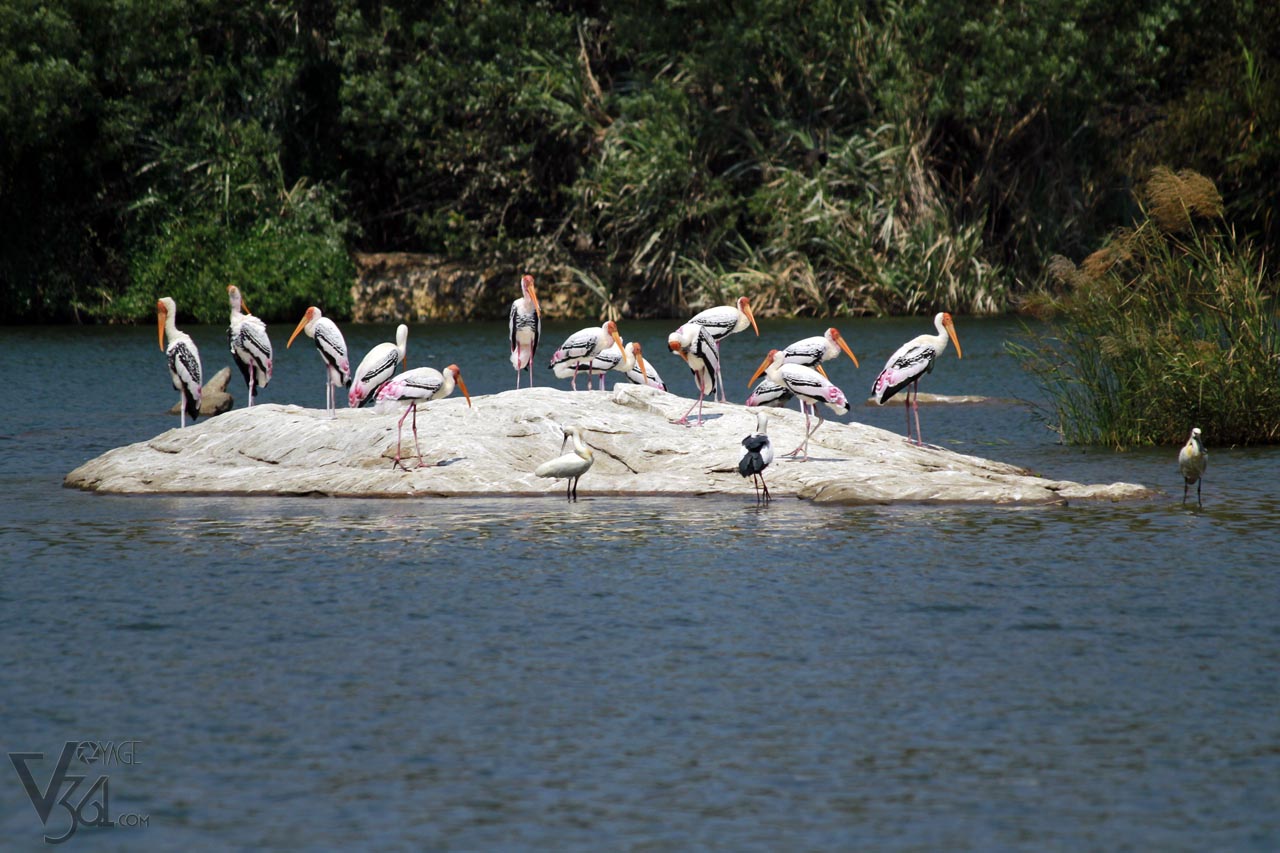
A mustering of storks along with Spoonbills
Ranganathittu is a designated Bird Sanctuary preserved and maintained by the Forest Department of Karnataka State. It was declared a wildlife sanctuary in 1940 after the ornithologist Dr. Salim Ali observed that the isles formed an important nesting ground for birds, and persuaded the Wodeyar kings of Mysore.
Ranganathittu Bird Sanctuary
Sight of the BS
Every year thousands of birds migrate here from as far as Siberia for the purpose of nesting and fly back with their young ones later. River Cauvery flows through Ranganathittu forming many islets covered with trees, where the birds build their nests. Ranganathittu is home for both Migratory and resident birds, along with a float of marsh crocodiles and colonies of bats.
Marsh Crocodile at Kaveri river, Ranganathittu
The sanctuary is best explored through boating where they take you very near to the birds nest. It was an amazing experience to spot over 15 different species of birds. Pelicans were spotted in great numbers; Painted Stork and Asian Open-Billed Stork were also in large numbers. Colonies of exotic birds like Great Egret and Eurasian Spoonbill were also found. Apart from these, we spotted Little cormorant, Black-Crowned Night Heron, Pied Kingfisher, Snakebird, Darter, Eurasian marsh harrier, White Spotted Fantail Flycatcher, and Pale Billed Flower Pecker. This dissimulation of birds is a must see for every bird enthusiast.
Pelican in flight
Pelican in flight
Birds of Ranganathittu
Pelicans
Pelican fishing at Ranganathittu
Pelican fishing
Painted Stork gathering sticks for building nest
 painted stork in close encounter with Crocodile
A painted stork in close encounter with Crocodile
Asian Open-Billed Stork in their nest
Asian Open-Billed Stork
Great Egret at Ranganathittu
Great Egret
Great Egret in Ranganathittu
Closer view of Egret
Eurasian Spoonbill at Ranganathittu
Eurasian Spoonbill
flight of Spoonbills at Ranganathittu
flight of Spoonbills
Cormorant in flight
Cormorant in flight
Cormorant at Ranganathittu
Cormorant
Black-Crowned Night Heron
White Spotted Fantail Flycatcher
Pale Billed Flowerpecker
Eurasian marsh harrier
In our earlier visit to the Sanctuary during October, we spotted different species of birds, Black Headed Ibis in large numbers, River Tern and Stone plover.
Black Headed Ibis
Black Headed Ibis
River Tern
River Tern
Best time to visit Ranganathittu Bird Sanctuary:
Although November to June is the best time to visit Ranganathittu, but every season you can spot different species of birds. This means that round the year bird’s flock here.

Birds at Ranganathittu Bird Sanctuary:
This place is termed as bird’s paradise for a reason; there is a long list of birds which come to this sanctuary,
  1. Spot-billed Pelicans
  2. Painted Stork
  3. Open-Billed Stork
  4. Black Headed Ibis
  5. Eurasian Spoonbill
  6. River Tern
  7. Cormorant
  8. Snakebird/Darter
  9. Great Egret
  10. Cattle Egret
  11. Little Egret
  12. Great Stone-Curlew/Great-billed Thick-knee/Great Stone Plover
  13. Black-Crowned Night Heron
  14. Purple Heron
  15. Indian Pond Heron
  16. Grey Heron
  17. Brahminy Kite
  18. Baya Weaver bird
  19. Large Pied Wagtail
  20. Grey Wagtail
  21. White-browed Wagtail
  22. Indian Cliff Swallow
  23. Streak-throated Swallow
  24. Pied Kingfisher
  25. White-Throated Kingfisher
  26. Stork-billed Kingfisher
  27. Small Green Bee-Eater
  28. Red-Wattled Lapwing
  29. Grey-Headed Fishing Eagle
  30. Crested Serpent Eagle
  31. Oriental Magpie Robin
  32. Great Tit
  33. Red-Whiskered Bulbul
  34. Purple-Rumped Sunbird
  35. Black-Headed Munia
  36. Eurasian Marsh Harrier
  37. White Spotted Fantail Flycatcher
  38. Asian Paradise Flycatcher
  39. Tickells Blue Flycatcher
  40. Slaty-backed Flycatcher
  41. White-cheeked Barbet
  42. Common Hawk Cuckoo
  43. Indian Roller
  44. Pale Billed Flowerpecker
 and the list goes on and on....

Although the Sanctuary is popular for birds, they are also home for fish eating Smooth Coated Otter, large number of Marsh Crocodiles, many species of Butterflies, colonies of Fruit bats and Indian Flying fox.


Tourist Information:

Timings 08:30 am - 06:00 pm
Entry Charges (Indian National) Rs. 60
Boating Charges (Indian National) Rs. 60
Car Parking Charges Rs. 30
Restaurant: Available
Washrooms: Available

How to reach:
Take a bus from Bengaluru - Mysuru and get down at Srirangapatna, take an auto from Srirangapatna to Ranganathittu BS which is a 4km ride.
Nearest major railway station is at a distance of 16km which is Mysore Railway Station (MYS); take a city bus from Mysore to Ranganathittu BS.
Nearest International Airport is Kempegowda International Airport Bengaluru
Taxi: you can also hire a taxi from Bengaluru or Mysuru for half day fare.

Summer treat for birdwatchers at Ranganathittu Bird Sanctuary


Comments

Popular posts from this blog

Micromax Canvas 2 A110 Hands on Review

Micromax Superfone Canvas 2 A110(Jet Black/Calm White): After using it for a week, I felt pretty good about my decision for going with a new brand like Micromax over the mighty Samsung Galaxy S Duos and Sony Tipo Dual. Particularly not sure about its reliability but the build quality looks pretty decent. Below are my ratings for the phone aka Phablet. Build Quality (8/10): The build quality was above my expectations keeping in mind of the price tag, from front it looks just like a Galaxy high end smartphone like SIII or Note II. It has a matte finished back cover which is good for protection towards scratches and there is a metal casing all around the phone, which adds up the beauty of the phone. One more advantage of this phone is it has a touch home button instead of a hard button as seen in iPhone and Galaxy phones. Camera (5/10): [8MP autofocus (Tap to Focus), dual flash, supports up to 3264x2448 pixels, Panorama] Don't fall for the specs as it is said...

Trip to the Misty Hills of Kudremukh

Trip to the Misty Hills of Kudremukh: About Kudremukh: Kudremukh National Park is the second largest protected wildlife area in the Western Ghats (around 600 sq.kms). Three important rivers of Karnataka, the Tunga, Bhadra and Netravathi are said to have their origin in this area. Mist covered roads in Kudremukh All these can be reached within 80km. We first started with sringeri, which is famous for its Vidyashankara temple built in1342 AD. Reached Sringeri at 11am. There is a bridge Sri Vidya Teertha Setu across the Tunga river which connects from Vidyashankara temple to Sringeri Mutt. We had prasadam (lunch) at the mutt. There is one more temple called as Sharadamba temple which has lovely architecture built inside and photography is banned inside. The whole temple area is kept very clean and it was a pleasant experience to spend time in the temple complex. We then left at 12.30pm towards Kudremukh. Vidyashankara temple  Vidyashankara temple  Vidyas...

5 Places in Maharashtra you must visit atleast once

5 places in Maharashtra you Must Visit At Least once Maharashtra is a state best described as a land of cave temples, hilltop forts, and Mountains. Best time to explore them are the monsoons and post monsoons, definitely not in summers. These 5 places in Maharashtra are a must visit, 5. Lavasa The first planned hill station in India and probably the most controversial for the deforestation reasons. Even the road from Tehghar dam till Lavasa is spectacular with forest cover and green valleys. Best time to visit is during monsoons and post monsoons. Best time of the day is after the sun goes down with the entire city lighted up, and the musical fountains adding more flavour to the evening. Lavasa City during night For more information on Lavasa CLICK HERE 4. Lonavla-Khandala Unlike Mahabaleshwar, Lonavla is a monsoon hill-station. Best time to visit is during monsoon and post monsoons (July-Dec) when the entire hill range turns into lush green grasslands and num...

Lalbagh Flower Show Jan-2012

Lalbagh Flower Show 2012 - 100th Exhibition Event :            January 20 till 29, all roads lead to the Glass House in Lalbagh Botanical Gardens. Around 10 lakh visitors are expected to visit the gardens and see a visual treat, thanks to the Mysore Horticultural Society. This flower show is the 100th exhibition of the Mysore Horticultural Society that was started by the then Superintendent of Lalbagh GH Krumbiegal in 1912. Major Attractions this time include Buddha Stupa, Floral dance forms, Floral Flow, Florance Flora Show and Diagonal floral Lines. Buddha Stupa Early Hours crowd at the Glass House GH Krumbiegal Visited the show on Sunday noon (22nd), on that day it recorded a whopping 100,000 visitors, making it difficult to capture the rich colors at the show. I could somehow manage to get a few colorful pics. It was more beautiful and creative than the previous flower shows held here. Entered the Glasshou...

Masinagudi Jungle Trails : A Road Trip to Nilgiris

Masinagudi Jungle Trails : A Road Trip to Nilgiris - II All set and packed for a long road trip to Ooty, left Bangalore late at 8am. What to pack for a long road trips?? Click here The motive of the road trip was to voyage around less explored and adventurous places, rather than popular and easily accessible tourist destinations. To avoid Mysore traffic, we tried to explore another route from Mandya through Somnathapura to Nanjangud, but it turned out to be more tiring and longer route. We reached Bandipur forest check post only by 2pm. Driving through Bandipur forest is a pleasure, with good road conditions, greenery around and spotting wildlife was more exciting. In an intention to spot wildlife, and to maintain silence in the forest, we were driving steadily at 15kmph speed without using horn. We could spot a lot of deer herds, elephants, black bear, boar, Grey Langur monkeys and peacocks.  Peacock spotted on the Bandipur Mudumalai stretch Elephant...