
Pattadakal – Bagalkot Heritage Drive - Day 2


Bagalkot Heritage Drive - Day 2 – Pattadakal

Some facts about Pattadakal: Actually Pattadakal represents the final or culminating stage of the early Chalukyan style of architecture. It is believed that the experiments made in Aihole was later implemented in a more professional manner in Pattadakal & hence it has more matured & finished monuments compared to Aihole group of temples. Both Dravida & Nagara type of temples were built at Pattadakal during the reign of the early Chalukyan kings. Sangamesvara, Virupaksha, Mallikarjuna & Jaina temples belong to the Dravidian style, whereas Galaganatha, Papanatha, Kasi Visvesvara, Kadasiddesvara & Jambulinga temples belong to Nagara style. The temple building activity started from the early 7th Century & continued up to the middle of the 9th century A.D. Thus 300years saw a glorious epoch in the evolution of temple architecture in Pattadakal. There were master architects like Revadi Ovajja, Anivarita Gunda, supported by sculptors like Changamma, Pullappan & Beladeva.
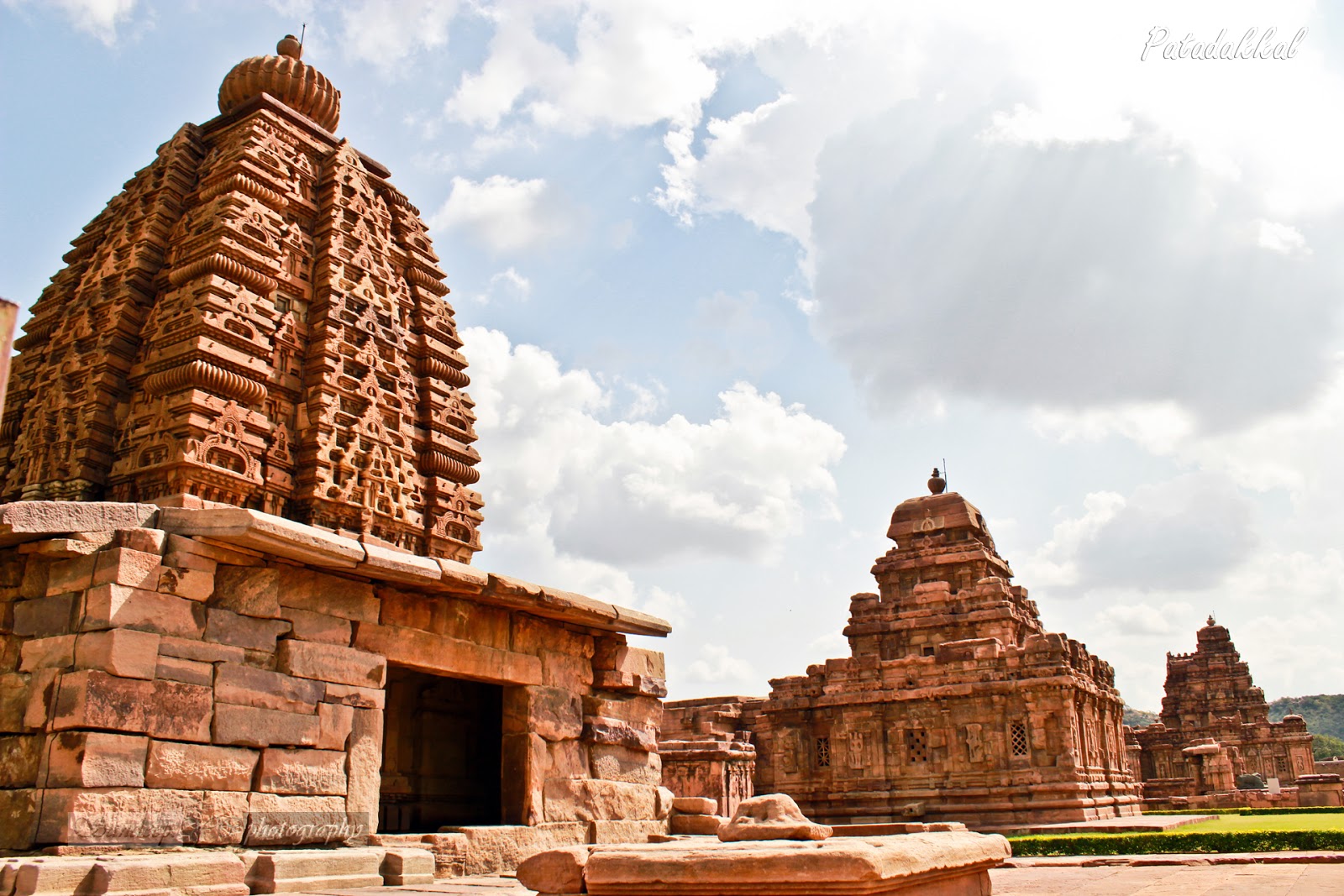
Galaganatha Temple(750 AD), Sangameshwara Temple(720 AD) & Virupaksha Temple(740 AD)
Back to the travelogue, it was almost 1pm by the time we reached Pattadakal temple complex which is just 13km from Aihole. Unlike Aihole, the temples here are not scattered at different, so it will be easier to locate the temples all at one campus. There is a nominal entrance fee for the maintenance. As you enter the temple complex you find all the temples at a glance right from the entrance. Also this is the most visited & most beautiful among the Chalukyan temples.

The temple complex consists of Jambulinga temple, Galaganatha temple, Sangameshwara temple, Kashivishwanatha temple, Mallikarjuna temple, Virupaksha temple & Papanatha temple in the order of distance from the entrance.
Galaganatha-Jambulinga-Sangameshwara-Nandi Mandapa-Virupaksha-Mallikarjuna-Kashivishwanatha Temples(left-to-right)

We opted for a guide here also, & he first took us for the Galaganatha temple built in 700-750 A.D., even from a distance it attracts our attention because of the presence of the prominent northern type Shikhara. It is described as belonging to Rekha-Nagara type, also found in Bhubanesvar in Orissa. The entire Shikhara is highly proportioned & this is the unique feature of this temple. The garbhagriha has a polished black-stone linga of the 12th century.


Subsequent to this was the Jambulinga temple, Built probably in the middle of the 7th century A.D. The superstructure over the sanctum is of the rekha-nagara (northern) style. This was just looking like a miniature of the Galaganatha temple next to it.
Jambulinga temple(back) & Galaganatha temple(front)
Further we moved towards the Sangameshwara temple, which is Dravidian type temple built by Chalukyan king Vijayaditya (693-733 A.D) & he established Vijayesvara Siva linga in it. Southern parts of the mandapa have fallen down. Efforts have been taken to preserve & maintain the remaining part of the temple.

Last in the lane was the Mallikarjuna temple, both Virupaksha temple and Mallikarjuna temple look similar, with one difference is that Virupaksha tower has a square top, while the top of Mallikarjuna is a dome. Also the interiors of both the temples are similar.
This temple was built around 740 A.D. by one of the Queens, Trailokyamahadevi of Vikramaditya II (733-45 A.D.) to commemorate her husband’s victory over the Pallavas of Kanchipuram built for the same purpose as Virupaksha temple.
tales of Panchatantra
The epic & puranic episodes carved on the pillars of the sabha-mandapa include goddesses fighting Mahisasura, churning of the ocean (samudra-manthana), Narasimha fighting Hiranyakasipu “exploits of Krishna” slaying of Maricha etc., . The amorous couples relieved on the engaged columns here are slightly bigger in size & better preserved than those in the Virupaksha temple.

Mallikarjuna Temple south face
The Samudra Manthan: Scene from Hindu mythology depicting the Churning of the Primordial Ocean of Milk in order to obtain Amrita or Amrit, the nectar of immortality
One more important sculptures found on the pillars are the tales of Panchatantra, “The mongoose & the farmer’s wife” & “The monkey & the crocodile”; here the first one teaches “Don’t act in haste. Think & act” & the later’s moral says that “At times, presence of mind pays well”

For a detailed explanation on the Panchatantra tales follow this link http://www.bharatadesam.com/literature/panchatantra_stories/tales_of_panchatantra.php

Just beside Mallikarjuna temple is the Kashivishwanatha temple, built in the middle of the 8th century A.D, probably the last to be built in the Early Chalukyan style at Pattadakal. It contains on plan a garbhagriha housing a linga & a Nandi-mandapa opposite to it.
Mallikarjuna Temple & Kashivishwanatha Temple
The superstructure displays the fully evolved rekha-nagara (Northern) Sikhara rising in five stages with its amalaka & kalasa missing. A mesh-like design covers its surface completely. The well-developed sukanasa projection has a fine sculpture of dancing Uma-Maheswara within the Chaitya-arch.


Virupaksha-Mallikarjuna-Kasshivishwanatha temple(left-to-right)
360 degree view of Pattadakal(from left to right - Jambulinga, Galaganatha, Sangameshwara, Nandi mandapa, Virupaksha, Mallikarjuna, Kashivishwanatha temple)
Next was the most important temple of Chalukyan architecture, The Virupaksha Temple, which I will be posting it separately... to be continued…


Comments

Popular posts from this blog

Sky Islands to the Pacific shores - Part 1: The Sky Islands of Southeastern Arizona

In August 2026, I crossed the Atlantic to chase a long-cherished dream, stepping into the vast, untamed birding horizons of the American Wild West. Across a sweeping route through Arizona, Texas, Utah, and California, I logged 108 total species -  the vast majority of them absolute lifers for me! While the landscapes were vast and the wildlife was extraordinary, what truly made the Arizona portion of the trip unforgettable was the incredible warmth of the local birding community. At almost every trail, feeding station, and wetland, I met welcoming, friendly locals who were quick to share site tips, point out hidden roosts, and make a first-time visitor feel right at home. While North America’s diverse habitats delivered endless surprises, it was Arizona's high-desert canyons, towering rims, and lush riparian corridors that anchored the trip. Here is a location-by-location breakdown of the top birding hotspots, standout avian highlights, and unexpected wildlife encounters from the A...

Sky Islands to the Pacific Shores – Part 2: Desert Valleys, Urban Wetlands & The Grand Canyon

If you missed Part 1: The Sky Islands of Southeastern Arizona , we explored the cool, high-elevation pine-oak Canyons of Madera, Montosa, Ramsey, Ash, and Carr, tracking hummingbird diversity and vibrant montane species across the legendary Sky Island ranges. Leaving the high, pine-scented peaks of the Sky Islands behind, the journey transitions into the sprawling lowlands and desert basins of Arizona. This second leg follows a dramatic ecological gradient—from open desert waters and lush suburban wetland oases into the iconic giant Saguaro forests of the Sonoran Desert, before ascending the Colorado Plateau to the high-elevation pine rims of the Grand Canyon. 3. Canoa Ranch Conservation Park Nestled in the Santa Cruz River Valley, Historic Canoa Ranch combines rich Southwestern heritage with wide-open water and vast desert horizons. Spending the late afternoon here delivered a bustling wildlife spectacle right up until dusk. Active hunters like the Belted Kingfisher, Black Phoebe, Ver...

Seabird photography adventure on the Isle of May

Seabird Photography Adventure on the Isle of May – July 2025 Tucked off the east coast of Scotland, the Isle of May National Nature Reserve is a dream for wildlife and photography enthusiasts alike - especially during seabird breeding season. My trip in early July 2025 turned out to be more thrilling and rewarding than I had imagined, thanks to an unexpected boat change, incredible wildlife encounters, and a few lucky early moments of solitude with the stars of the island— the Puffins . A puffin staring right at the lens, proud of its catch. Getting There: A Wild Ride on the North Sea Originally, I had booked a standard boat tour with BlueWild from Dunbar harbour, but due to a last-minute issue with the vessel the night before, our journey was downgraded - well, depending on how you look at it - to a RIB (Rigid Inflatable Boat) . What followed was a wild, wind-whipped ride across the North Sea , bouncing over waves with little warning. Thankfully, our guide kindly offered me a spar...

Birding in the Netherlands

The Netherlands has a coastline of over 451 km, wide open to the north sea. Much of its land has been reclaimed from the sea and is below sea level, not surprisingly its coastal wetlands make up some of the best birding hotspots, apart from the inland nature reserves. Close to 500 bird species are recorded in the country, much of them are waders and water birds due to its geography. As a non-resident birdwatcher it was not an easy task to locate the right bird watching spots, whilst ebird helped considerably, the rest was on me to explore the Dutch lands. Nevertheless, the country is much safer to explore and the good facilities such as birding hides at the right places, easy access to most reserves makes it a birder friendly country. I have explored two of the birding hotspots, the Texel Island and Oostvaardersplassen nature reserve. Apart from these, I found bird watching and bird photography can be interesting in the neighborhood city parks and also tourist places such as Zaans...

Chennakeshava temple of Belur- Exteriors

Chennakeshava temple of Belur: Some facts about the Chennakeshava Temple: Hoysala king Vishnuvardhana defeated the Cholas at Talakad & to commemorate this great event built many temples in 1117 A.D., of which Chennakeshava temple at Belur is the most important & beautiful , dedicated to Keshava one of the 24 forms of Vishnu. Although the temple was completed by Narasimha, it took over 103 years to finish the structure. Though the legends assign this temple to have been built by Jakanachari, as per the inscriptions the master builders of this temple are Dasoja and his son Chavana, other sculptors include Chikka-Hampa, Malliyana, Padari Malloja, Masada and Nagoja who bestowed their best in creating this masterpiece. Chennakeshava Temple, Belur Back to the travelogue: Most important aspect of these Belur Halebeedu temples is that Chennakeshava temple is famous for beautiful and intricate interiors and Hoysaleshwara temple is famous for the magnificent sculpture...