Shravanabelagola
About the place:

Shravanabelagola (ಶ್ರವಣಬೆಳಗೊಳ) is a town located in the Hassan district, Karnataka which is just 158km from Bangalore and 51km from Hassan, just 12km from the NH-48 it has easy accessibility to reach on road. This place has one of the highest importance in history, dating back to 298BC when Chandragupta Maurya said to have died here after he became a Jain monk. Chandragupta Basadi, which was dedicated to Chandragupta Maurya, was originally built there by Ashoka in the third century BC.
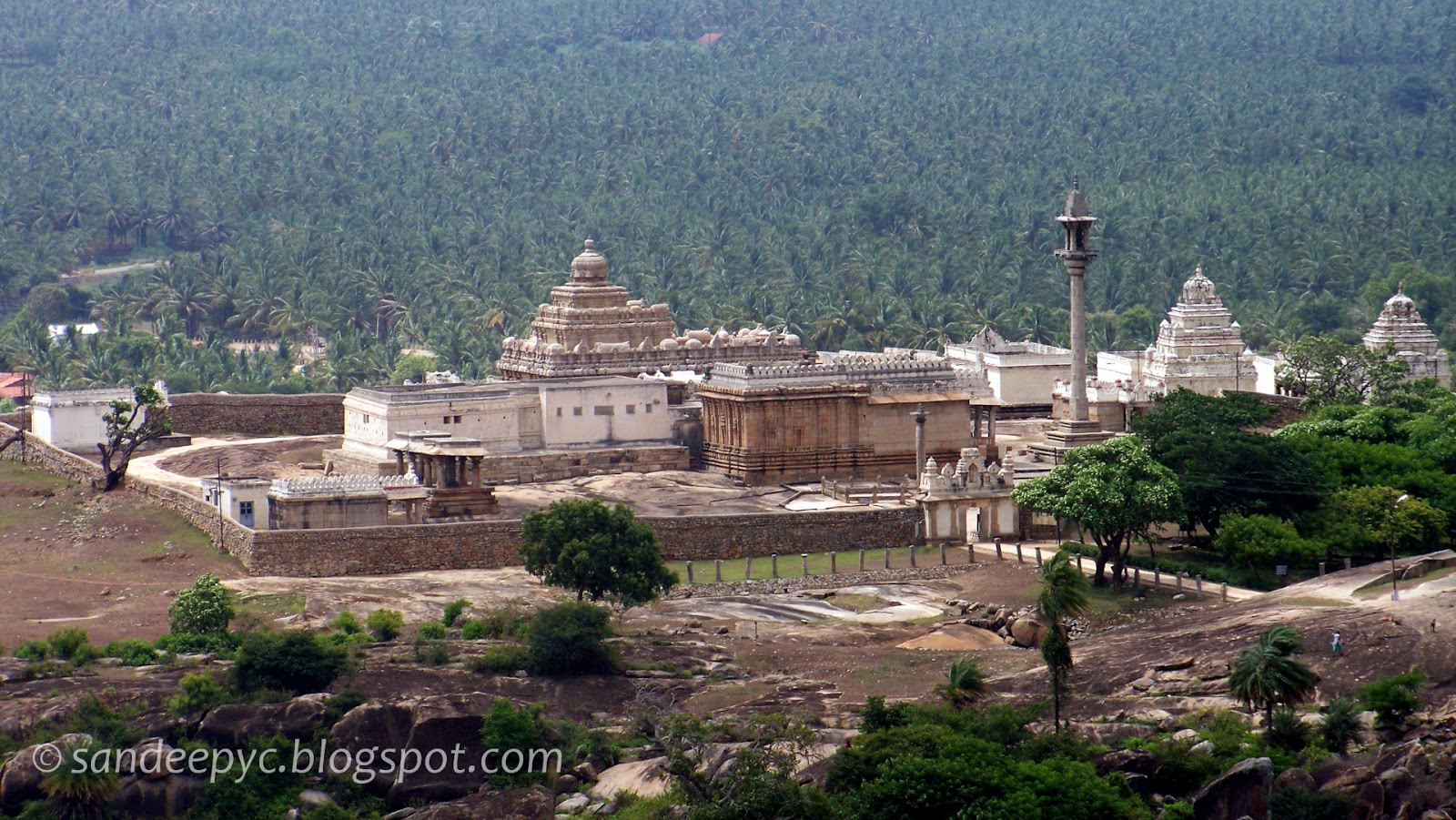
It has two hills Chandragiri and Vindhyagiri, the later being of more importance with its 57-feet tall monolithic statue of Gommateshvara, considered to be the world's largest monolithic stone statue. The base of the statue has inscriptions in Kannada as well as devnagari script, dating from 981 AD. Chandragiri being on the other side of the pond has more number of inscriptions found, these inscriptions include texts in the Kannada, Sanskrit, Konkani, Tamil, Marwari and Mahajani languages. Some of these inscriptions mention the rise and growth in power of the Western Ganga Dynasty, the Rashtrakutas, the Hoysala Empire, the Vijayanagar Empire and the Wodeyar dynasty. These inscriptions have helped modern scholars to understand the nature and development of the Kannada language and its literature.
It is also voted as the one of the seven wonders of India by Times of India.
 |
| Pillars at Gomateshwara statue temple complex |
 |
| Pillars at Gomateshwara statue temple complex |
 |
| Belagola as seen half way through the Vindhyagiri hill |
 |
| view of Chandragiri and the belagola |
The route we covered was left Bangalore at around 7am-through NH4(Dasarahalli-Nelamangala)-take left on to Bangalore-Mangalore Highway at Nelamangala-after about 100km take one more left into SH47, further 10km u reach shravanabelagola.


.
 The tall statue on top of the hill is visible as you go near by the Vindhyagiri hill. We parked our vehicle in front of it and entered the entrance bare foot with socks, since footwear is not allowed but can wear socks as the steps are carved on the rocks and will become hot as the sun rises up. You have to climb up the Vindhyagiri hill top to reach the Gommateshvara statue. We could see some senior citizens also climbing, so it must not be impossible though for 60+ age group but certainly a no to persons with knee problem. There are over a thousand steps up the hill and once you reach some part of the steps you enter a big entrance gate and you will then realize that there are further many steps to go. There are many other walkways around from this place. There are many inscriptions you can find at this place. There are also many basti’s around here. You finally realize that this is not the end destination and you still have to take some more steps further to reach one more big entrance gate and only then you enter the Gommateshvara statue area and the temple. The whole place around here is cleanly maintained, from here you can have a good view of the Chandragiri hill and the temple complex on top of it, also the belagola pond is visible down from here.
You can explore around the hill top and you can witness heavy breeze flowing at high speeds when you go near the wall which is covered around the Vindhyagiri hill top.

 |

 After visiting the temple we started to climb back, which was so effortless, having a wonderful view around the town and the pond below, kept taking snaps in between and finally reached the base of the hill where you find lot of tender coconut being sold which you can’t miss out. We then moved towards the pond which was closed for the public and then there is a small park area next to it where we had our lunch which we packed from home. After having lunch we started our journey back towards our next destination Yediyur, since we were not much interested about the inscriptions and the archeological importance of Chandragiri hill we skipped climbing that hill as we were a bit tired in the hot sun.


 |
| Yediyur Temple |
Yediyur: We reached the Bangalore-Mangalore highway and about 50km we reached Yediyur. You have to take right at Yediyur town and go further about 1km to reach Shri Siddalingeshwara Temple. There was lot of construction works which were going on when we visited this place. This place has its own importance and a famous Pilgrimage. Though termed as a Temple, it contains Gaddige (Tomb) i.e.,Nirvikalpa Shivayoga Samadhi of Tontada Siddhalinga, a great Vireshaiva teacher and author who flourished at the end of 15th century. Part of the temple was closed for renovation so couldn’t see much in the temple.
There were a lot of monkeys found in this place as all other temples in India. We then moved back towards Bangalore as it was getting dark, ending our journey of temple and ancient history.
 |
| Yediyur Temple |
Related Posts
 |
Somnathpur Keshava Temple |
Comments
Post a Comment