Bird watching in Coorg:
It was my fourth visit to Coorg, but first dedicated to birding. Have been hearing that Coorg is home for about 25% of bird species found in India, which raised my expectations to spot some exotic and new bird species.
We had booked a homestay amidst the plantations and in my bucket list were the Horn-bill, Drongo, Indian roller and Trogon. We reached the homestay after visiting the common tourist destinations of Coorg, the Namdroling Monastery or the Golden temple, Kaveri Nisargadhama and Raja seat.
It was already getting dark while we reached the homestay, but couldn't resist the chirping of the birds in the plantations and we headed deep inside the estate. The coffee estates have very tall trees covering the coffee plants from direct sunlight, and most of the birds love to hang out on the treetops, making it very difficult to focus them on the camera and due to low light conditions I couldn't click any but enjoyed spotting them. We had a long 1 hour walk inside the estate and by the time we reached homestay it was already dark. The local kids were very helpful in finding our way out as the estate trails were confusing to locate back to homestay. Later we came to know one of the trails was leading to jungle. We spotted hundreds of birds during the estate walk.
The next day morning woke up at dawn and followed the estate trails only to be mesmerized with the music of the birds and the mist covered trees. The first bird which I could take a clear shot was the Malabar Grey Hornbill, this was my closest encounter with a horn-bill.
Description, appearance and diet:
Malabar Grey Hornbill are endemic to the South Indian hills, mostly in the Western Ghats. They have a large beak and unlike other hornbills they dont have the casque. They mainly feed on fruits, especially figs. They are large in size about 45-58cm in length with a pale or yellowish to orange bill and brown-grey wings.
After the close hornbill encounter, my expectations grew higher to spot more exotic birds, and then at a farther distance I was able to spot a Drongo, getting more closer to it realized it was a Greater Racket-tailed Drongo. While I tried to get more closer, it flew away in its way.
Was a bit disappointed for not getting a clear view, tried to venture deep inside the estate in the direction where it flew. There she is, I was able to spot it again and this time I was able to get a closer view. They are a very shy birds and doesn't seem to get through with humans. It further flew deep inside the estate and I couldn't venture further deeper inside, being afraid of getting lost inside the woods.
Description, appearance and diet:
Greater Racket-tailed Drongo are a medium-sized bird with an elongated outer tail feathers. They are generally found in the forests and have a distinctive feature of tail rackets and curled feather above the beak when compared to other species of drongo's. They feed mainly on insects, along with fruits and nectar. Another interesting feature of this bird is, they can imitate the calls of many other bird species.
Back to the estate trails, was able to spot several small velvet birds on their morning walk over the trunk and branches of the trees, walking down and up all around the trunk of the tree. Yes it was the Velvet-fronted Nuthatch and it can walk against the gravity upside down below the branches of the tree or sometimes slant trunk of the trees.
Description, appearance and diet:
Velvet-fronted nuthatch is a small bird about 12.5cm long, with a short tail, powerful bill and tail. It has a violet-blue above with lavender cheeks, beige underparts and a slightly whitish throat. They have a very interesting feature to climb down trees unlike woodpeckers which can only go upwards. They feed on insects and spiders.
While I was focusing the Nuthatches, a yellowish and an orange couple caught my eyes flying and I could barely click while it had wide opened its wings. Which made me follow its way again inside the estate away from the trail. It was the Scarlet Minivet couple.
Description, appearance and diet:
Scarlet minivet (Pericrocotus speciosus) are small to medium sized passerine birds about 20-22cm long with a strong dark beak and long wings. They are generally found in the hilly regions and forests. The male and female have a distinctive appearance. Males have black upper-parts and head, and scarlet to orange underparts, tail edges, rump and wing patches. While the female is grayish olive upper-parts, with yellow underparts including the face, tail edges, rump and wing patches.
Further down the hills we could spot a green colored cute couple, perched on the tree branches. It was the Grey-fronted green Pigeon.
Description, appearance and diet:
Grey-fronted green Pigeon (Treron affinis) or The Pompadour Green Pigeon, is endemic to the Western Ghats of India. The hinderneck, upper back and underparts are pale green. The legs are short and dark. The distinction with male and female are the brownish red wings in male and greenish in female.
The loud three and four note calls caught my attention to spot the Red Whiskered Bulbul perched on the branches and then their was the Common Tailorbird, which was hard to spot due to its color contrast with the leaves.
Some of the other birds we were able to spot and couldn't get a clear shot were the Coucal, Golden Oriole, White-cheeked Barbet, laughing Dove, Grey Wagtail and several other species of birds which we couldn't identify their names.
On our way to various tourist destinations of Coorg I was able to spot several tiny tree dwellers. With less than 10 cm long the sunbirds are a difficult catch to photograph, but can be noticed with its continuous calls.
Description, appearance and diet:
Purple Sunbirds basically feed on nectar and insects. The appearance is quite different from male to female. The males appear completely black in its breeding plumage, and the purple iridescence becomes visible when exposed to direct sunlight. The male purple sunbird in its non-breeding plumage appears with a slightly yellowish underparts with a central black streak. While the female is easy to identify with olive brown above and yellowish underside.
They are sometimes seen hovering like a hummingbird while taking nectar from flowers.
Another small bird with a vibrant white eye-ring caught my eye, this was somewhat smaller than the purple sunbird, about 8-9cm long. It was the Oriental white-eye. It took a while to spot this.
Description, appearance and diet:
It has a yellowish olive upper parts with a white eye ring, yellow throat and vent. Their diet is similar to purple sunbird, and feed on nectar and small insects.
Apart from the birds we spot many species of Butterflies and was able to get a clear shot of Common Four-ring and Nigger Butterfly.
On our way back to Bengaluru, we visited Nagarahole National Park and spotted a White Browed Wagtail with its catch.
List of birds spotted during the trip:
Chestnut-tailed starling
Malabar Grey Hornbill
Greater Racket-tailed Drongo
Velvet-fronted nuthatches
Scarlet Minivet (Both male and female)
Grey-fronted green Pigeon
Red Whiskered Bulbul
White-cheeked Barbet
Common Tailorbird
Oriental White-Eye
Purple sunbird (Both male and female)
White Browed Wagtail
Laughing Dove
Coucal
Indian Golden Oriole
Grey Wagtail
Blackbird female
 |
| Malabar Grey Horn-bill |
We had booked a homestay amidst the plantations and in my bucket list were the Horn-bill, Drongo, Indian roller and Trogon. We reached the homestay after visiting the common tourist destinations of Coorg, the Namdroling Monastery or the Golden temple, Kaveri Nisargadhama and Raja seat.
It was already getting dark while we reached the homestay, but couldn't resist the chirping of the birds in the plantations and we headed deep inside the estate. The coffee estates have very tall trees covering the coffee plants from direct sunlight, and most of the birds love to hang out on the treetops, making it very difficult to focus them on the camera and due to low light conditions I couldn't click any but enjoyed spotting them. We had a long 1 hour walk inside the estate and by the time we reached homestay it was already dark. The local kids were very helpful in finding our way out as the estate trails were confusing to locate back to homestay. Later we came to know one of the trails was leading to jungle. We spotted hundreds of birds during the estate walk.
 |
| Flock of Chestnut-tailed starlings hanging out on the treetop |
 |
| Another close shot of Malabar Grey Horn-bill |
Malabar Grey Hornbill are endemic to the South Indian hills, mostly in the Western Ghats. They have a large beak and unlike other hornbills they dont have the casque. They mainly feed on fruits, especially figs. They are large in size about 45-58cm in length with a pale or yellowish to orange bill and brown-grey wings.
After the close hornbill encounter, my expectations grew higher to spot more exotic birds, and then at a farther distance I was able to spot a Drongo, getting more closer to it realized it was a Greater Racket-tailed Drongo. While I tried to get more closer, it flew away in its way.
Was a bit disappointed for not getting a clear view, tried to venture deep inside the estate in the direction where it flew. There she is, I was able to spot it again and this time I was able to get a closer view. They are a very shy birds and doesn't seem to get through with humans. It further flew deep inside the estate and I couldn't venture further deeper inside, being afraid of getting lost inside the woods.
 |
| Greater Racket-tailed Drongo |
Greater Racket-tailed Drongo are a medium-sized bird with an elongated outer tail feathers. They are generally found in the forests and have a distinctive feature of tail rackets and curled feather above the beak when compared to other species of drongo's. They feed mainly on insects, along with fruits and nectar. Another interesting feature of this bird is, they can imitate the calls of many other bird species.
Back to the estate trails, was able to spot several small velvet birds on their morning walk over the trunk and branches of the trees, walking down and up all around the trunk of the tree. Yes it was the Velvet-fronted Nuthatch and it can walk against the gravity upside down below the branches of the tree or sometimes slant trunk of the trees.
 |
| Velvet-fronted Nuthatch climbing down the tree |
Velvet-fronted nuthatch is a small bird about 12.5cm long, with a short tail, powerful bill and tail. It has a violet-blue above with lavender cheeks, beige underparts and a slightly whitish throat. They have a very interesting feature to climb down trees unlike woodpeckers which can only go upwards. They feed on insects and spiders.
While I was focusing the Nuthatches, a yellowish and an orange couple caught my eyes flying and I could barely click while it had wide opened its wings. Which made me follow its way again inside the estate away from the trail. It was the Scarlet Minivet couple.
 |
| Scarlet Minivet Male |
Scarlet minivet (Pericrocotus speciosus) are small to medium sized passerine birds about 20-22cm long with a strong dark beak and long wings. They are generally found in the hilly regions and forests. The male and female have a distinctive appearance. Males have black upper-parts and head, and scarlet to orange underparts, tail edges, rump and wing patches. While the female is grayish olive upper-parts, with yellow underparts including the face, tail edges, rump and wing patches.
Further down the hills we could spot a green colored cute couple, perched on the tree branches. It was the Grey-fronted green Pigeon.
 |
| Grey-fronted green Pigeon |
Grey-fronted green Pigeon (Treron affinis) or The Pompadour Green Pigeon, is endemic to the Western Ghats of India. The hinderneck, upper back and underparts are pale green. The legs are short and dark. The distinction with male and female are the brownish red wings in male and greenish in female.
The loud three and four note calls caught my attention to spot the Red Whiskered Bulbul perched on the branches and then their was the Common Tailorbird, which was hard to spot due to its color contrast with the leaves.
 |
| Red Whiskered Bulbul |
 |
| Its a tough guess, a female blackbird? |
 |
| Female Purple Sunbird feeding on nectar |
Purple Sunbirds basically feed on nectar and insects. The appearance is quite different from male to female. The males appear completely black in its breeding plumage, and the purple iridescence becomes visible when exposed to direct sunlight. The male purple sunbird in its non-breeding plumage appears with a slightly yellowish underparts with a central black streak. While the female is easy to identify with olive brown above and yellowish underside.
They are sometimes seen hovering like a hummingbird while taking nectar from flowers.
Another small bird with a vibrant white eye-ring caught my eye, this was somewhat smaller than the purple sunbird, about 8-9cm long. It was the Oriental white-eye. It took a while to spot this.
 |
| Oriental white-eye |
It has a yellowish olive upper parts with a white eye ring, yellow throat and vent. Their diet is similar to purple sunbird, and feed on nectar and small insects.
Apart from the birds we spot many species of Butterflies and was able to get a clear shot of Common Four-ring and Nigger Butterfly.
 |
| Common Four-ring (Ypthima huebneri) |
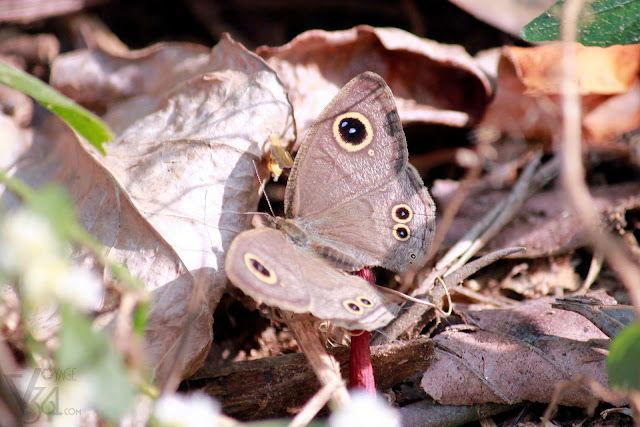 |
| Nigger Butterfly/dark grass-brown/smooth-eyed bushbrown (Orsotriaena medus) |

 |
| White Browed Wagtail |
Chestnut-tailed starling
Malabar Grey Hornbill
Greater Racket-tailed Drongo
Velvet-fronted nuthatches
Scarlet Minivet (Both male and female)
Grey-fronted green Pigeon
Red Whiskered Bulbul
White-cheeked Barbet
Common Tailorbird
Oriental White-Eye
Purple sunbird (Both male and female)
White Browed Wagtail
Laughing Dove
Coucal
Indian Golden Oriole
Grey Wagtail
Blackbird female
Comments
Post a Comment